
Trust Wallet vs Phantom at a glance
The table puts the two wallets, and SpendTheBits, side by side on nine points. Every cell about Trust Wallet or Phantom is what that company says on its own pages; where its pages are silent, the cell says so.
| What is compared | Trust Wallet | Phantom | SpendTheBits |
|---|---|---|---|
| Custody | Self-custody; keys stay on the device | Self-custody | Self-custody; keys and recovery phrase stay on the phone |
| Networks | 100+ blockchains | 9 networks listed, including Solana, Ethereum, Bitcoin, Base and Polygon | 13 chains from one recovery phrase |
| Bitcoin over Lightning | Not stated by the vendor | Not stated by the vendor | Yes, built in |
| Platforms | iOS, Android, browser extension | iOS, Android, browser extension | iOS, Android |
| Recovery besides the phrase | Passkey for its smart-wallet account | Sign-in with Google or Apple | Guardians you choose, and an inheritance plan |
| Scam protection | Security Scanner rates a transaction before you send | Transaction previews with warnings, a public blocklist, spam NFTs hidden | Recipient screening before a send, fake tokens quarantined |
| Fee on a plain send | Network fee only | Network fee only | Network fee, plus a small wallet fee on larger sends (ranges on the pricing page) |
| Stablecoin yield in the app | Stablecoin Earn (not offered in the UK or the US) | No in-app vault; yield on its Cash balance is through a third party | Earn: lending vaults your own key controls |
| Recurring payments | Not stated by the vendor | Not stated by the vendor | Yes, from one revocable allowance |
Chain coverage: breadth vs depth vs one seed for everything
Trust Wallet supports a very long list of blockchains and tokens, which is its historical strength — if an asset exists, Trust Wallet can probably display it. Phantom takes the opposite approach: it started as the best Solana wallet and has expanded carefully to a handful of additional networks, keeping its UX tight at the cost of breadth.
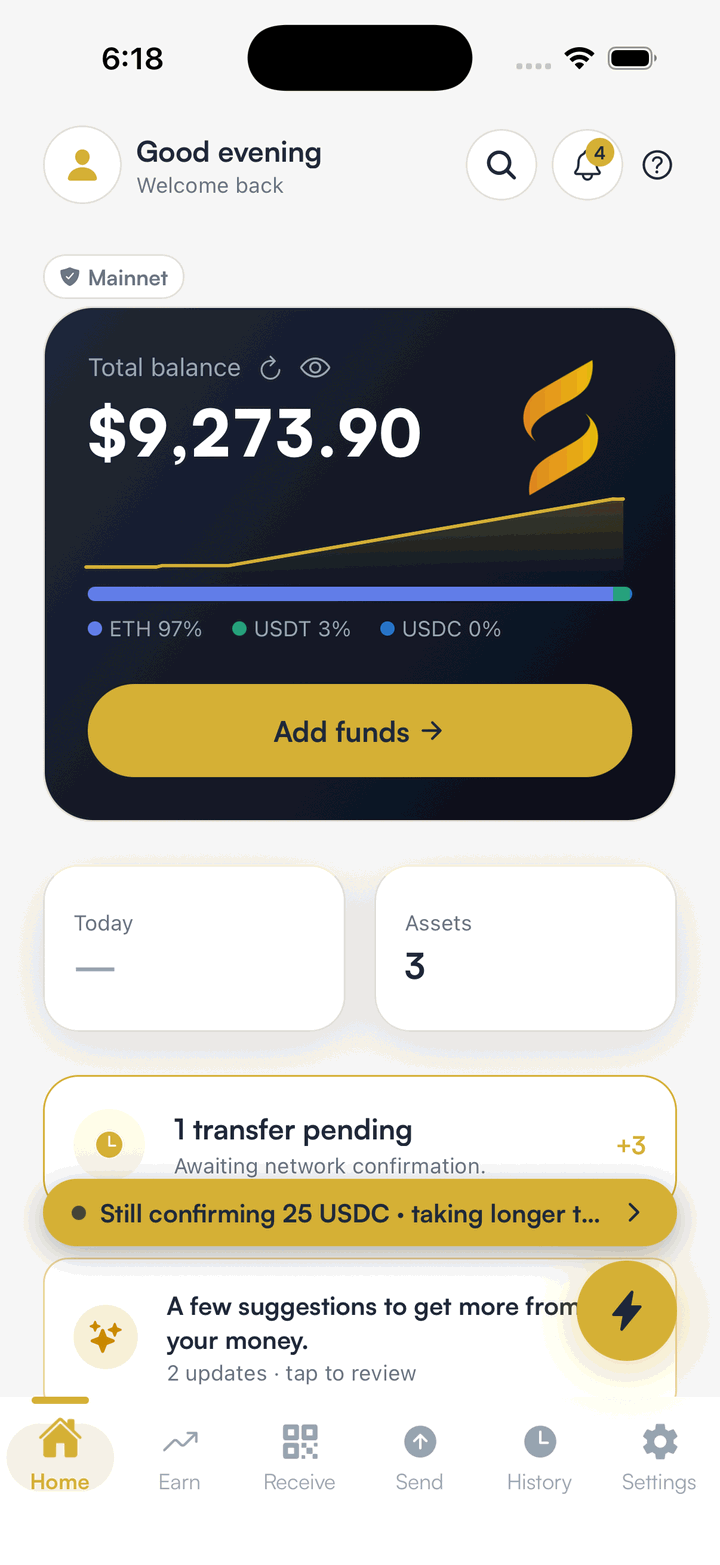
SpendTheBits sits deliberately between the two: 18 curated coins and tokens across 13 chains — Bitcoin, Litecoin, Ethereum, Base, Linea, BNB Chain, Polygon, Avalanche, Solana, XRP, TRON, Flare, and Sui — every one derived from a single BIP-39 seed created on your phone. The list is curated on purpose: every supported asset gets first-class treatment, including USDC shown as one aggregate balance across every chain it lives on, rather than a wall of thousands of tokens where scams hide in the noise.
Bitcoin: Lightning is the dividing line
All three wallets can hold Bitcoin, but how it moves is very different. In Trust Wallet and Phantom, Bitcoin travels on-chain — fine for holding, slow and comparatively expensive for actual payments.
SpendTheBits runs a Lightning node on your phone, initialized from your own seed, so Bitcoin payments settle in about a second for pennies — and it stays fully non-custodial, with no server node or channel operated by the company. Your @handle even works as a Lightning address anyone can pay. If you want Bitcoin you can actually spend, this is the widest gap in the comparison.
When things go wrong: recovery and inheritance
Trust Wallet and Phantom both use the classic model: your seed phrase is your only lifeline. Lose it — or leave your family without it — and the funds are gone. It is simple, but it is also why billions in crypto are permanently stranded.
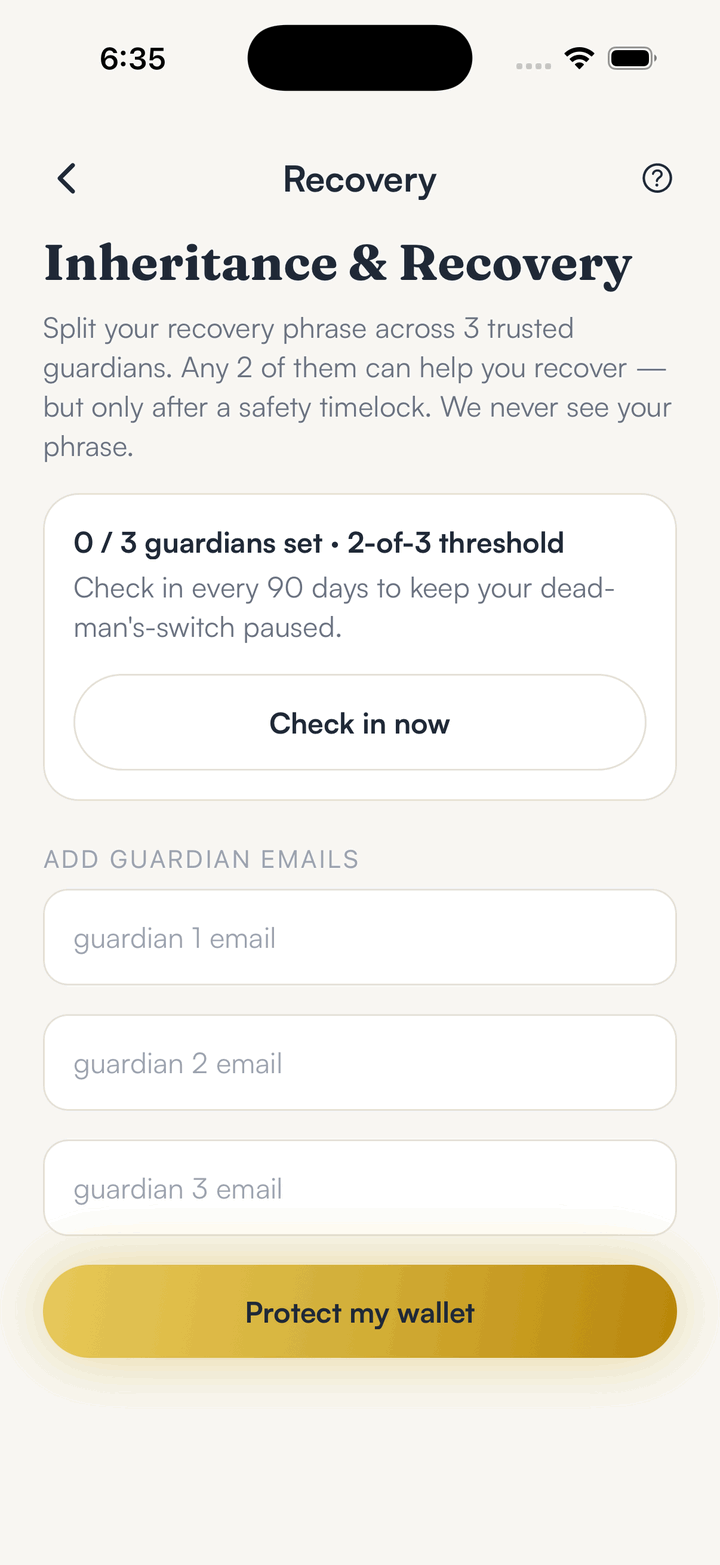
SpendTheBits removes the single point of failure without adding a custodian. Guardian-based social recovery splits your secret into Shamir shares held by people you trust (an M-of-N threshold, owner-cancellable, server sees only ciphertext), and a dead-man's-switch inheritance flow lets heirs claim only after a long, configurable silence. Neither Trust Wallet nor Phantom offers anything comparable built in.
Scam protection: the unglamorous feature that saves you
Phishing, address poisoning, and fake-token airdrops are how most people actually lose crypto — not exchange collapses. Trust Wallet and Phantom both flag known-malicious sites and tokens, and Phantom in particular has invested in transaction simulation.
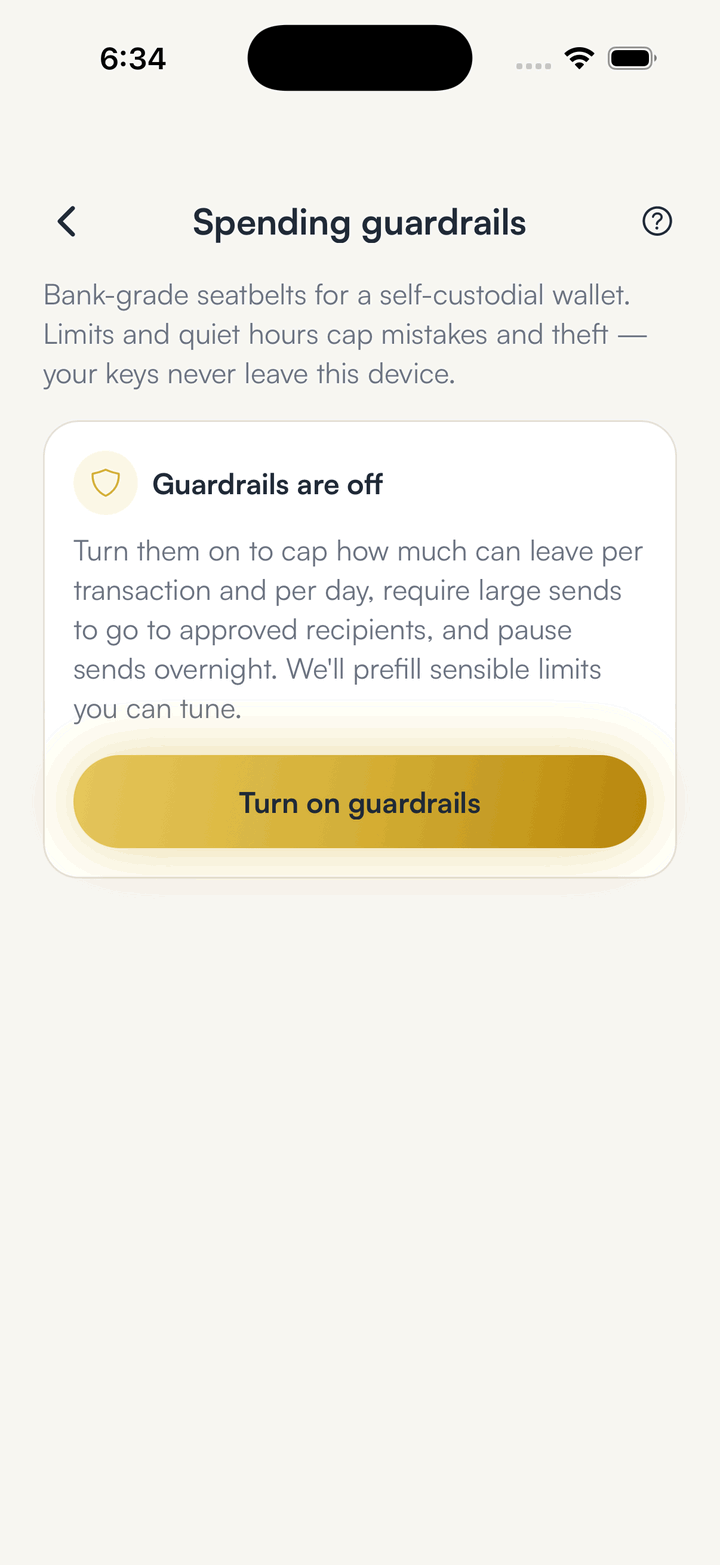
SpendTheBits goes further because it controls the whole payment pipeline: recipient risk-screening before every send, an anti-swap broadcast firewall (a screened payment cannot be swapped for a different recipient between review and broadcast), an address-poisoning guard, clear-signing, and hard quarantine of unverified token contracts so a scam airdrop can never masquerade as your balance. There are also bank-grade guardrails — per-transaction caps, daily limits, allowlists, quiet hours — and a one-tap freeze.
Beyond holding: what the wallet does for you
Trust Wallet and Phantom cover the classics — swaps, staking, NFTs, a dApp browser. SpendTheBits skips the dApp browser and instead builds the money features in natively: yield on idle stablecoins in vetted vaults (with a Yield Safety Score and an automatic circuit breaker), recurring autopay and per-second money streams from one revocable signature, native USDC bridging over Circle CCTP, payment requests, crypto gift cards, and founder-grade bookkeeping with QuickBooks/Xero export.
On cost: all three are free apps where the network gas fee is the baseline. SpendTheBits charges a small service fee — under 1% — on a few value-adding actions like bridging, and a small share of yield earned (never principal), always shown before you sign. There are no hidden swap spreads.
Verdict: which should you choose?
Choose Phantom if you live on Solana and want the most polished experience there. Choose Trust Wallet if you need to hold a long-tail token that curated wallets don't list.
Choose SpendTheBits if you want one seed for Bitcoin (with Lightning), Ethereum, Solana, XRP and ten more chains — plus recovery and inheritance that survive a lost seed phrase, scam protection at the pipeline level, and payments, yield, and bookkeeping built in. It is the only one of the three trying to replace your bank, not just your exchange.
Ready to hold your own keys?
SpendTheBits is a fully non-custodial wallet for 13 chains, free on iOS and Android.