

Founders & startup treasuries
Crypto treasury management for startups
Run your company's money without handing anyone the keys
You raised in USDC, you pay contractors in USDC, and your runway sits in USDC. A custodial platform asks you to trust them with all of it — and history is not kind to that trade. A bare wallet keeps you safe but gives you none of the operations: no yield, no recurring payouts, no books.
SpendTheBits gives the treasury a bank-like operating layer while the keys never leave the founder's phone. Every automated action is an allowance you signed, scoped and revocable — not custody.
How it plays out
A week on SpendTheBits
- 1
Idle runway earns, spending stays instant
Park idle USDC in vetted on-chain vaults (Aave v3, and ERC-4626 venues like Morpho and Sky) with a 0–100 Yield Safety Score guiding where it goes. When a payment needs more than your liquid balance, the app unwinds exactly the shortfall just-in-time — the treasury earns until the second each dollar leaves.
- 2
A circuit breaker watches the vaults
Treasury Auto-Defense monitors the safety score around the clock. On a breach it can exit the position back to liquid USDC in your own wallet and alert you — the automation is cryptographically limited to withdraw-to-you-only, so even a full server compromise could not send funds anywhere else.
- 3
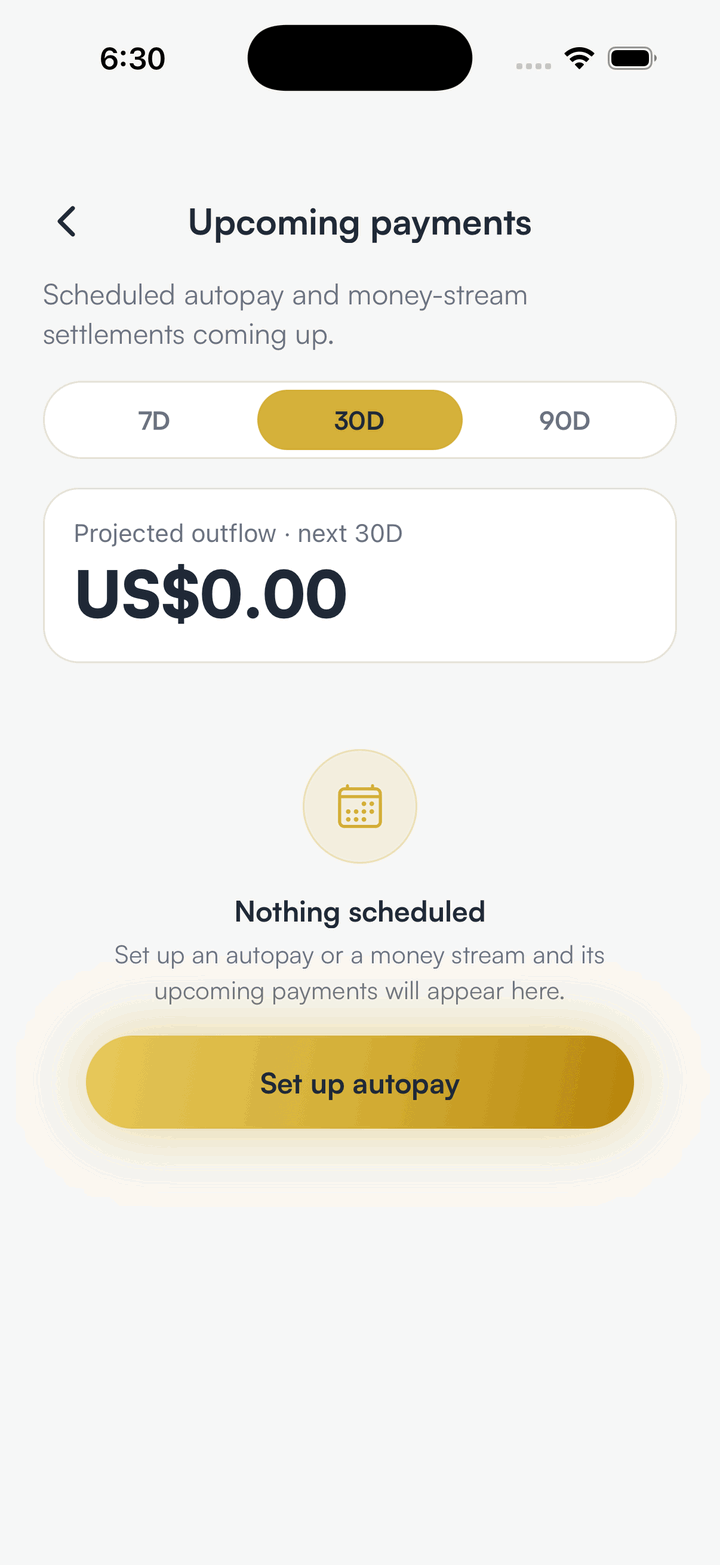
Vendors and salaries pay themselves
Programmable Autopay turns retainers and subscriptions into one signature for the whole schedule, capped and revocable. Money Streams handle salary continuously — pay accrues per second and your team claims whenever they like, while the unclaimed float keeps earning.
- 4
Spend policy, enforced by the wallet
Guardrails give the treasury bank-grade controls: per-transaction and daily caps, recipient allowlists, quiet hours, and a cooldown on brand-new recipients. A compromised laptop can't drain what policy won't sign.
- 5
Board-ready books, without a bookkeeper
CFO Books turns the public ledger into FIFO/HIFO cost-basis lots, realized and unrealized P&L, a treasury statement, and a general-journal CSV that drops straight into QuickBooks or Xero. An automatic tax reserve ring-fences taxable inflows so quarter-end is never a surprise.

The features doing the work
Questions & answers
Founders & startup treasuries: common questions
Can my company earn yield on USDC without giving up custody?+
Yes. SpendTheBits deposits idle USDC into vetted on-chain vaults from your own wallet — the position is held by your keys, not by us. Withdrawals are signed on your device, automation is scoped to withdraw-to-you-only, and the fee is a small share of the yield earned, never your principal.
How do we handle bookkeeping and taxes for on-chain activity?+
CFO Books computes FIFO or HIFO cost-basis lots, realized and unrealized P&L, and exports a general-journal CSV for QuickBooks or Xero. An auto tax-reserve can set aside a share of taxable inflows into a savings goal automatically.
What stops an employee or attacker from draining the treasury?+
The keys live only on the owner's device behind biometrics, and Guardrails add per-transaction caps, daily limits, recipient allowlists, and quiet hours enforced before anything is signed. There is also a one-tap freeze that halts all outbound activity instantly.
Keep learning
Free on iOS and Android. Your keys from minute one.