
Understanding the core parameters of transferWithAuthorization
It requires the payer address, the payee address, and the exact token amount [1]. An authorization parameter represents a signed transfer that can be executed directly on compliant token contracts via a smart contract function [1]. This ensures total precision when moving funds. It removes the need for two separate on-chain transactions, creating a unified flow.
To make the signature, a user can call the standard eth_signTypedData JSON RPC method [1][3]. These signatures are made using the EIP-712 structured data signing standard [1][3]. Any third party can pay the gas and submit the transaction [1]. This separates the right to sign from the task of paying gas [1]. It allows developers to build smooth applications. Users do not need to understand complex blockchain mechanics to pay. This reduces friction for everyday transactions.
The validity of the signed authorization is controlled by two parameters, validAfter and validBefore, which both use unix time [1]. A contract can see if a random nonce is spent by calling the authorization state view [1]. The receive with authorization variant ensures the caller matches the payee [1].
Why random nonces outperform sequential nonces
Sequential nonces work well for main chain deals [1] but cause big issues for gasless moves [1]. If a user signs two payments, they must process in order [1]. If the first transaction gets stuck in the mempool, all others behind it will fail [1]. This is a major bottleneck when gas costs are high [1]. Users are left waiting, and developers struggle to track pending states.
The EIP-3009 standard solves this by using unique random nonces [1]. Each nonce is a random 32-byte value instead of a sequential number [1]. Because each transfer has a random nonce, they do not depend on each other [1]. Users can sign and send multiple payments at the exact same time [1]. You do not have to worry about a stuck transaction blocking the rest [1]. It makes transaction management highly reliable. This parallel setup is key for busy spots where small payments happen fast.
If validators reorder your transactions, random nonces ensure they still succeed [1]. There is no risk of using the same nonce twice by mistake [1]. This is true even when you switch between different apps [1]. For native blockchain transactions, a transaction with a high nonce stays pending [1]. But for meta transactions, a high sequential nonce makes the deal fail fast and wastes gas [1]. But EIP-3009 lets coders group many transactions with low cost and no order worries [1].
Comparing EIP-3009 to the EIP-2612 permit standard
We should compare EIP-3009 to the popular ERC-2612 permit standard to see its benefits [1][2]. The ERC-2612 standard modifies the spending allowance mapping with a signature [2]. This means the user signs an approval first [2]. Then, the contract must run a separate transferFrom transaction to move the funds [2]. This requires two steps and maintains the allowance pattern [1][2]. It is not as clean as a direct transfer. This old way makes smart contracts that pay in one transaction much more hard to write.
In contrast, EIP-3009 does not use the allowance system [1]. It executes the transfer directly [1]. It does not give a third-party address the right to spend your tokens [1]. This direct model reduces the security risks of upgradeable smart contracts [1]. It avoids the issues associated with infinite allowances [1]. To read more about keeping your funds safe, check out our guide to self-custody. You will see how non-custodial wallets protect your keys.
There are also small safety points to check when you choose between these two systems. With the permit tool, the ecrecover precompile fails with no sound if a message is bad [2]. Coders must check that the owner is not the zero address to avoid letting dead funds pass [2]. Furthermore, a relayer can choose to withhold or submit a signed permit [2]. Setting a short deadline parameter helps mitigate this censorship risk [2]. These subtle design choices affect both user experience and contract safety.
How x402 utilizes transferWithAuthorization on EVM chains
The x402 standard defines a secure protocol for executing stablecoin payments [4]. The facilitator pays the gas, but the client keeps full control [4]. This is perfect for native stablecoins like USDC [4]. The user signs a code message to control the path of funds in an x402 transaction [4]. The facilitator then broadcasts this signature to the blockchain [4]. This keeps the integration clean.
The client device makes an EIP-3009 signature for the exact price and recipient [4]. The parameters also set the validity window [4]. The signature for an authorization can be obtained using a web3 provider with the eth_signTypedData method [3]. The facilitator cannot modify the amount or destination [4]. It serves only as the transaction broadcaster [4]. For a deeper look, check our analysis of gasless stablecoin transfers. This creates a fast payment experience. It is great for everyday users and machines.
The payment protocol supports multiple transfer methods [4]. If no method is specified, the implementation prioritizes EIP-3009 if compatible [4]. For other tokens, a backup uses the Permit2 contract [4] at one address across EVM chains [4]. The proxy enforces recipient security through a witness pattern [4]. The ERC-7710 asset transfer method is a smart account option that allows transfers to be paid from an account that supports this standard [4]. These fallbacks guarantee that payments remain robust across any technical environment.
Implementing secure gasless payments in SpendTheBits
When a SpendTheBits user pays an x402 URL, the device signs the authorization and the facilitator submits it; the key never leaves the phone. Our backend stores public data only, relaying signed transactions but never touching your keys. SpendTheBits is fully non-custodial because keys are generated and transactions are signed only on the user's device. No third party can freeze or seize your digital assets, ensuring users retain ownership. The app relies on local hardware security to run all cryptographic functions.
SpendTheBits is a self-custody wallet, not a centralized platform. For more context on why this matters, read our guide on non-custodial wallets. We never hold your assets or manage your balances. Everything is generated and stored on your own device. The app works on iOS and Android. It uses a single seed to derive addresses across many chains. This includes Bitcoin, Ethereum, Base, Polygon, Solana, and the XRP Ledger. You can switch between these networks seamlessly depending on your transaction needs.
Our system also screens for scams before any transfer goes out. We quarantine unknown tokens to keep you safe. This blends gasless speed with top-tier local security. For more details, read about how x402 payments work in production. You can see how fast these systems settle. It is a secure way to manage your crypto. This mix of speed and safety shows the next big step for digital cash. It allows developers to build payments with peace of mind.
The future of programmable payments for AI agents
Old payment rails need human steps, stopping automated bots from doing tasks. With signed messages, an agent gets a signature from a user device to manage small payments. This makes automated machine-to-machine payments real. Agents can pay for tools fast without help from people. This stops the lag of old card systems.
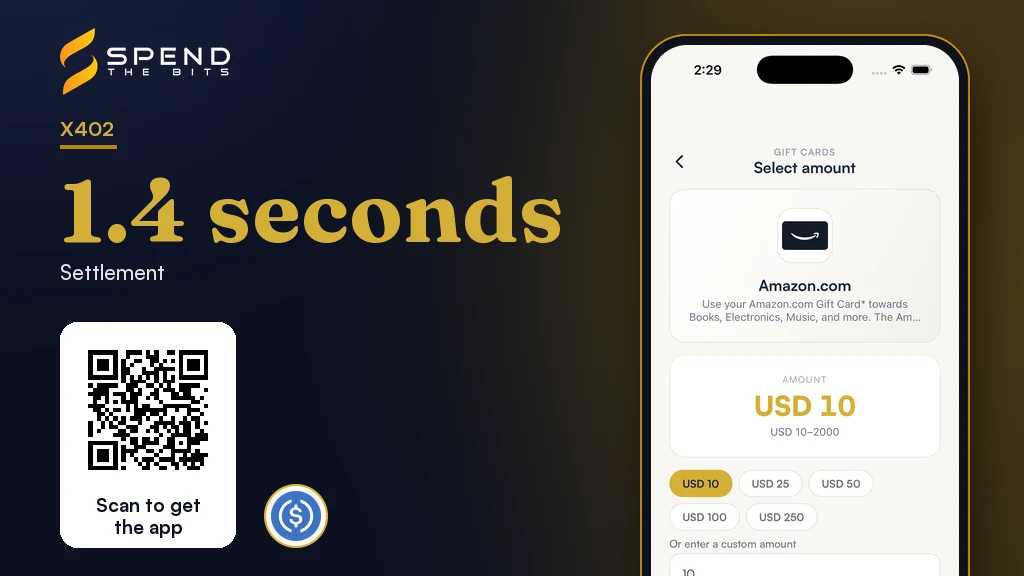
On 2 September 2026, we measured that an agent paid a SpendTheBits x402 resource on Base mainnet through CDP and it settled in about 1.4 seconds. This ultra-fast speed makes real-time payments viable. Developers can build marketplaces where bots pay each other. Deals with no gas fees settled fast. This proves the system is ready to use now. It handles high traffic with no line blocks.
To start building, read our guide on how to get paid by AI agents. Any user can sell a resource with a personal handle. Buyers pay in stablecoins, and funds settle directly to the seller address. The process is smooth, gasless, fast, and safe through cryptographic signatures.
In the app · 3 steps
See one-signature payments in SpendTheBits
An agent pays with a signed authorization, never with your keys. Here is where that shows up in the app.
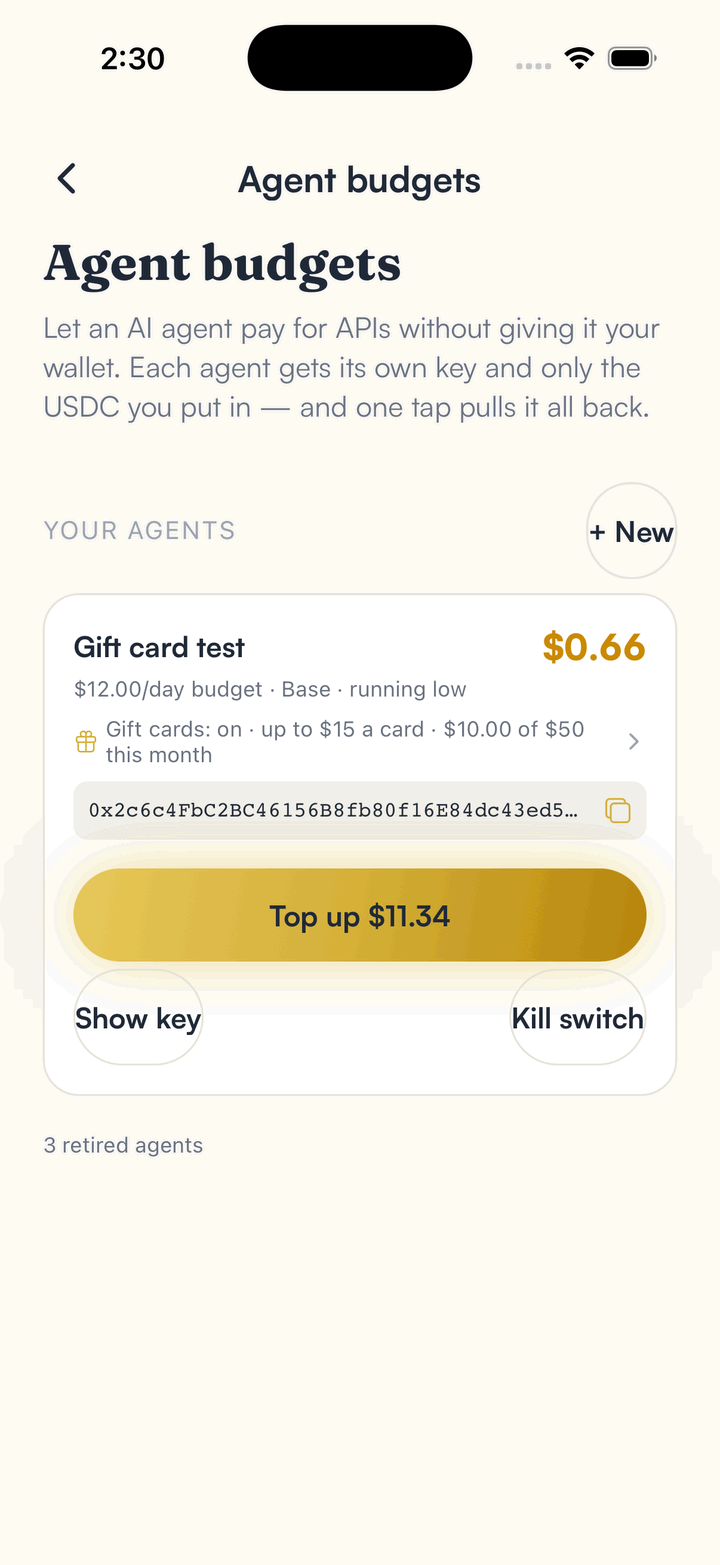
Give an agent its own budget
Each agent has a dedicated key and only the USDC you put there, so the cap is enforced by the balance itself.
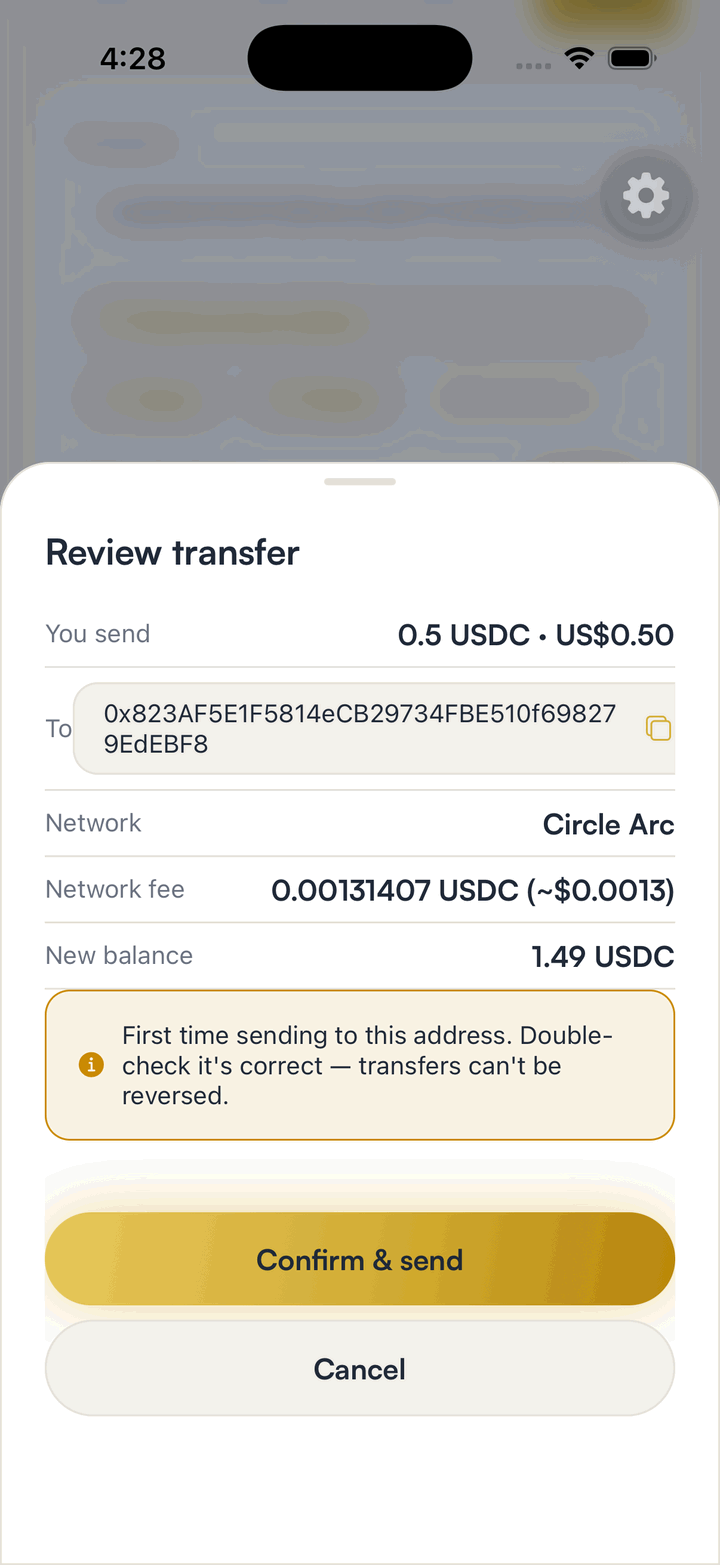
Review anything that moves your funds
A payment from your own wallet is reviewed and signed on the phone, never by the agent.
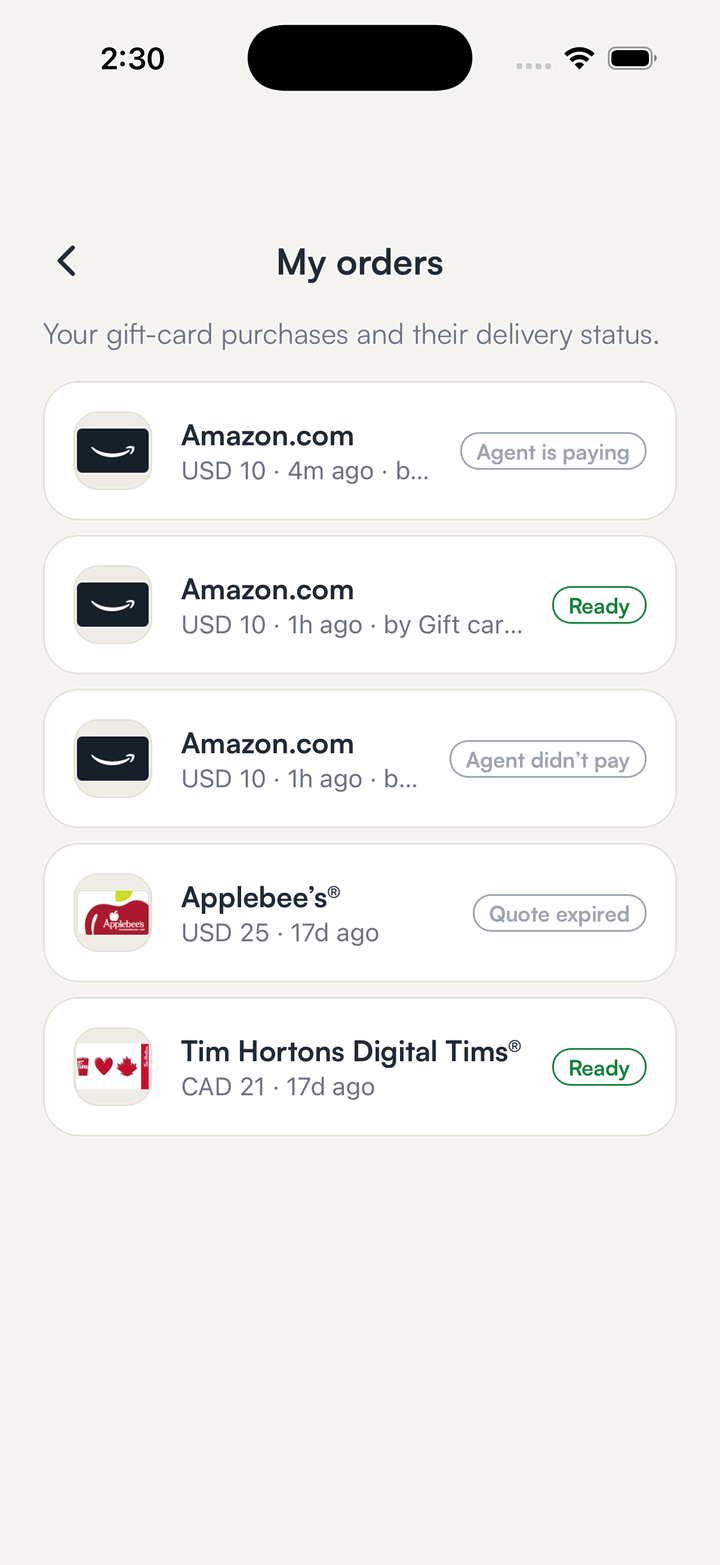
See what the agent paid for
Orders an agent placed are labelled as theirs, so your own activity stays readable.
Hold your own keys, keep the yield, skip the middleman.
SpendTheBits is a fully non-custodial wallet for 13 chains, free on iOS and Android.