
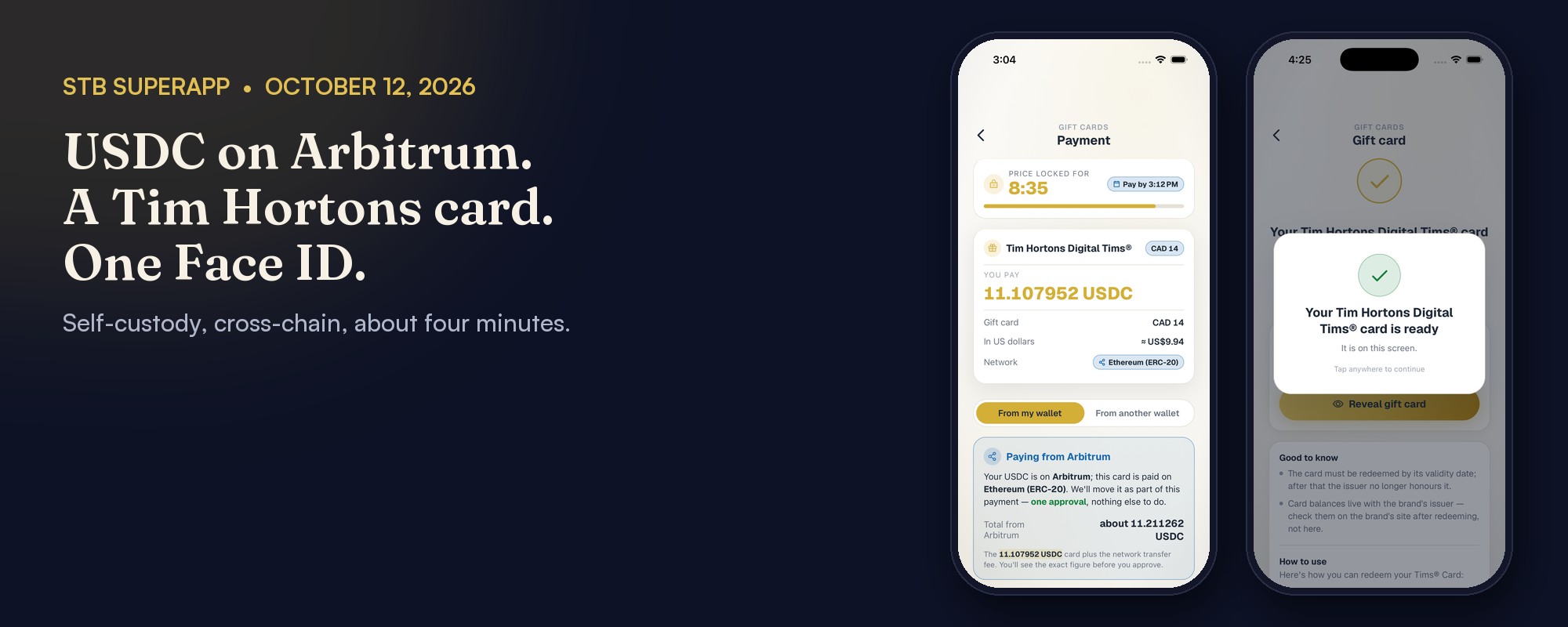
On October 12, 2026 at 21:04 UTC, a CAD 14 Tim Hortons gift card was bought from the STB Superapp with USDC that was sitting on Arbitrum. The card is priced and paid on Ethereum. The buyer never opened a bridge, never held ETH for gas on Arbitrum, and approved the whole thing once, with Face ID.
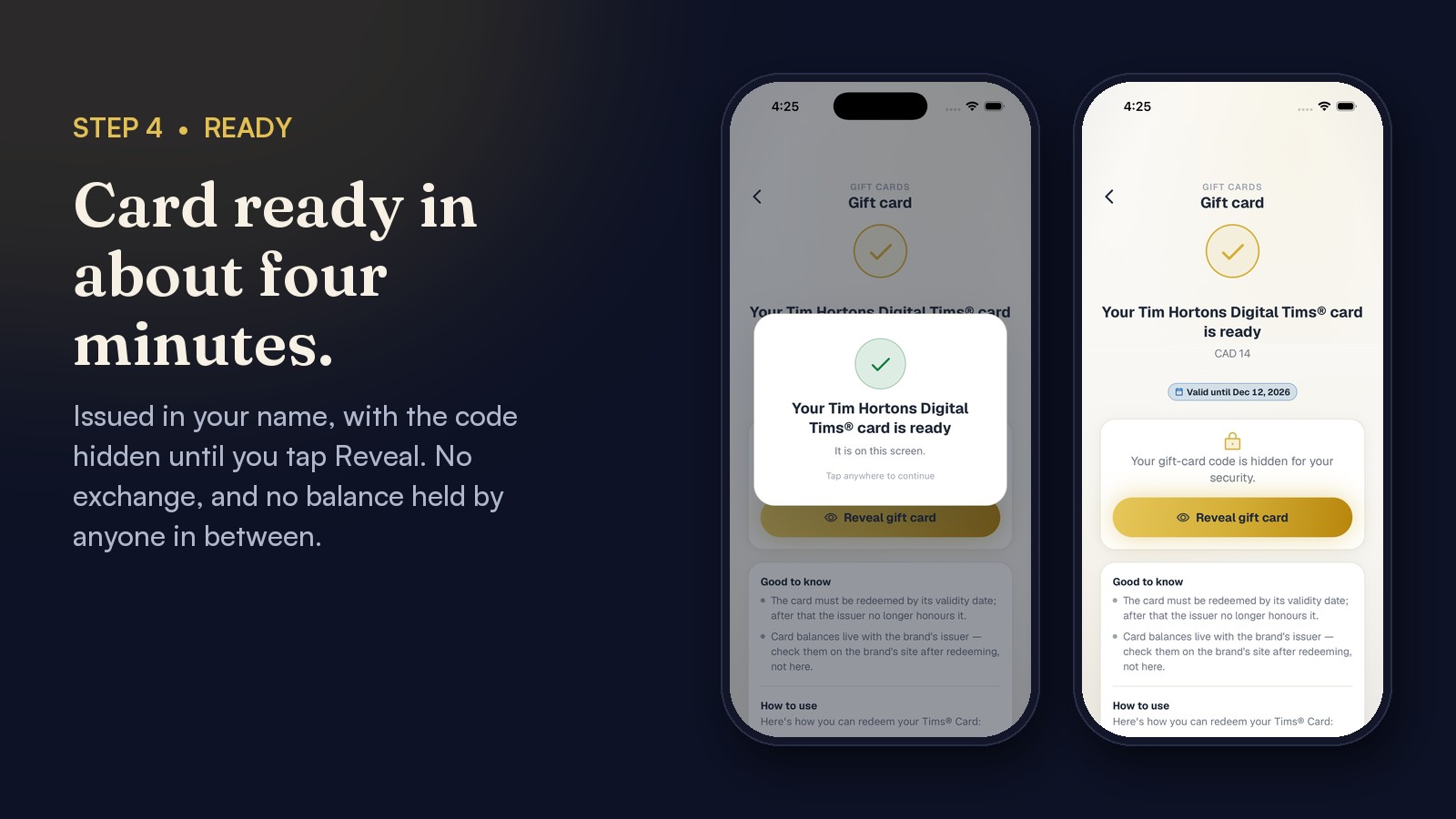
About four minutes later the card was ready in the app, issued in the buyer's name.
Moving money between blockchains is still the part of crypto most people get wrong. The STB Superapp now does it as part of the purchase, from a self-custody wallet, without ever holding the funds.
“People don't keep their stablecoins where a merchant wants them. Your USDC is on Arbitrum, the card wants Ethereum, and until now that meant a bridge, a gas token and three apps. We wanted it to be one tap, and we wanted it to stay self-custody the whole way.”
What happened, step by step
- 1
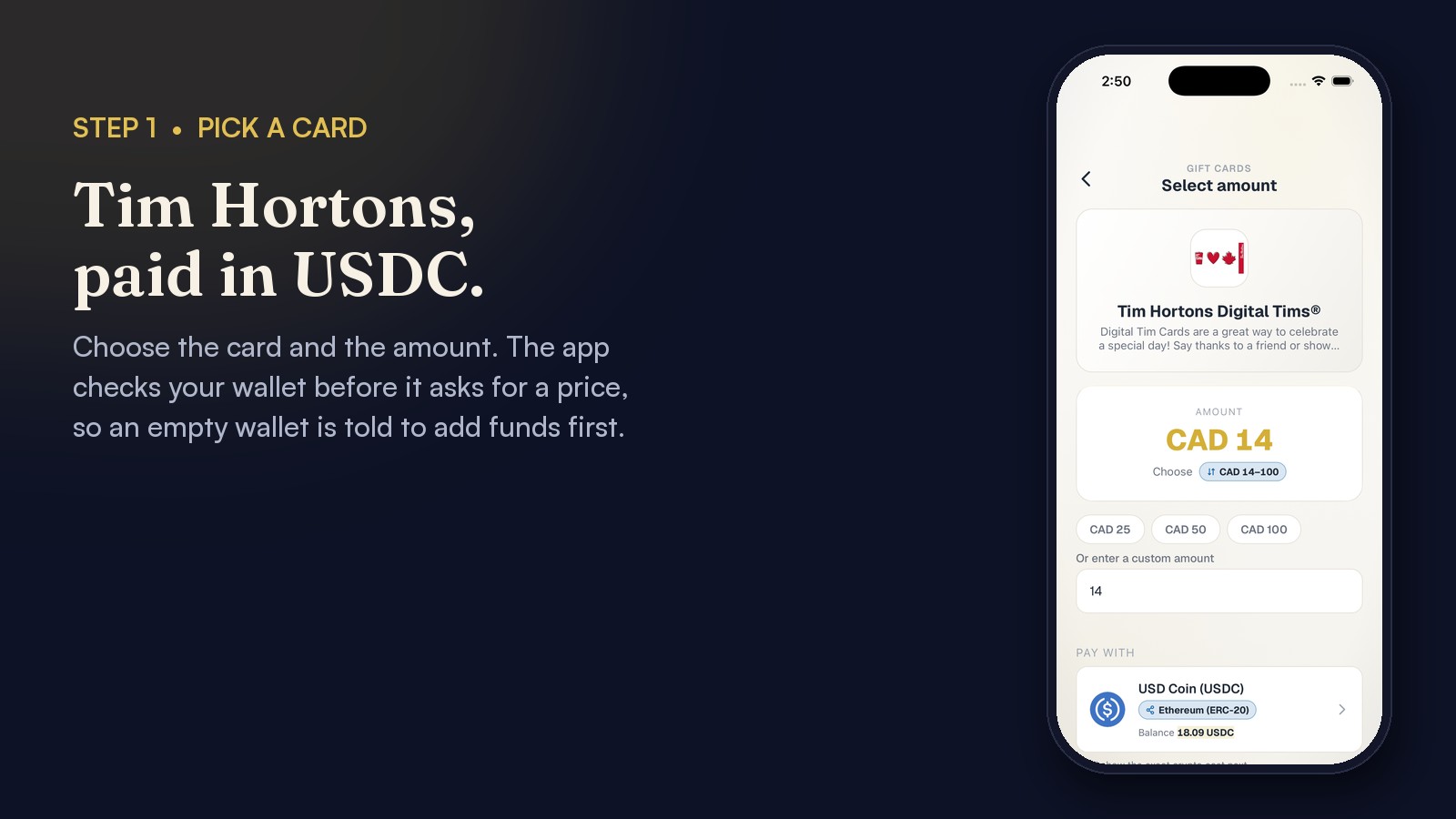
Pick the card. Tim Hortons Digital Tims, CAD 14, paid in USDC. The app checks the wallet before it asks for a price, so an empty wallet is told to add funds instead of opening an order it cannot pay.
- 2
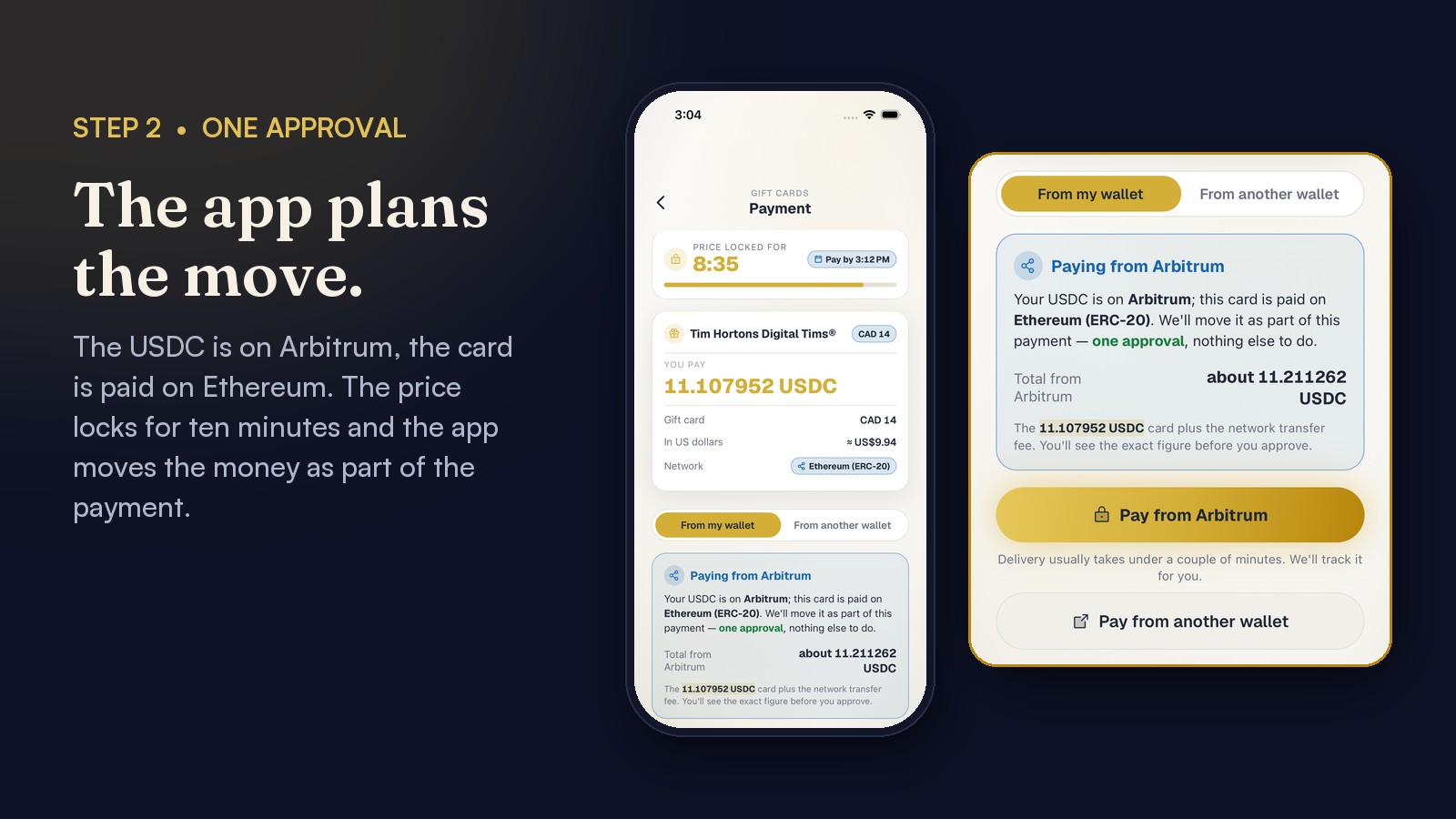
Lock the price. The quote holds for ten minutes. The app sees the USDC is on Arbitrum while the card is paid on Ethereum, and plans the move as part of the payment: one approval, nothing else to do.
- 3
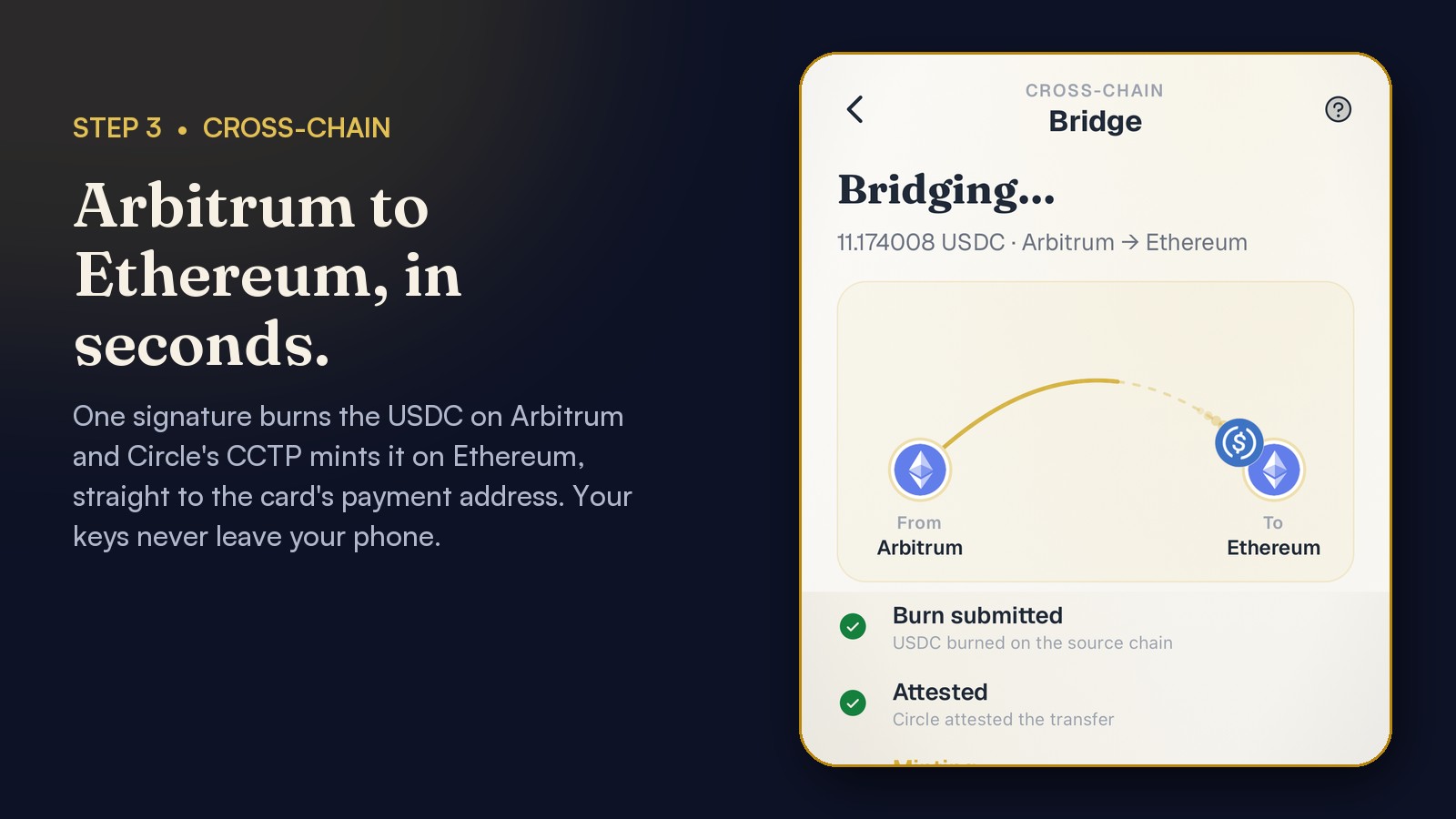
Approve once. One signature burns the USDC on Arbitrum. Circle's CCTP attests it and mints native USDC on Ethereum, straight to the card's payment address. The network fee on Arbitrum is paid in USDC, so no ETH was needed there.
- 4
Receive the card. The payment was seen at 21:06 UTC and the card was ready at 21:08, issued in the buyer's name, with the code hidden until they tap Reveal.
The payment is public and can be checked on-chain: the Arbitrum transaction.
Step 1: pick a card
Step 2: one approval, the app plans the move
Step 3: Arbitrum to Ethereum in seconds
Step 4: the card is ready
Why it matters
Stablecoins now live on many chains at once. A person's USDC ends up wherever the last app, exchange or employer sent it, and a merchant asks for it somewhere else. The usual answer is a bridge site, a second token for gas and a long wait, and each step is a chance to send money to the wrong network.
The STB Superapp treats that as its job, not the buyer's. It reads where the USDC actually is, picks a route that can pay, and folds the cross-chain move into the same approval as the purchase.
The risks, and how we handle them
Who holds the money while it crosses chains?
Nobody but the protocol. The USDC is burned by the buyer's own signed transaction on Arbitrum and minted by Circle's CCTP on Ethereum to the card's payment address. SpendTheBits prepares the transaction and relays it once the device has signed. It never signs on anyone's behalf.
What if the price or the network fee changes while I review?
The card price is locked for ten minutes. If the network fee rises before the payment is sent, the app now says plainly that nothing was sent and asks you to review again, rather than leaving you to wonder.
What if I don't have enough?
The app checks your wallet before it asks the card provider for a price. If the wallet can't cover the card, it asks you to add funds first, and no order is opened.
Can SpendTheBits see my card code?
The code is delivered to your app and stays hidden until you choose to reveal it.
Availability
Gift cards from brands in more than 90 countries can be bought in the STB Superapp, paid in USDC, BTC, ETH, SOL and other coins, on iOS and Android. Paying with USDC from another chain works today from Base, Polygon, Arbitrum and other supported networks. Read how an AI agent bought a gift card over x402.
Give your AI agent a budget, not your wallet.
The STB Superapp is a free, self-custody wallet on iOS and Android.
About SpendTheBits
SpendTheBits Inc. builds the STB Superapp, a self-custody wallet for stablecoins and crypto across more than ten blockchains. It offers yield on idle stablecoins, automatic payments, gift cards, Lightning, cross-chain transfers and AI-assisted money management, all without ever holding its users' keys. It is not an exchange and does not hold customer funds.
Media contact: hello@spendthebits.com
Gift cards are issued by a third-party provider and are subject to its terms and pricing. Small cards cost proportionally more, and a cross-chain payment carries a small bridge fee. Nothing in this release is financial advice.