
What being an unsecured creditor means on day one
A bankruptcy filing draws a line through the company's balance sheet. Everything the company owns goes into a pool called the estate. Everyone the company owes joins a queue. Secured creditors, the ones with collateral, stand at the front. Lawyers and the people running the case get paid as they go. Unsecured creditors stand at the back and share whatever is left. In an exchange collapse, customers almost always land in that last group.
Landing there has two consequences that surprise people. First, you cannot withdraw. The moment the case is filed, an automatic stay freezes every claim so that no creditor can jump the queue. Second, you no longer have a coin. You have a dollar-denominated claim, and its size is fixed by what the company's records say you were owed on the filing date.
None of this depends on the company being dishonest. An exchange collapse can follow a hack, a bad loan book, or a bank run. The legal machinery is the same in each case, and the customer sits in the same place in the queue.
Customer property or estate property: the Celsius ruling
The single most important question in any crypto bankruptcy is whether the coins in customer accounts belong to the customers or to the estate. If they belong to the customers, they are handed back. If they belong to the estate, they are sold to pay everyone, and customers get a share.
Celsius answered this question in court. The company filed for bankruptcy in July 2022 [6]. On January 4, 2023, Judge Martin Glenn of the Southern District of New York ruled that assets deposited in Celsius Earn accounts belonged to Celsius, not to the account holders [5]. The reason was the terms of use. Customers had granted Celsius "all rights and title" to their deposits, which became "Celsius' property, in every sense and for all purposes" [5]. Roughly $4.2 billion of customer crypto became estate property with that ruling, and the depositors were left holding unsecured claims [5].
Nobody who clicked "accept" on those terms thought they were signing over ownership. But that is what a custodial account is. The company holds the keys, the contract decides who owns the balance, and in an exchange collapse a judge reads the contract, not the marketing. Our guide to non-custodial wallets explains why a wallet where you hold the keys has no such clause to read.
The price freeze: why FTX's 119 percent felt like a loss
FTX filed for bankruptcy in November 2022 [4]. Its plan was confirmed on October 7, 2024, and it promised that 98 percent of creditors by number would receive about 119 percent of their allowed claims [2]. The estate expected to have between $14.7 billion and $16.5 billion available to distribute [2]. On paper, that is a full recovery plus interest, and the court called it a model case [2].
Here is the catch. Claims were paid in cash, not in coins, and the value of each claim was set at the time of the collapse [3]. Bitcoin was worth around $16,000 when FTX failed and over $63,000 when the plan was approved [4]. A customer who held one bitcoin on FTX got a claim worth roughly $16,000 plus interest, while the bitcoin itself had nearly quadrupled [4]. One creditor group argued this meant users were really getting 10 to 25 percent of what their crypto was worth by then [4].
This is the price freeze, and it is standard in any exchange collapse, not an FTX quirk. The estate has to fix every claim in one currency on one date so it can be shared out. The upside for the coin between that date and the payout goes to the estate, not to you. The plan did add interest at up to 9 percent per year from the filing to the distribution [3].
It also matters what the estate actually held. At the time of its filing, FTX had only 0.1 percent of the bitcoin its customers believed it was holding [3]. The rest had been lent out, moved, or never bought. A customer balance on a custodial exchange is a promise, and this is what a promise looks like when it breaks.
The clock: months at best, more than a decade at worst
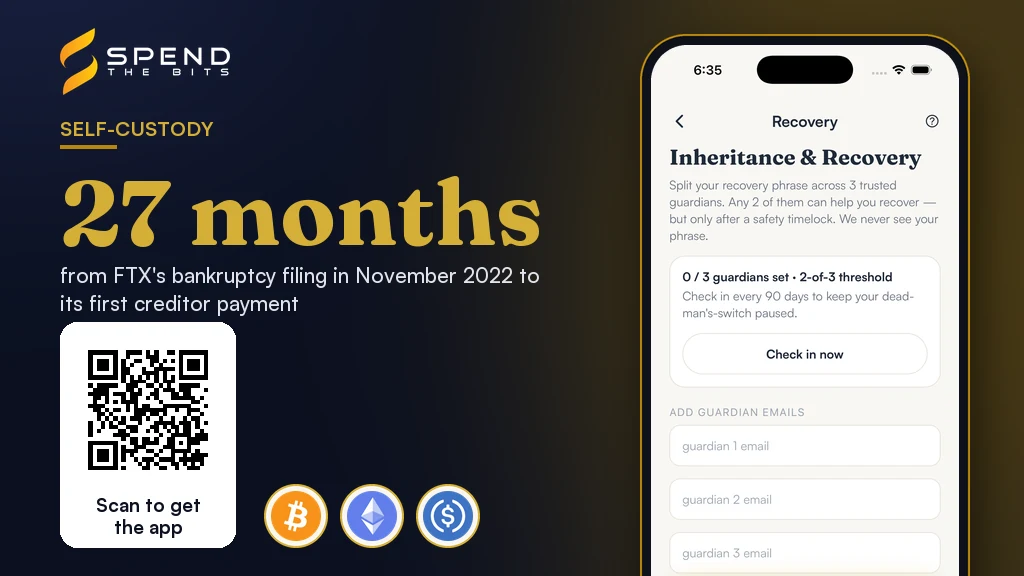
Time is the second cost of an exchange collapse, and it compounds with the price freeze. FTX moved fast by the standards of large bankruptcies. It filed in November 2022, its plan took effect on January 3, 2025, and the first distributions to smaller creditors began on February 18, 2025, paid out through BitGo and Kraken [1][12]. That is 27 months between the doors closing and the first dollar arriving, and it was praised as quick [2].
Celsius took about eighteen months to emerge from bankruptcy, on January 31, 2024 [7]. Its first distribution paid creditors about 57.65 percent of eligible claims in liquid crypto or cash, and a second round in November 2024 lifted that to 60.4 percent [8]. Distributions were priced as of January 16, 2024 [7].
Mt. Gox is the long tail. It collapsed in 2014 after roughly 850,000 bitcoin were stolen [11]. The trustee announced in June 2024 that repayments in bitcoin and bitcoin cash would begin in early July 2024 [9], about 142,000 BTC worth close to $9 billion at the time [10]. Even then, the job was not done. In October 2025 the deadline was pushed again to October 31, 2026, with around 34,689 BTC still held by the trustee and several thousand of the roughly 24,000 creditors still waiting [11]. Some of those people have been creditors for twelve years.
Where a non-custodial wallet sits: outside the estate
Now look at what the estate can reach in an exchange collapse. It can reach assets the company controls. A custodial exchange controls the private keys to every customer balance, so every balance is inside the perimeter. A non-custodial wallet keeps the keys on your device. The company that built the app never holds them, cannot move your funds, and has no balance sheet entry for your coins. If that company failed tomorrow, there would be no filing that mentions you, no automatic stay on your money, and no petition-date price.
This is how SpendTheBits is built. The seed phrase and private keys are generated on the phone and stored in the device keychain, and the backend only ever sees public data such as addresses and transaction hashes. Our security page lays out the boundary in detail. Because the seed is a standard one, you can restore it into any compatible wallet, which means the app itself is not a point of failure for your coins.
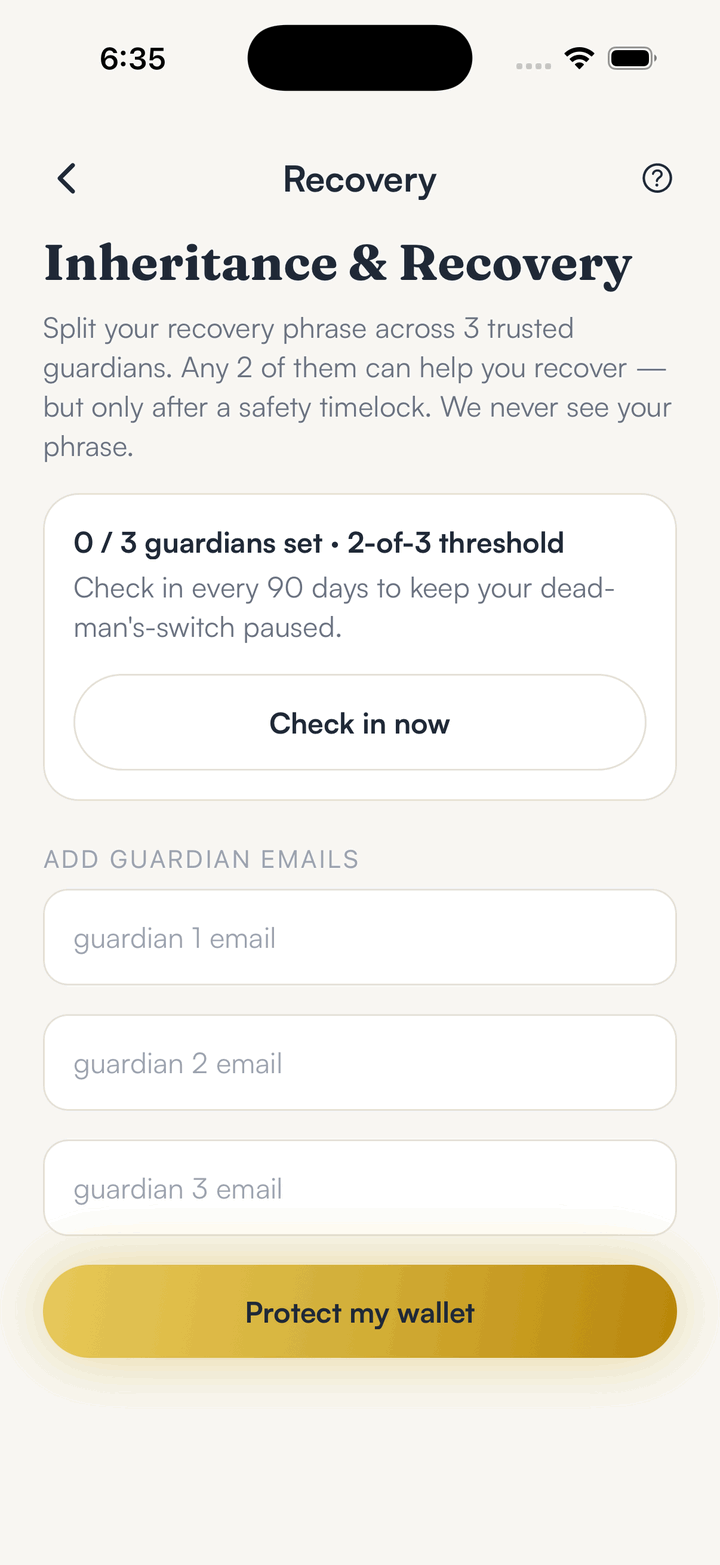
The honest cost is that responsibility moves to you. There is no support desk that can reset a seed phrase. SpendTheBits answers that with guardian-based social recovery and an inheritance flow, so a lost phone or a death in the family does not become a lost fortune. That is the version of safety a custodial account was pretending to offer, without the bankruptcy risk attached. If you are choosing between models, our Coinbase comparison sets the two side by side.
A checklist for families and long-term holders
If you plan to hold for years, the bankruptcy risk is the one risk you are choosing to carry every single day you leave coins on an exchange. It is also the easiest one to remove. Here is what we would do, and what we built the families and long-term holders flow around.
Keep long-term holdings in a wallet where you hold the keys, and keep exchange balances to whatever you are actively using. Back up the seed phrase properly and test the restore once, so you know it works before you need it. Set up guardians so a lost device is a nuisance rather than a disaster. Write down which wallet holds what, and where the backup is, for the person who would need it. And read the terms of use of any custodial account you keep. If it says the company owns the assets, believe it, because a judge will.
What this does is take one entire category of loss, the exchange collapse, and move it out of your life. After FTX, Celsius and Mt. Gox, that category has a well-documented price tag: years of waiting for a dollar figure set on the worst day.
In the app · 5 steps
Move off an exchange into your own keys, in SpendTheBits
The safest order is backup first, then the address, then a small test, then the rest.
Back up your recovery phrase first
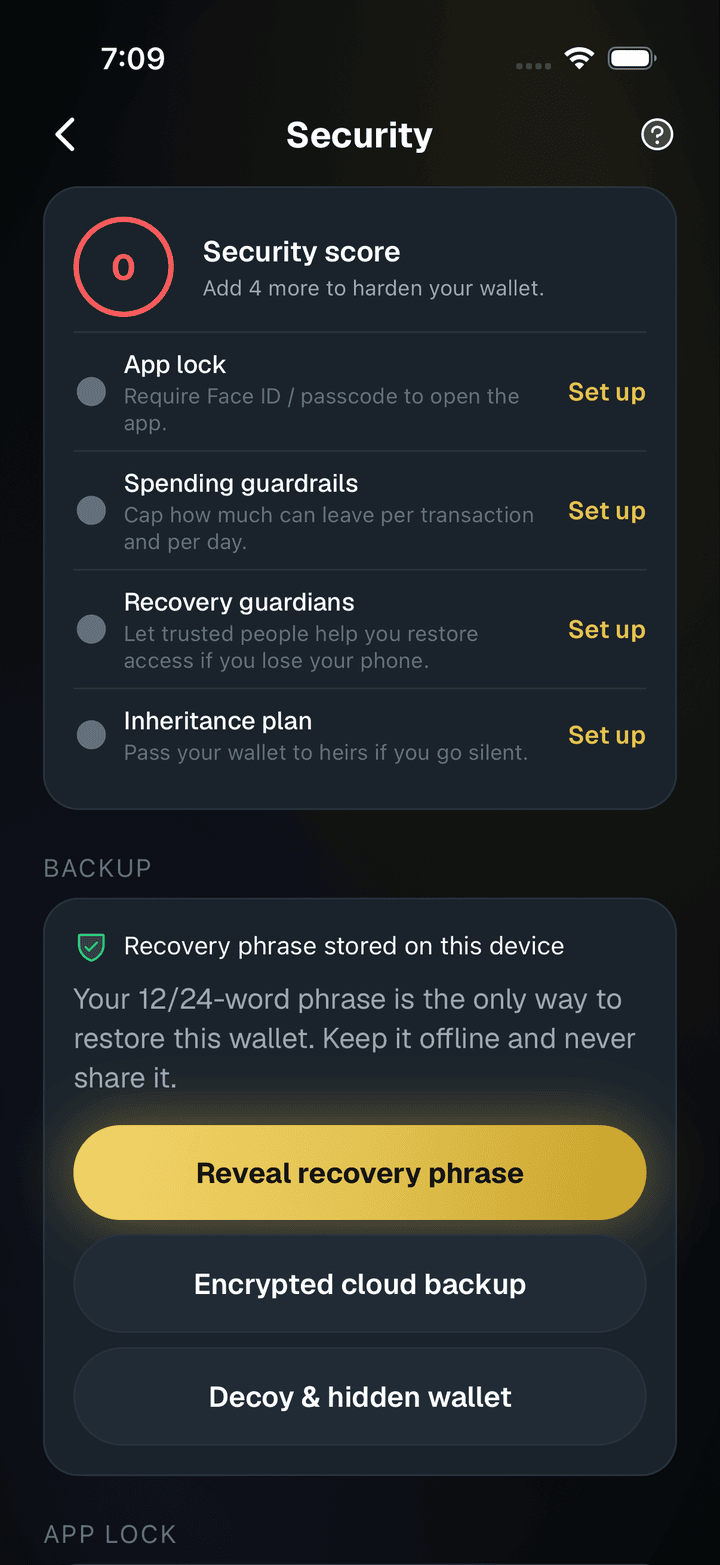
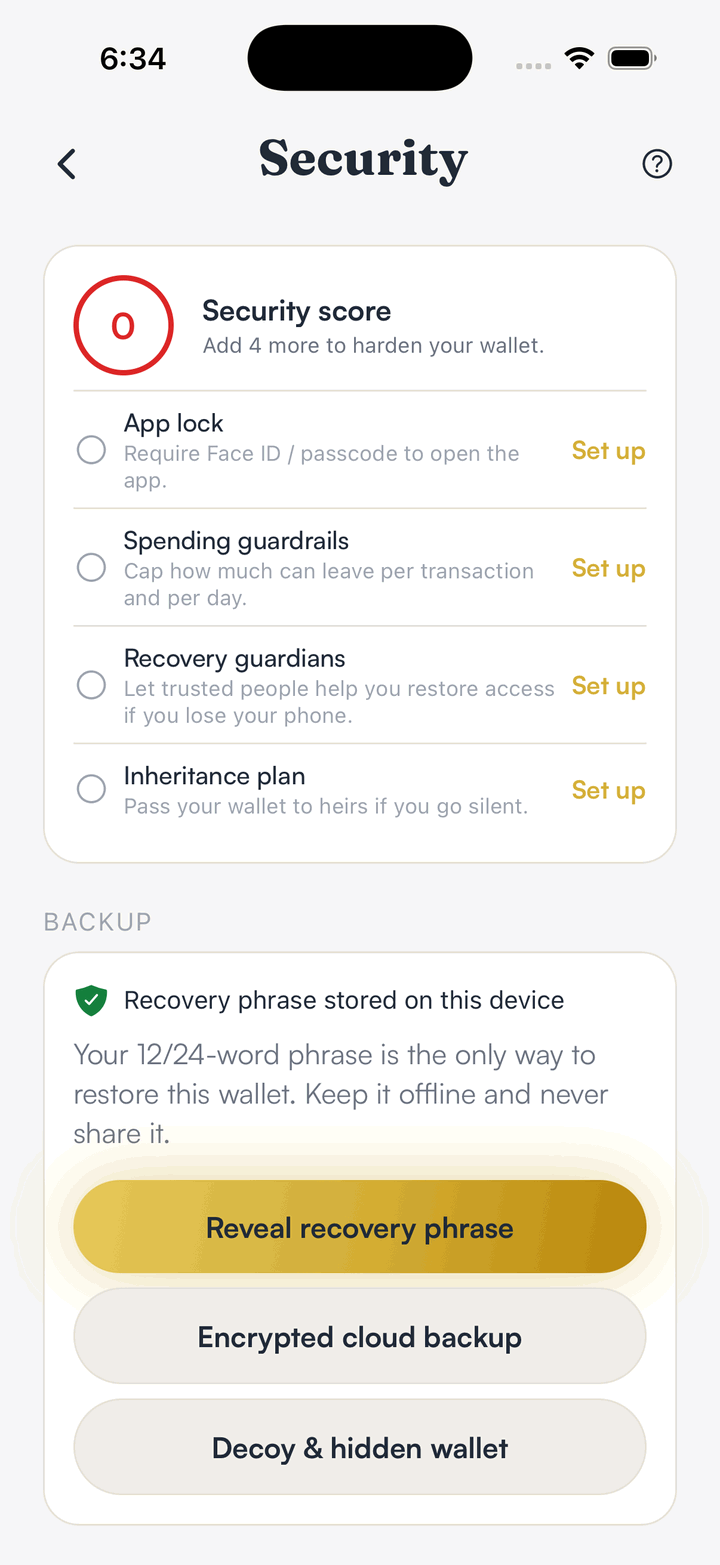
From Security, reveal the phrase, write it down on paper in order and finish the quiz. Funds you move in are only as safe as that backup.
Add a second way back
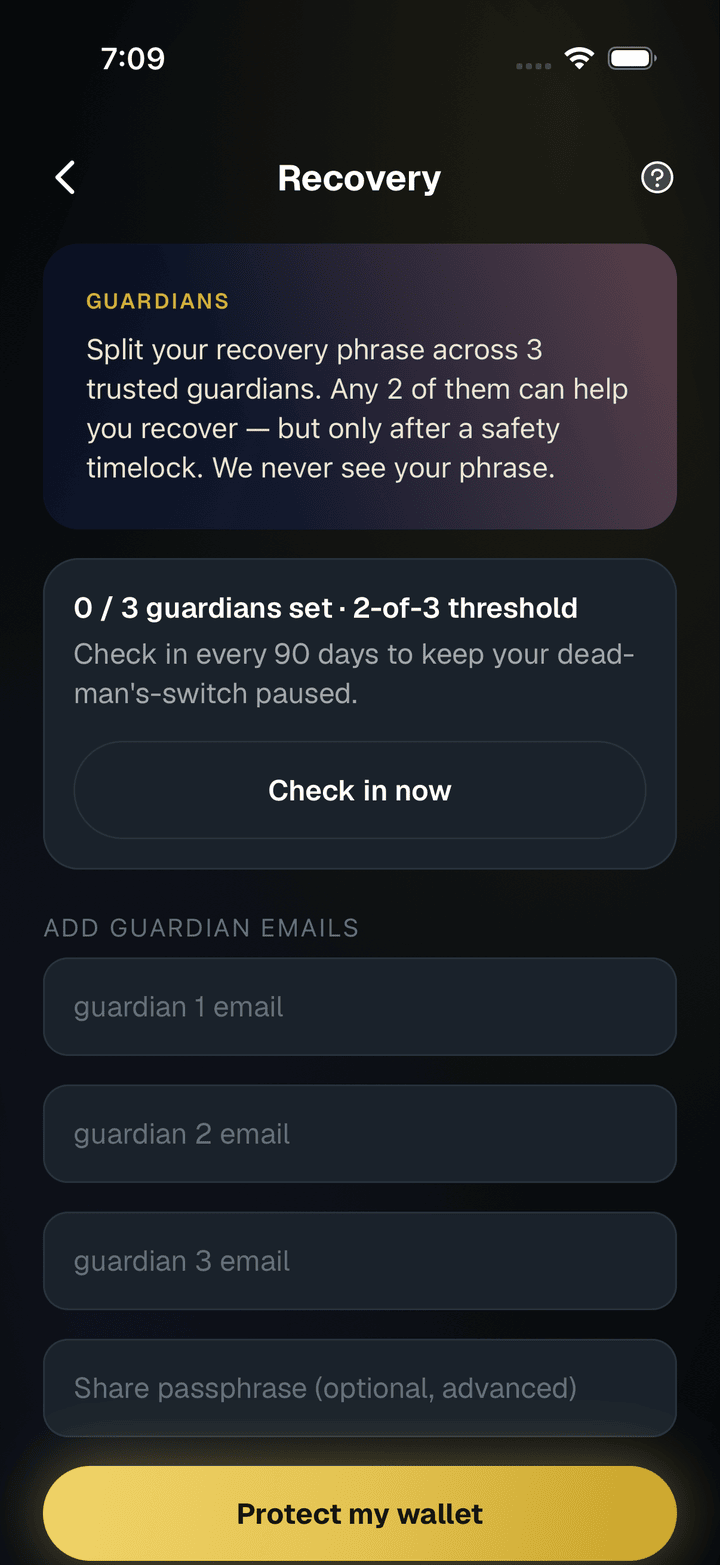
Add guardians so a lost phone does not become a lost wallet. They hold encrypted shares, not your phrase.
Get your own address
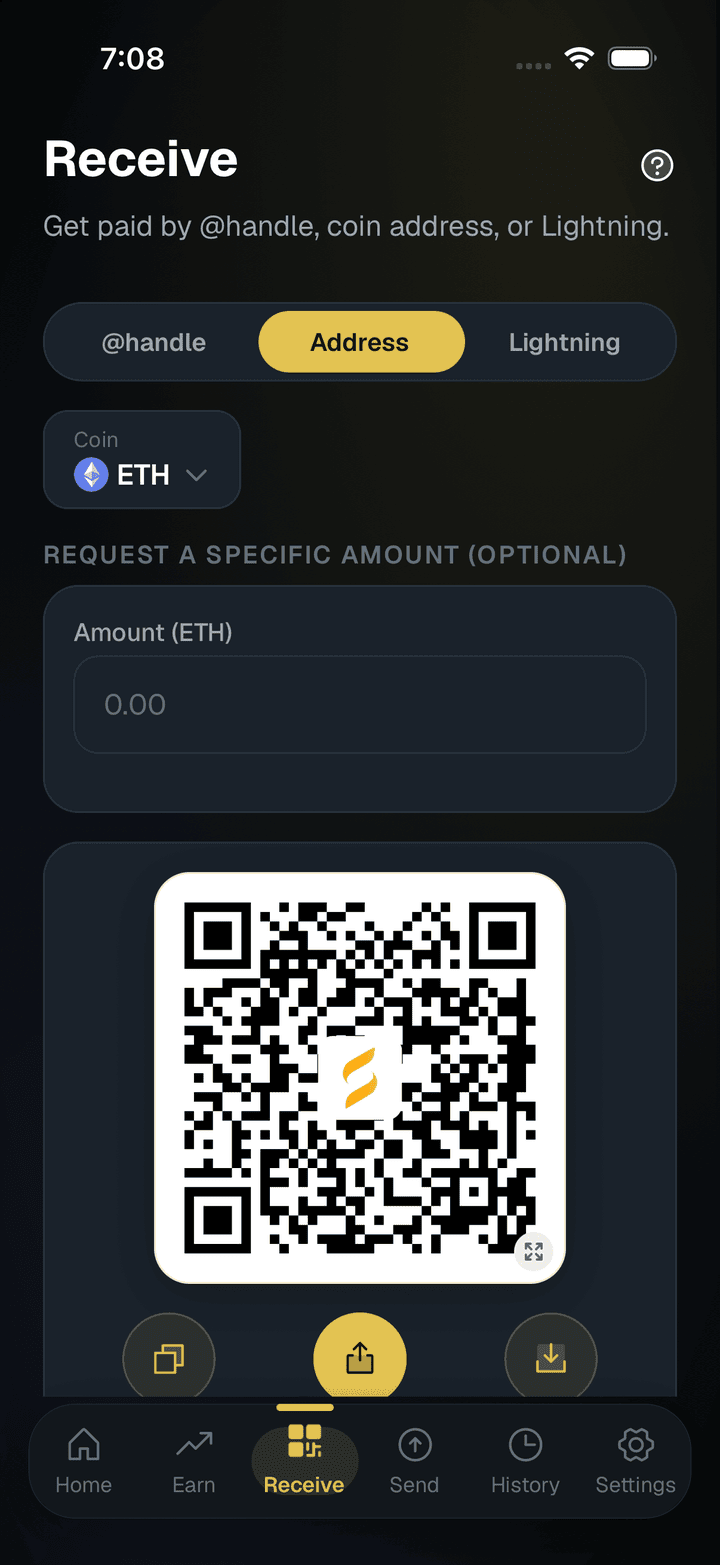
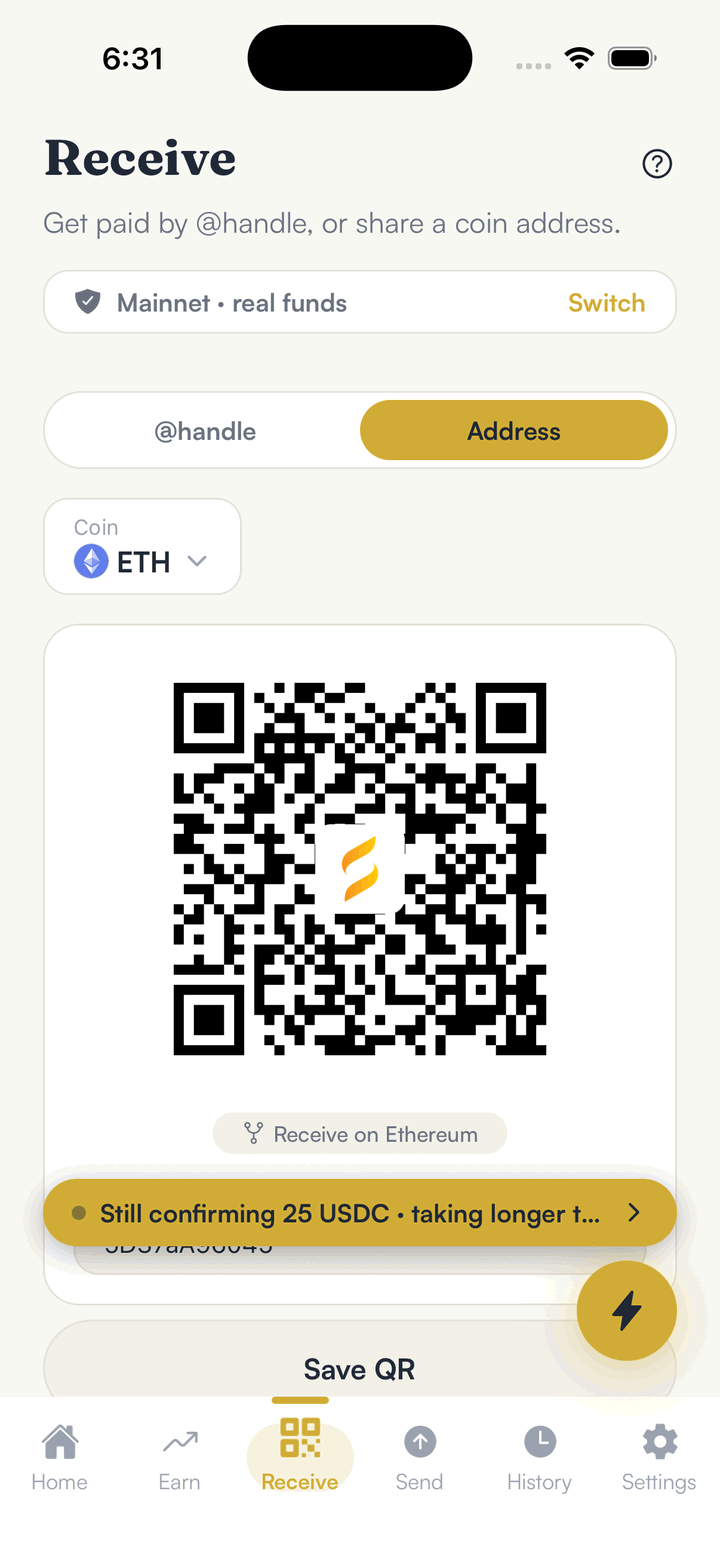
Tap Receive, choose the coin and the chain the exchange will send on, and copy the address. Pick the chain carefully, because a withdrawal on the wrong network is usually unrecoverable.
Withdraw a small test amount
Send a small amount from the exchange first and wait for it to arrive before you move the rest. It costs one extra network fee and catches every address mistake.
Watch it land
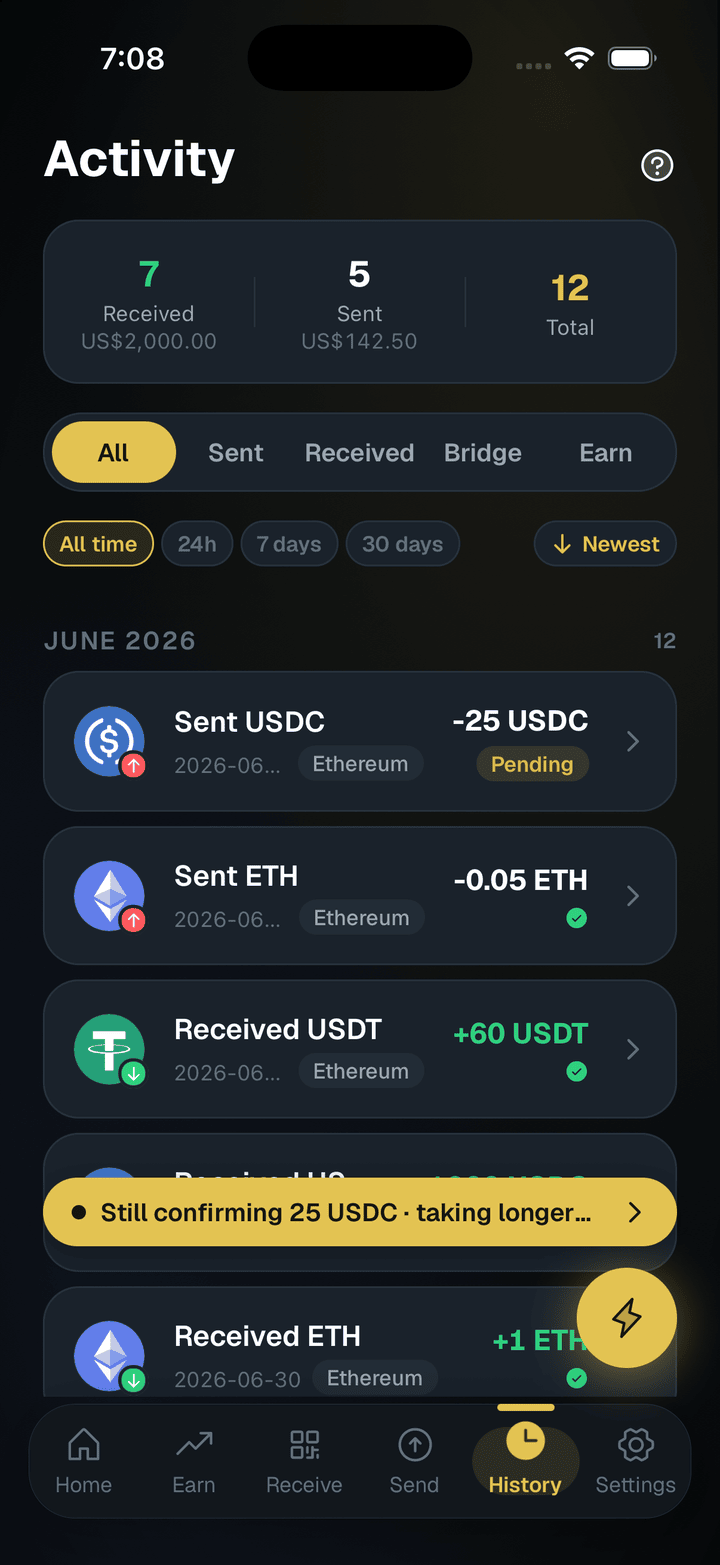
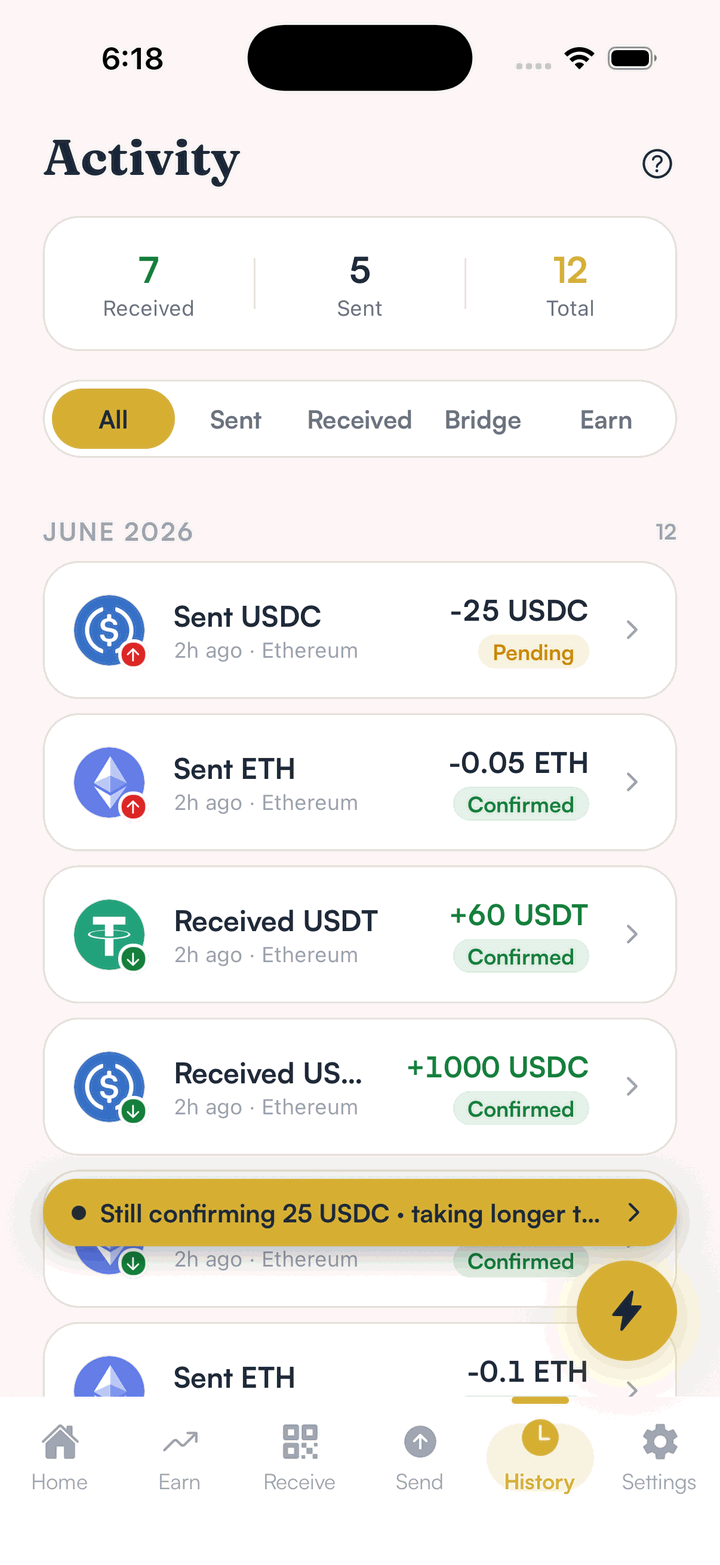
The deposit shows in Activity once the chain confirms it. From then on the coins sit under keys only your phone holds.
Hold your own keys, keep the yield, skip the middleman.
SpendTheBits is a fully non-custodial wallet for 13 chains, free on iOS and Android.