
What the words really hold
Most wallets use the BIP-39 standard. It turns a random number into a list of plain English words, and those words later turn back into the seed that creates all your keys [1]. The standard allows phrases of 12, 15, 18, 21 or 24 words, carrying between 128 and 256 bits of randomness [1]. The longer phrase is not something you need to fear. It is just more randomness written down.
The last word is partly a checksum. BIP-39 takes the first bits of a SHA-256 hash of the randomness and folds them into the final word [1]. That is why a wallet can often tell you a phrase is wrong as you type it. It is also why you cannot invent your own words. A phrase you made up will usually fail the check.
Order matters as much as the words. The phrase is a number written in a special alphabet, so the same words in a different order give a different number. Write the position next to each word. A clean list of the right words in the wrong order restores nothing useful.
One handy detail: the standard says typing the first four letters of a word is enough to identify it [1]. So if your handwriting is poor, print the first four letters clearly. That small habit removes most of the risk of misreading a word years later.
The passphrase is a second secret
BIP-39 also supports an optional passphrase, sometimes called the twenty-fifth word. The wallet mixes it into the seed, and when there is no passphrase it simply uses an empty one [1]. Every passphrase produces a valid wallet [1]. There is no error for a wrong one. You just open a different, empty wallet.
That design gives you protection against someone who finds your written words. They also need the passphrase. But it creates a new way to lose money. If you forget the passphrase, the words alone will open the empty wallet and you may think your funds are gone.
So treat the passphrase as its own backup problem. Ask yourself who would need it if you were not around, and how they would find it. Do not write it on the same sheet as the words, or it protects nothing. Do store it somewhere you and your family can find it. If that sounds like too much to manage, skipping the passphrase is a fair choice for many households.
Paper, metal and the places backups go wrong
Paper is cheap and easy, and it is fine for a start. It also burns, fades and soaks through. Metal plates, where you stamp or engrave each word, survive heat and water far better. The bitcoin.org guide on securing a wallet suggests keeping copies on durable media in more than one place, because single points of failure are bad for security [3].
The dangerous backups are the convenient ones. A photo of the phrase goes to your photo library and often to a cloud account. A note in a notes app syncs to a server. A message to yourself sits in an inbox. The same guide warns that any backup stored online is highly vulnerable to theft [3]. Each of these turns a secret that lives on paper into one that lives behind a password you may have reused.
Think about who can reach each copy. A phrase taped under a desk is reachable by every visitor. A phrase in a bank box is reachable by you and the bank's process. A phrase in a cloud folder is reachable by anyone who phishes one login. Pick places where the list of people who can read it is short and known. If you cannot name everyone on that list, the place is too open.
Finally, never type the phrase into a website or share it with anyone who asks. Ethereum's security page puts it bluntly: never, for any reason, share your recovery phrase or private keys [4]. Real support staff do not need it.
How many copies, and where to keep them
Two or three copies in separate places is the usual answer. One at home in a fire safe, one somewhere else you control, such as a trusted relative's house or a safe deposit box. The aim is that a single bad day, a fire or a burglary, cannot take every copy at once.
More copies are not always better. Each one is a full key to the wallet, so each one widens the circle of risk. A good rule of thumb: add a copy only when it guards against a failure the existing copies do not already cover.
Keep each copy sealed in an envelope you would notice had been opened. A tamper-evident bag works too. If a seal is ever broken and you did not break it, assume the phrase is known. Move the funds to a new wallet with a new phrase, then back that one up with the same care.
Write down where the copies are, without writing the words. Your family should know that a backup exists and roughly where. A clear note in your will or estate papers can save heirs months of searching, without exposing the phrase while you are alive. If you want help with that side, our guide to backing up your seed phrase covers the basics.
Test the backup before it holds real money
A backup you have never tested is a hope, not a backup. The best test is a real restore. Create the wallet, write the phrase, then wipe or set aside the device and restore from your written copy into the same app or another one that supports the standard. If the same addresses appear, your copy is right.
Do this while the wallet is empty or holds a small amount. If you find a mistake then, you lose nothing. If you find it after years of saving, the money may be gone for good. Our help article on restoring a wallet on a new phone walks through what to expect.
Repeat a lighter check now and then. Look at your copies once a year. Make sure the ink has not faded, the plate is still readable and you still know where each copy is. The bitcoin.org guide also notes that some wallets need regular backups as they add keys [3]. A single phrase avoids that, but only if the phrase itself is still readable.
When one copy is not enough: split shares
Some people want a stronger answer to the copy problem. The SLIP-39 standard splits a secret into shares so that a set number of them, say any two of three, is needed to rebuild it [2]. It also states that knowing fewer than the required number of shares reveals nothing about the secret [2]. A thief who finds one share finds nothing useful.
The trade-off is that SLIP-39 is mostly not compatible with BIP-39 [2]. Its shares use their own list of exactly 1024 words [2]. So you need a wallet that supports it, and you must plan who holds each share.
SpendTheBits uses this approach for social recovery. Social recovery splits the seed into SLIP-39 guardian shares with an M-of-N threshold, and the server stores only ciphertext, never the seed. Recovery can be started by a guardian or by you, and you can cancel it. For long-term planning SpendTheBits also offers inheritance: you check in every 90 days by default, and heirs can claim only after a long silence that you can still cancel. See how recovery works for the full picture.
None of this replaces the written phrase. In SpendTheBits, as in any self-custody wallet, the seed phrase and private keys are generated and stored only on your device, and SpendTheBits never sees them. That is the point of self-custody, and it is why the quality of your backup matters so much. Our security page explains the rest of the model.
In the app · 3 steps
Back up and protect your phrase in SpendTheBits
Your phrase never leaves your phone. Here is where to find it and how to add a second route back in.
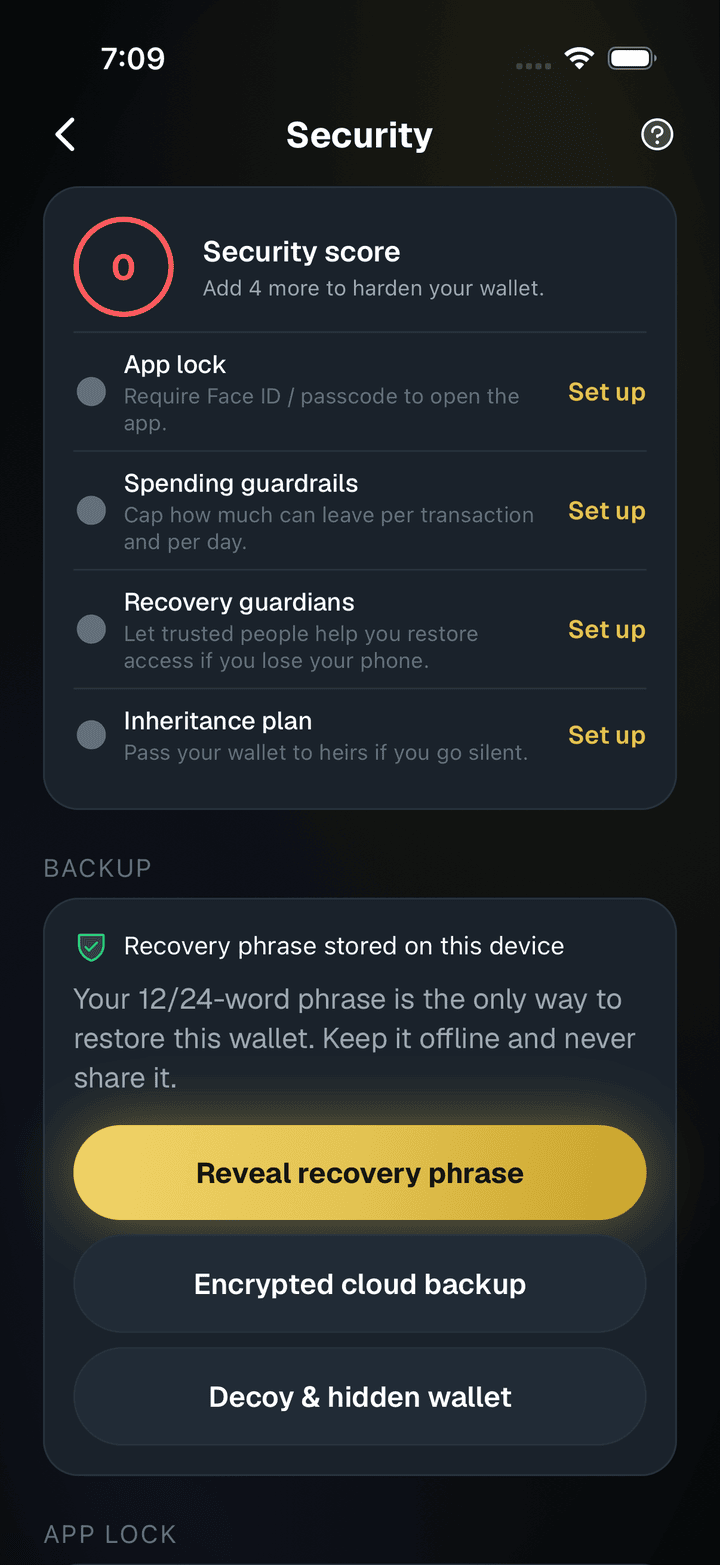
Open Security
Go to Settings, then Security, then Recovery phrase, and unlock with Face ID or your passcode. Write each word with its number.
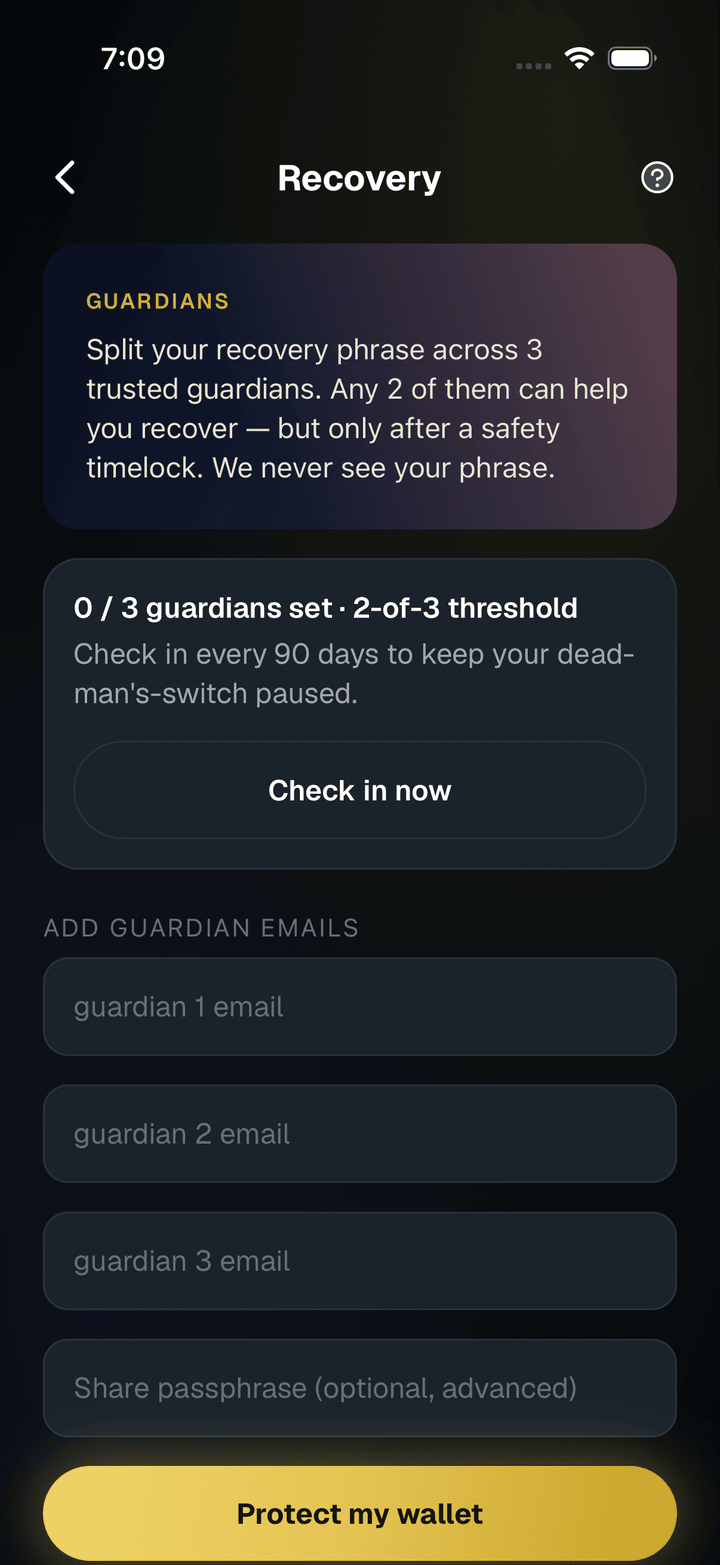
Add guardians
Social recovery splits your seed into guardian shares, so a set number of trusted people can help you back in.
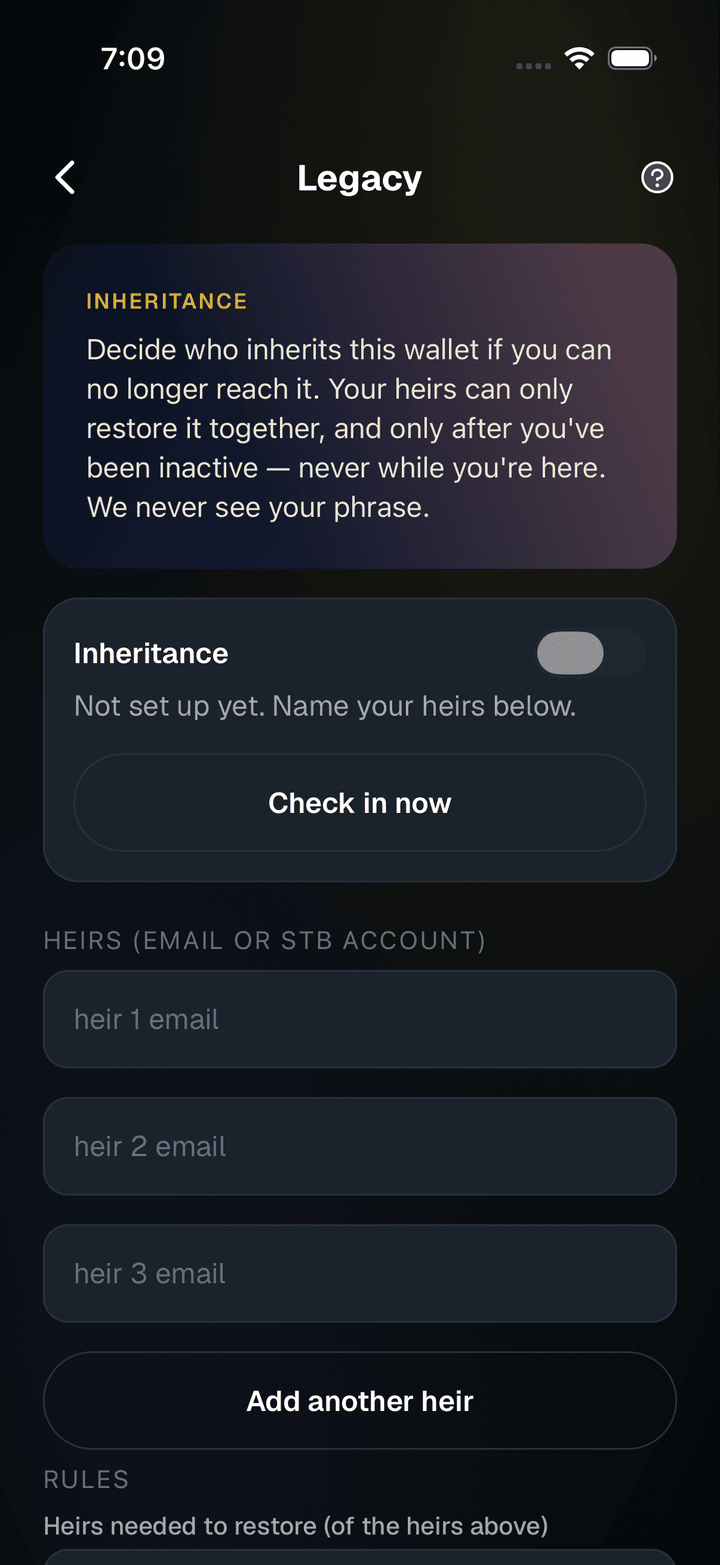
Plan for your heirs
Inheritance lets heirs claim only after a long silence, and a check-in from you cancels it.
Hold your own keys, keep the yield, skip the middleman.
SpendTheBits is a fully non-custodial wallet for 13 chains, free on iOS and Android.