
An account is a key, and the key is the power
Start with how an account works. On Ethereum, an externally-owned account is controlled by anyone with the private keys [3]. It is made of a pair of keys: a public one that makes your shareable address, and a private one you keep secret because it signs things [1]. Put simply, the account belongs to whoever can sign for it, and nobody else has a claim.
That leads to a line from ethereum.org worth reading twice. Your private key signs transactions, so it grants you custody over the funds tied to your account. You never really hold cryptocurrency, you hold private keys, and the funds always sit on Ethereum's ledger [3]. Your phone does not contain your money. It contains the means to sign for it. So custody has nothing to do with where coins are stored and everything to do with who can sign.
A wallet, then, is only a window. It is a tool that lets you interact with your account using your keys [1]. Ethereum's own guide says wallet providers do not have custody of your funds and only give you a view of your assets and tools to manage them [1]. That describes one model, the non-custodial one. The other model changes who holds the key, and that changes almost everything else.
Signing is the one act that matters, so it helps to see why it protects you. Keys help prove that a transaction was actually signed by the sender and prevent forgeries [3]. Whoever holds that secret holds the account.
What each model means in plain terms
In a custodial setup, a company holds the keys and gives you a username and password. Ethereum's guide notes that centralized exchanges link your wallet to a login you can recover in a traditional way, but you trust that exchange with custody over your funds [1]. Bitcoin.org says the same from the other side: when a third party controls your keys, you rely entirely on their security and honesty [4].
In a non-custodial wallet, you hold the keys yourself. Bitcoin.org describes wallets that give you full control, where no third party can freeze or take away your funds, though you remain responsible for securing and backing up your wallet [5]. That sentence holds the whole trade. You gain control and lose the safety net of a help desk.
Neither model is evil, and neither is free. Custodial convenience means a company can freeze, fail or be hacked. Self-custody means a mistake is yours to own. Ethereum's guide is blunt: there is no customer support in crypto, and you are responsible for keeping your keys safe and secure [1]. Knowing which model you use is the first act of safety. A good non-custodial wallet makes that duty manageable instead of scary.
A simple test places you in one model or the other. Ask who can move the funds if you vanish for a month. In a custodial setup, the company can, since you trust it with custody over your funds [1]. In a non-custodial setup, only the holder of the keys can. Bitcoin.org suggests keeping only small amounts on your computer or mobile device for everyday use and the rest in a safer environment [4]. That habit works under either model and costs nothing.
Scenario one: you lose your phone
Losing a phone is the most common disaster, so test each model against it. With a custodial service, you log in from a new device, reset your password the usual way, and your balance is there, because the company held the keys all along. That is a real advantage, and it is why many families start there.
With a non-custodial wallet, the phone was never the vault. Ethereum's guide notes that your account is not stored inside the wallet but on the blockchain, and that you can use the same address on multiple devices [2]. A new phone is just a new window onto the same account.
The risk runs both ways. If your backup is gone and the device is gone, nobody can help. Bitcoin.org warns that losing a device without a proper backup can make funds unrecoverable [5]. So the skill is planning for loss, not avoiding it. Our guide on how to back up your seed phrase covers safe places, and a short help page covers restoring your wallet on a new phone.
Scenario two: the company holding your crypto fails
Now the harder case. If a custodial company hits trouble, your claim is a claim on the company, not a key you control. Ethereum's guide says that if the exchange has financial trouble, your funds would be at risk [1]. Bitcoin.org goes further and says history has shown that exchanges and online wallets can be hacked, fail, or freeze access to funds [4].
The key point is that your balance on such a service is a record in their books. You asked them to hold the key, so when they cannot or will not honor that, you wait in line with other customers. A separate piece, what happens to your crypto when a platform collapses, covers how a collapse plays out for people holding funds there, and is worth reading before you decide how much to leave on any platform.
A non-custodial wallet removes that single point of failure. No company sits between you and your account, so none can fail with your funds inside. Other risks remain, and Bitcoin.org points to computer vulnerabilities and online thieves as threats a good setup must guard against [4]. But third-party failure is no longer one of them. For long-term holders, that is often the deciding difference, and it is why we keep a separate piece on custodial vs non-custodial wallets.
Scenario three: recovery, and why one backup is a weak plan
Recovery is where the two models feel most different. Custodial recovery is a customer service problem: prove who you are, reset the login. Non-custodial recovery is a key problem: there is no one to call. Bitcoin.org tells readers that, unlike their bank, there are very limited password recovery options with Bitcoin [4]. The same is true of a seed phrase.
So good practice is about removing single points of failure. It also raises multi-signature, where a transaction needs several independent approvals, and it asks readers to think about their testament, since bitcoins can be lost forever if no one knows where wallets or passwords are [4].
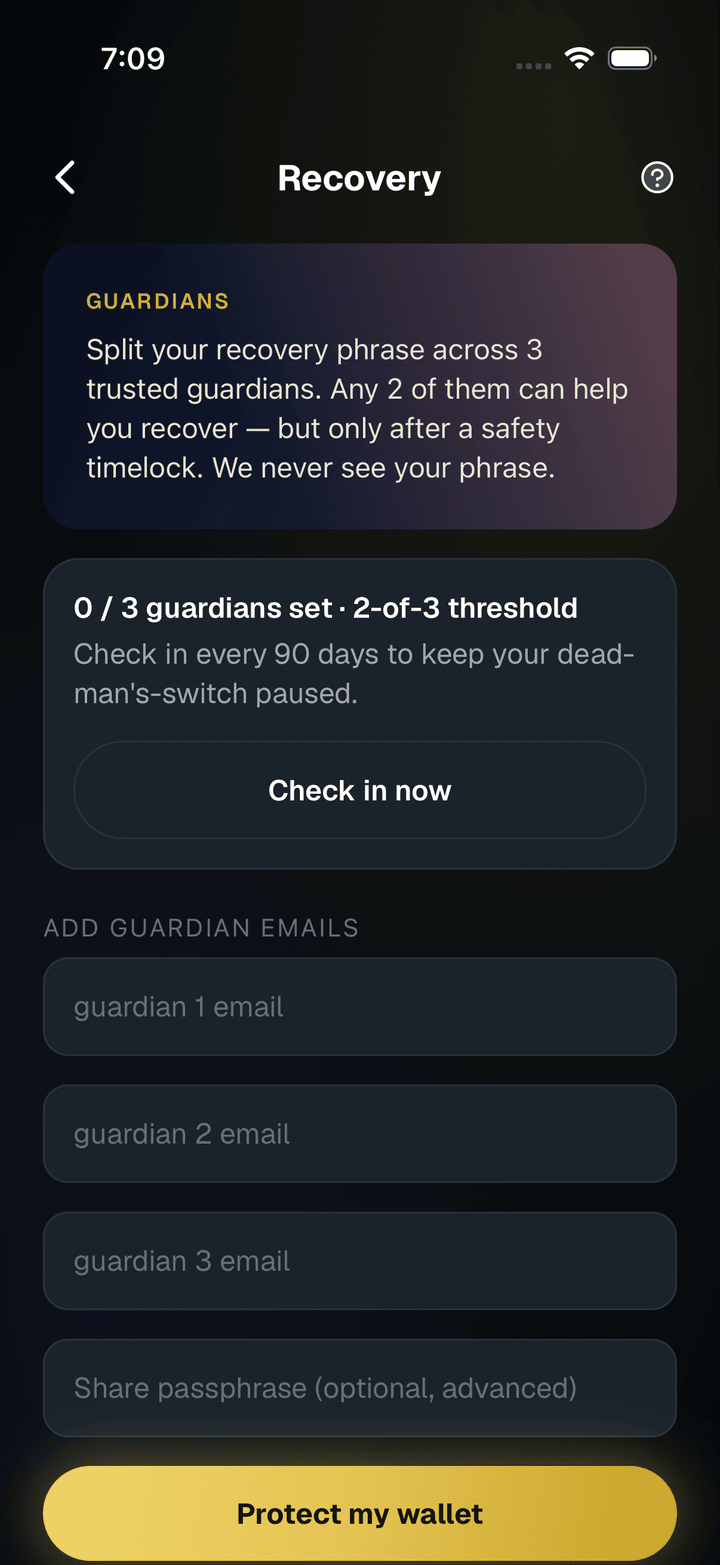
Recovery can be started by a guardian or by the owner, and the owner can cancel it. Inheritance works as a dead-man's switch: the owner checks in periodically, and heirs can claim only after a long silence. For the trade-offs, see social recovery vs a hardware wallet.
How SpendTheBits holds the line on custody
The seed phrase and private keys are generated and stored only on your device, and every transaction is signed there. The backend stores public data only, such as addresses and transaction hashes, prepares unsigned transaction context and relays device-signed transactions. It never sees a seed or private key and cannot move, freeze or reverse your funds.
That is a design choice, not a slogan. SpendTheBits is a self-custody wallet and it does not hold customer funds. The same logic covers the AI Copilot, which can prepare an action but cannot sign or send; the device signs only after you confirm. If you want the practical steps, our guide on how to self-custody stablecoins is the place to begin.
There is one honest limit. Because you hold the keys, anyone who gets your seed phrase can use it in another wallet. Freeze, a one-tap kill switch that blocks outgoing sends, cannot stop that. Control and responsibility arrive together, and a good wallet helps you carry both.
The same single seed shapes daily use. One seed derives wallets across many chains in SpendTheBits, and the wallet uses one EVM address, derived from that seed, on every EVM chain it supports. These checks help you act, and none takes control from you, because no company sits between you and the key.
In the app · 3 steps
Own your keys in SpendTheBits
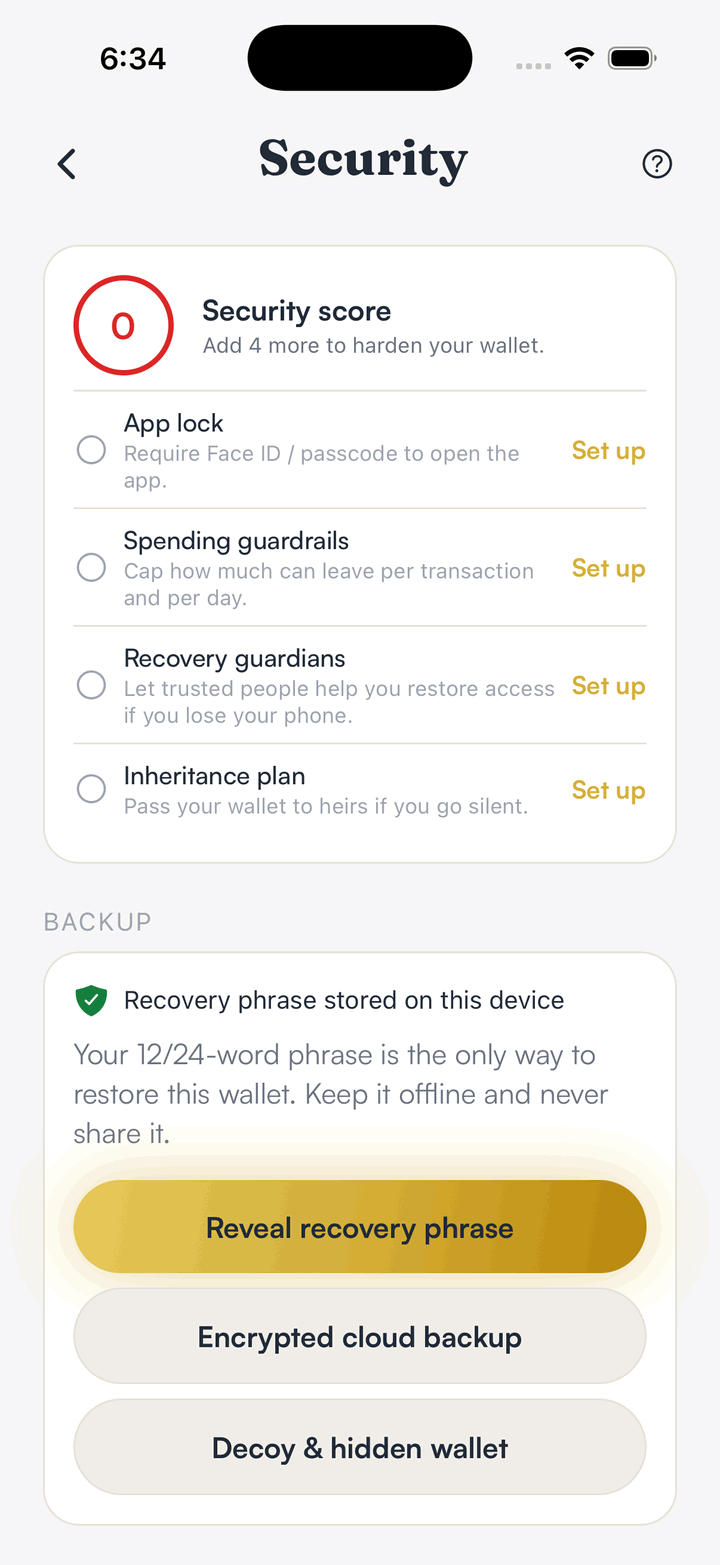
Your recovery phrase stays on your device. Back it up and plan for the day you lose the phone.
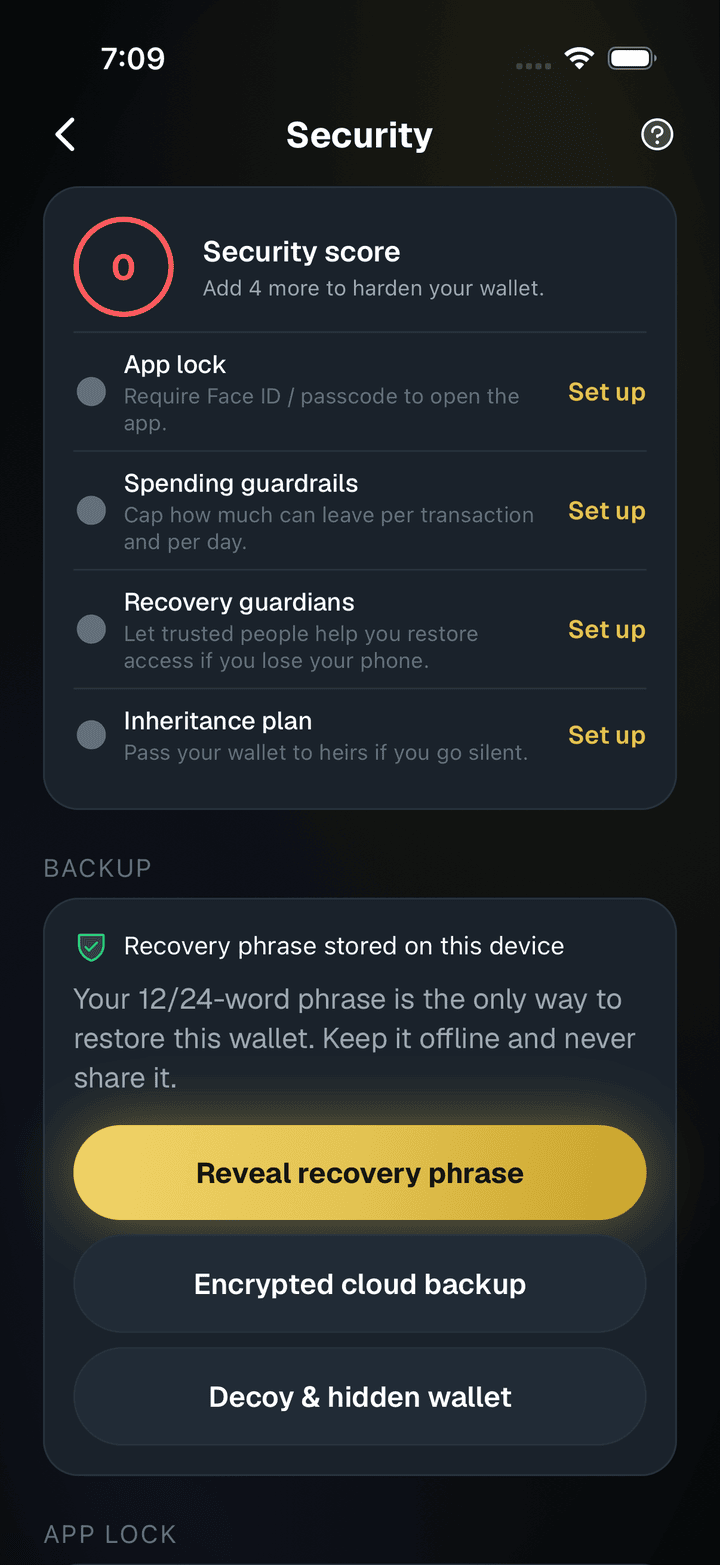
Back up your recovery phrase
Security shows the phrase is stored on this device and lets you reveal it to write down.
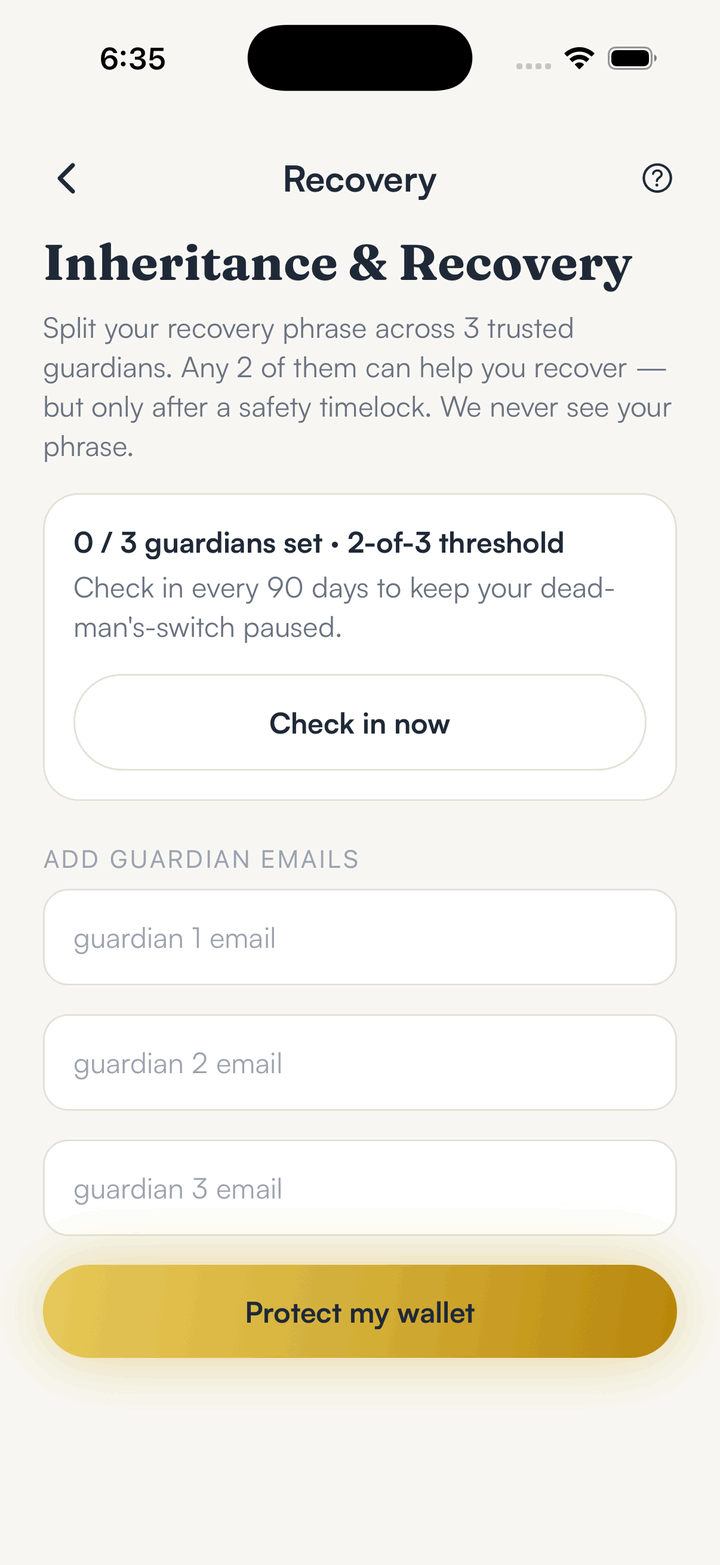
Add recovery guardians
Split recovery across trusted people so no single one can restore the wallet alone.
See every balance in one place
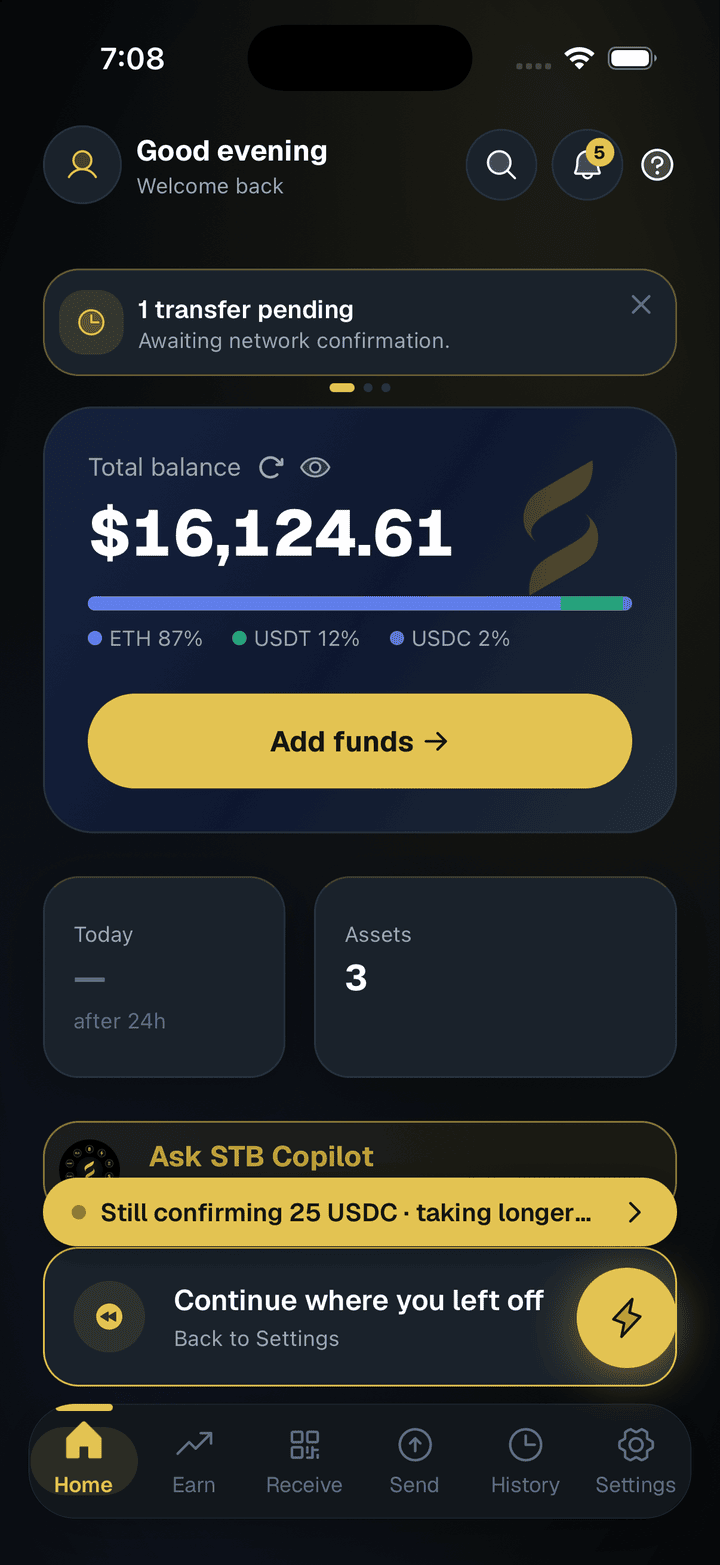
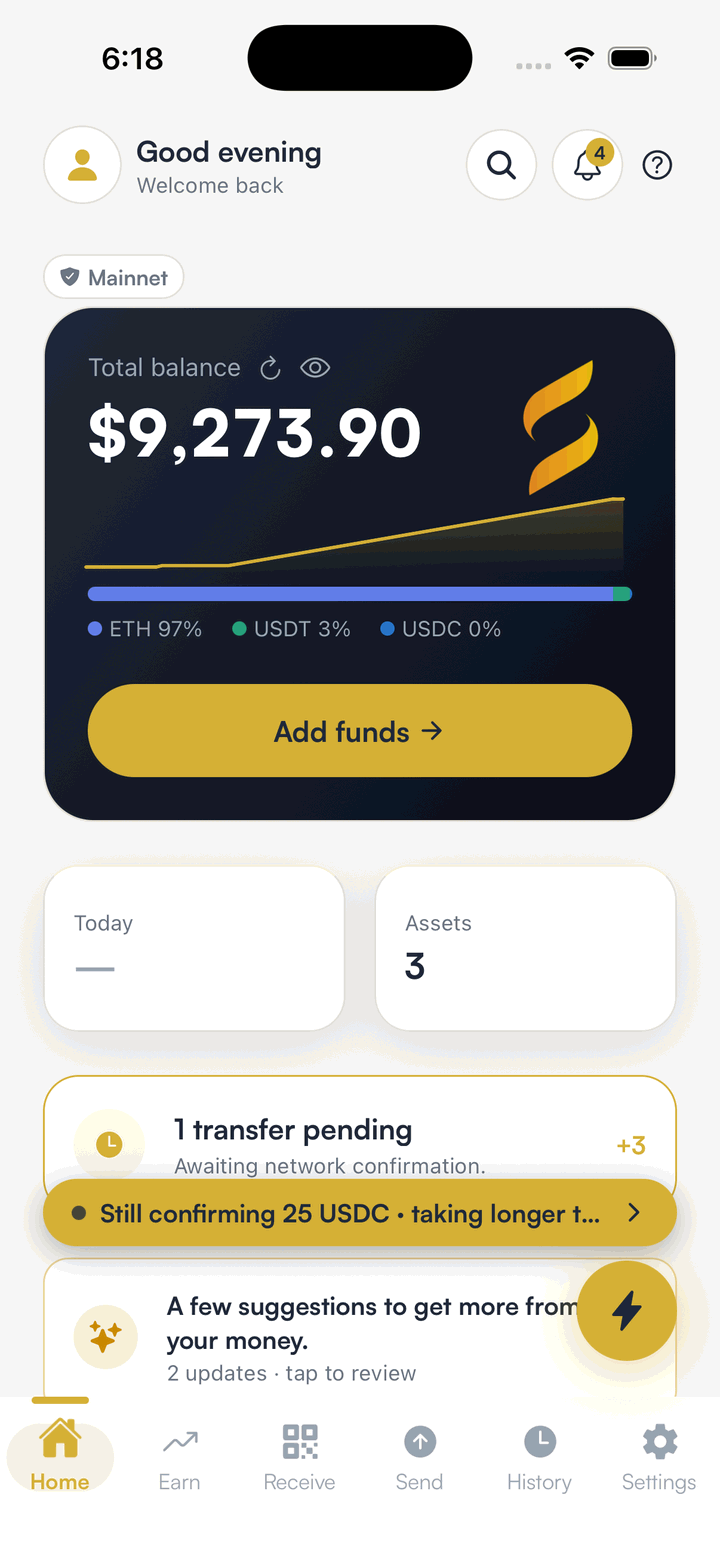
Home shows your total balance and how it splits across coins, including USDC and USDT.
Hold your own keys, keep the yield, skip the middleman.
SpendTheBits is a fully non-custodial wallet for 13 chains, free on iOS and Android.