

What the GENIUS Act is and who it covers
The bill was enrolled as a Senate bill. It carries a long name, the Guiding and Establishing National Innovation for U.S. Stablecoins Act, shortened to the GENIUS Act [1]. The White House fact sheet says President Trump signed it into law on 18 July 2025. It calls the act the first federal rule system for stablecoins [2]. A law firm tracker describes it the same way, as the first comprehensive federal framework for payment stablecoins [3].
The bill says it is a digital asset that is used, or made to be used, as a way to pay or settle. Its issuer must be bound to redeem it for a fixed amount of monetary value. It must also say that it will hold a stable value [1]. The definition leaves out national currency, bank deposits and securities.
The act says a payment stablecoin is a digital asset used or made for payment or settlement. Its issuer must redeem it for a fixed amount of monetary value [1]. It is built to be used for payments, and Circle states that it is always redeemable 1:1 for US dollars [5]. Here, the point is narrower: the GENIUS Act is about the instrument and the company behind it.
Who may issue: the permitted issuer rules
The act says a permitted payment stablecoin issuer is a person formed in the United States. It must be a subsidiary of an insured bank, a Federal qualified issuer, or a State qualified issuer [1]. It says a permitted payment stablecoin issuer is a person formed in the United States who fits one of three groups [1]. The first is a subsidiary of an insured depository institution that has been approved to issue. The second is a federal qualified issuer. The third is a state qualified issuer [1].
A federal qualified issuer can be a nonbank firm the Comptroller approves, an uninsured national bank, or a federal branch [1]. A state qualified issuer is a firm set up under state law and approved by a state payment stablecoin regulator [1]. The law firm tracker calls this a dual federal and state chartering and supervisory regime. It adds that federal regulators watch over issuers with a federal charter. State issuers can qualify if they meet rules of equal strength [3].
The bill also names a foreign payment stablecoin issuer. That means one organized or based outside the United States that is not a permitted issuer [1]. For a holder, the practical meaning is simple. The label permitted issuer tells you a regulator approved the firm. That is not the same as a promise that nothing can go wrong.
Reserves, disclosures and what happens if an issuer fails
The reserve rule is the part most holders care about. The White House fact sheet says the act requires 100% reserve backing with liquid assets such as US dollars or short-term Treasuries [2]. It also requires issuers to make monthly public disclosures of what the reserves contain [2]. Those two ideas, full backing and regular disclosure, are the core of the consumer protection case for the law.
The fact sheet adds a priority rule for bad days. If a stablecoin issuer fails, the act puts the claims of holders ahead of all other creditors. It calls this a final backstop [2]. Marketing is covered too. Issuers may not claim that a stablecoin is backed by the US government, federally insured, or legal tender [2]. That last point matters, because a stablecoin balance is not a bank deposit, and the law says so out loud.
For comparison, Circle publishes a reserve breakdown for USDC, shown as of Oct 15, 2026 [5]. It says USDC is fully backed by cash and cash-equivalent assets. It also says a Big Four firm gives monthly assurance that reserves exceed USDC in circulation [5]. So the law writes down a standard that large issuers were already trying to meet. Reading those disclosures is a habit worth keeping, whatever the statute says.
Anti-money-laundering duties and the power to freeze
The act also pulls issuers into the Bank Secrecy Act. The fact sheet says this obligates them to run effective anti-money-laundering and sanctions programs. Those programs need risk assessments, sanctions list checks and customer identification [2]. It adds that all issuers must have the tech to seize, freeze or burn payment stablecoins when the law calls for it. They must also follow lawful orders to do so [2].
The bill itself defines a lawful order as a final and valid requirement. A court or an authorized federal agency issues it. It tells a person to seize, freeze, burn or block transfer of the stablecoins it issued. The order must name the coins or accounts with fair detail. It can still be reviewed or appealed [1]. So the freeze power attaches to the issuer and to legal process, not to a wallet app.
This is worth understanding as a holder. The act says a lawful order is one that tells a person to seize, freeze, burn, or block the transfer of payment stablecoins that person issued [1]. A self-custody wallet does not change that rule, because the freeze power sits in the token itself. What the wallet does control is your keys, your signing and who you send to, and our guide to self-custody covers that side.
Where the rules stand now: implementation by the regulators
Signing a statute is only the first step. A law firm resource center tracking the act says federal regulators have since moved to put it into practice. They have done so through a series of proposed rules on capital, reserve and operational needs [3]. It also lists several from the Treasury [3].
The Treasury items include a proposed rule on anti-money-laundering and sanctions programs for issuers. Another asks whether a state regime is substantially similar to the federal framework [3]. The same tracker lists an advisory dated October 8, 2026 on a Federal Reserve plan to govern payment stablecoin issuance [3]. The FDIC's own press releases back up part of this. The FDIC lists a press release dated Apr 7, 2026 on a plan to put GENIUS Act rules in place. It also lists one dated May 22, 2026 on Bank Secrecy Act and sanctions rules for permitted payment stablecoin issuers [4].
The takeaway is that the framework is still being filled in. These are proposals, and details can change before final rules arrive. We will not guess at final text or effective dates. If you rely on a certain rule, check the agency's own site. Talk to a lawyer about anything that touches your case.
What the law does not do for a holder, and where SpendTheBits fits
Here is the honest split. The GENIUS Act does set reserve and disclosure standards. It ranks holders ahead of other creditors if an issuer fails. It also requires anti-money-laundering programs [2]. It does not make your balance insured, since issuers are forbidden from claiming federal insurance [2]. It also does not guard against the risks that sit with you. These are a phished approval, a wrong address, a lost seed phrase or a fake token.
One more detail concerns software. The bill's term for a digital asset service provider leaves out the work of building or running self-custodial software interfaces. That carve-out is about how the law treats such software. It is not a statement about any particular product, and it is not legal advice.
SpendTheBits is a self-custody wallet, not a stablecoin issuer and not an exchange. It holds USDC and USDT for you on your own device, and it never holds customer funds. The seed phrase and keys stay on the phone, and the backend cannot move, freeze or reverse your funds. Before each send, the app checks the risk of the recipient. It also sets aside unknown inbound tokens so a fake one cannot pass as a real balance. For the difference between native and bridged coins, see our explainer on native versus bridged USDC. For the wider picture, our overview of custodial versus non-custodial wallets is a good next stop.
In the app · 3 steps
Hold stablecoins in a self-custody wallet
The law governs issuers. In your own wallet, you hold the keys to the coins they issue.
See every balance in one place
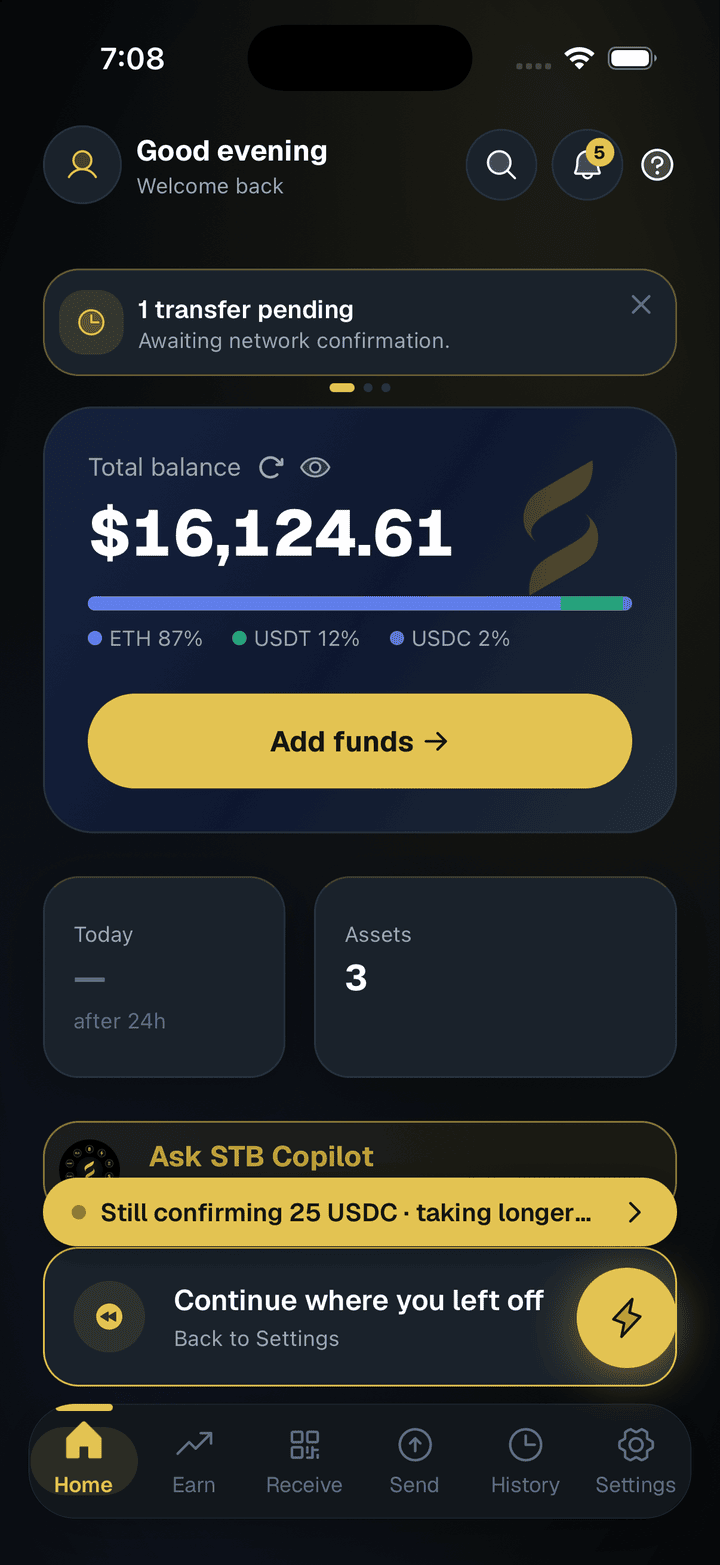
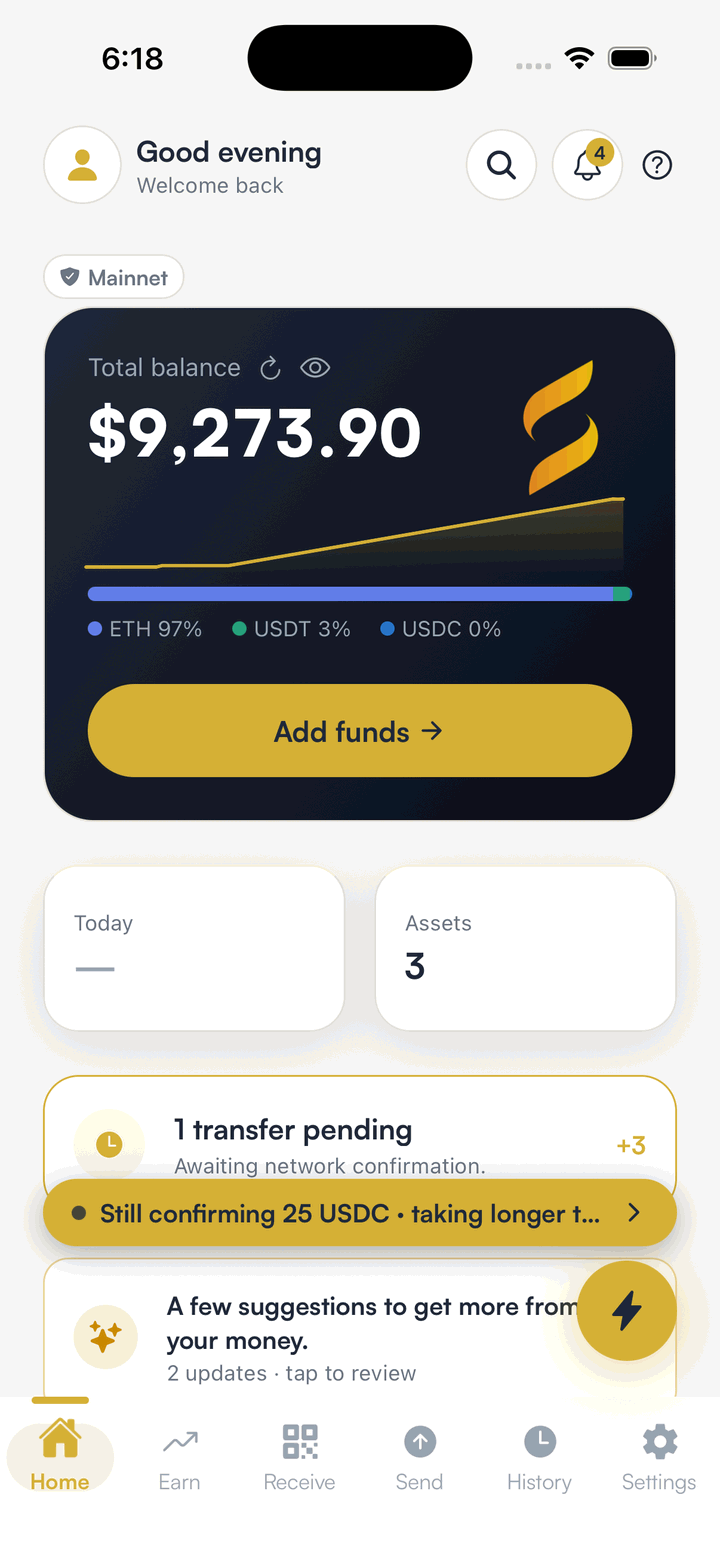
Home shows your total balance and how it splits across coins, including USDC and USDT.
See each holding
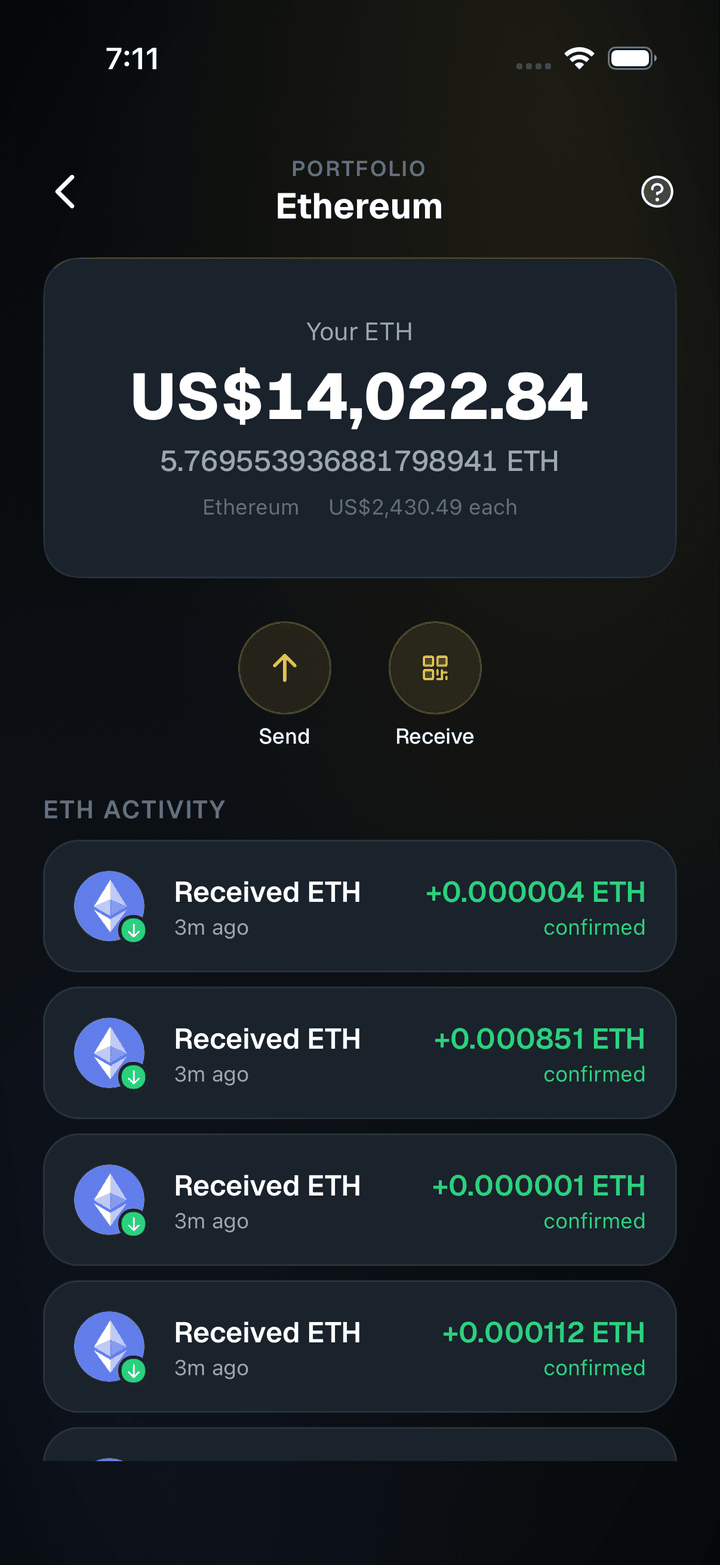
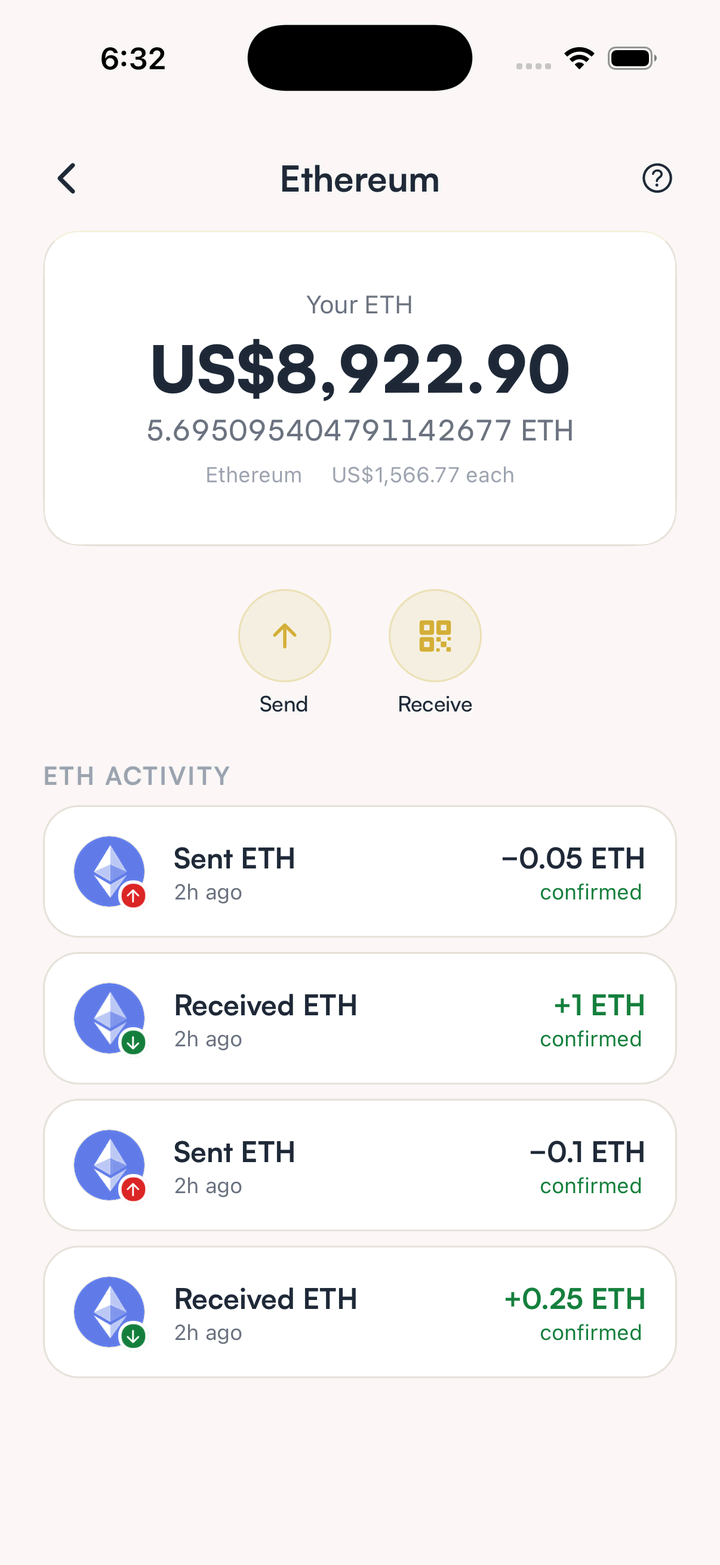
Open a coin to see its balance and history.
Keep your backup current
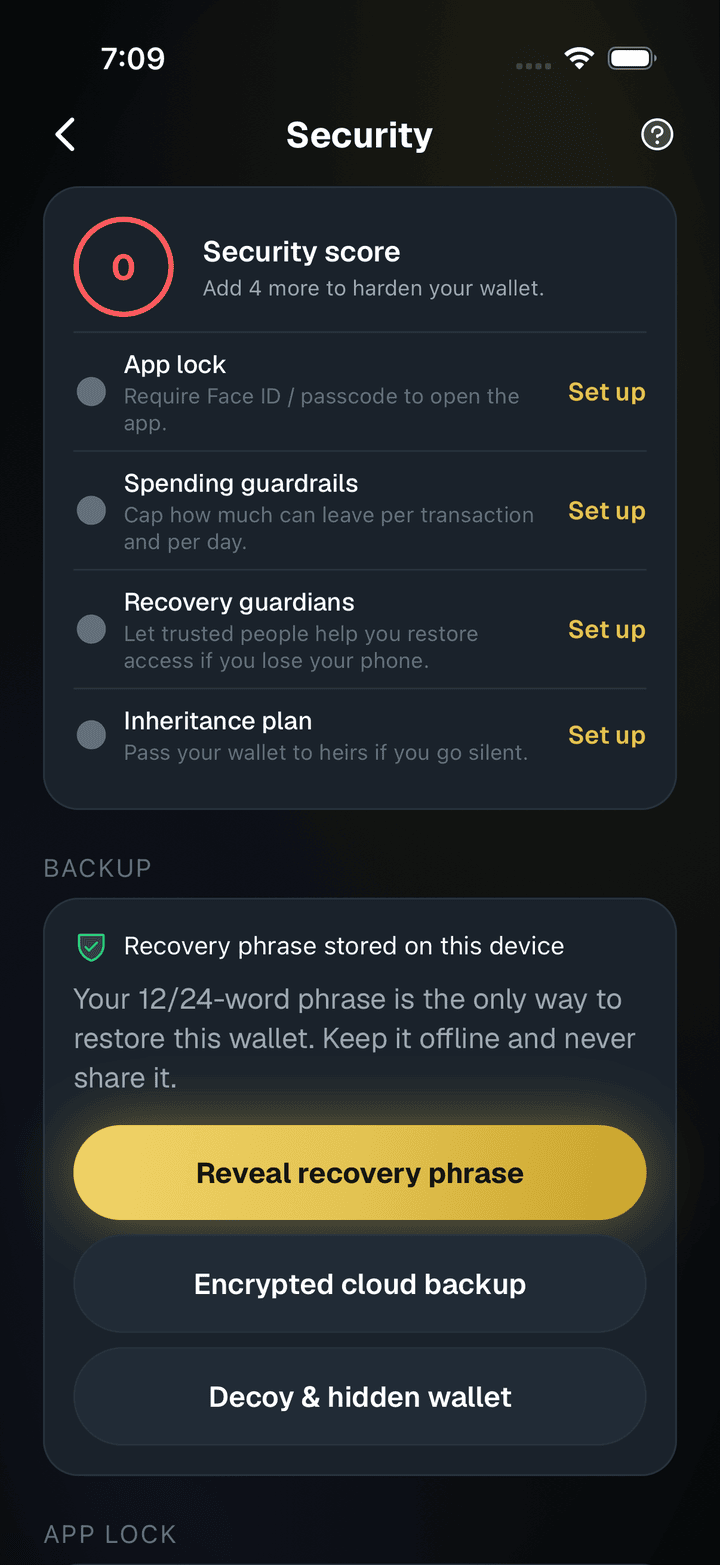
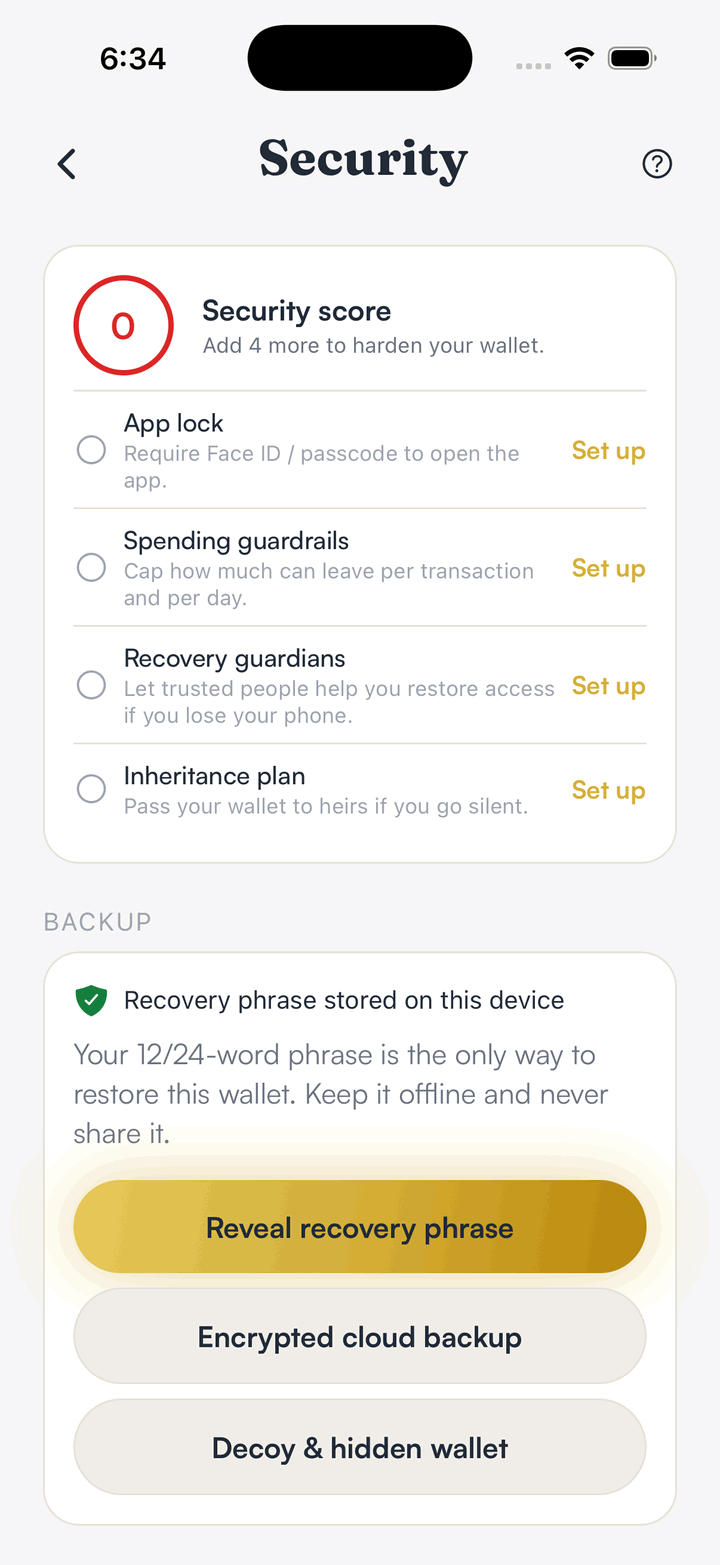
Your recovery phrase is the only way to restore the wallet.
Hold your own keys, keep the yield, skip the middleman.
SpendTheBits is a fully non-custodial wallet for 13 chains, free on iOS and Android.