
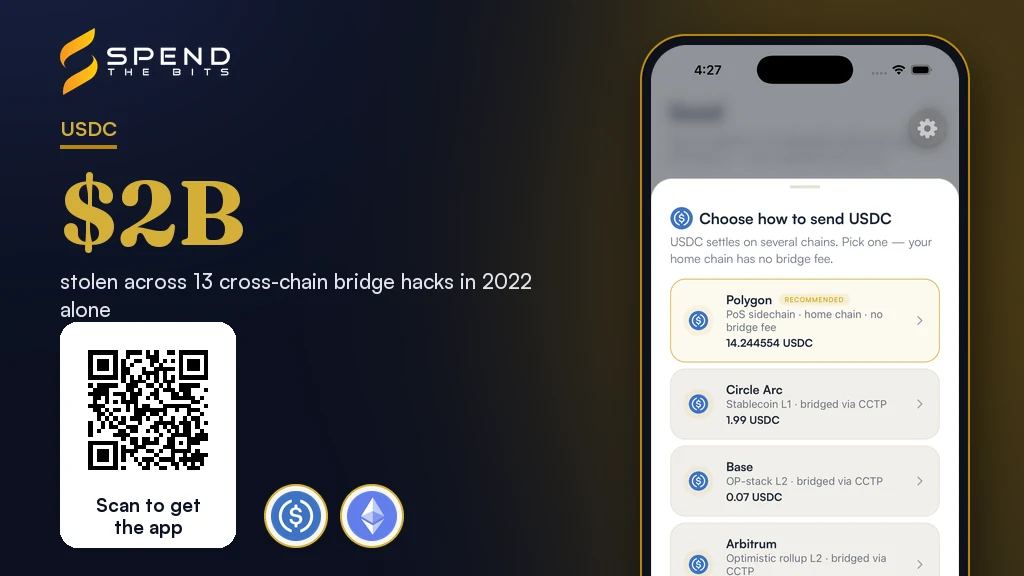
Bridged USDC is an IOU, not a dollar
A bridged token is created by a lock-and-mint bridge. You send real USDC to a contract on chain A. The bridge locks it there. A second contract on chain B then mints a wrapped token, commonly called USDC.e, and hands it to you. The wrapped token has no reserve of its own. It is a receipt for the USDC sitting in the lockbox on chain A.
Circle draws the line the same way. In its own words, bridged USDC is "created by a third party" and "backed by USDC on another blockchain locked in a smart contract", while native USDC is "issued by Circle" and "backed by US dollars and always redeemable 1:1" [8]. That is the entire native vs bridged USDC distinction in two sentences: who controls the mint function, and what sits behind the token.
For a treasury the native vs bridged USDC split matters because the wrapped token inherits every weakness of the bridge. If the lockbox is drained, every USDC.e in circulation is a claim on funds that no longer exist. The token keeps its name, its logo and its price feed until the moment liquidity providers notice. Native USDC has no such dependency. Its backing is Circle's reserve, not a contract.
The lockbox is the target: Ronin, Wormhole and Nomad
Chainalysis published the clearest explanation of why bridges get hacked. Bridges "often feature a central storage point of funds that back the 'bridged' assets on the receiving blockchain", and that storage point is the prize whatever the technique used to reach it [3]. By August 2022 that pattern had produced 13 separate bridge hacks worth about $2 billion, or 69% of everything stolen in crypto that year to that date [3]. Chainalysis's full-year report put 2022 at $3.8 billion stolen, with bridge protocols supplying 64% of the DeFi share [4].
The Ronin bridge behind Axie Infinity lost roughly $625 million, made up of 173,600 ether and $25.5 million in USDC, drained on March 23, 2022 and not noticed until March 29 [5]. The attackers used compromised validator private keys to forge withdrawals from the bridge contract [5]. Nobody broke the ether or the USDC. They broke the box the assets were locked in.
Wormhole, the bridge between Solana and Ethereum, lost about $320 million on February 3, 2022 [6]. The attacker found a smart contract flaw that let them mint 120,000 wrapped ether on Solana without posting the ether collateral that should have backed it [6]. That is the wrapped-token failure mode in its purest form: the receipt printed without the deposit.
Nomad lost over $190 million on August 1, 2022 after an upgrade set its trusted root to zero, which happened to match the value for an untrusted message, so every message was treated as already proven [7]. Once one person noticed, others copied the transaction with their own address and joined in [7]. Three different bugs, one shared lesson: a pool of locked collateral is a single point of failure, however it is guarded.
How CCTP burns and mints instead of locking
Circle's Cross-Chain Transfer Protocol takes the lockbox out of the design. When you move USDC with CCTP, the protocol burns your USDC on the source chain. Circle's attestation service, named Iris, observes the burn and signs an attestation. That signed attestation is then presented on the destination chain, where Circle's contract mints the same amount of native USDC [1].
Nothing is locked anywhere. The supply on chain A goes down, the supply on chain B goes up, and both tokens are Circle-issued, one-for-one redeemable USDC [1]. There is no wrapped receipt and no pool of collateral for an attacker to empty. The trust you are extending is the same trust you already extend by holding USDC at all: that Circle's reserve is real and its contracts are sound.
The second version of CCTP adds a choice of speed. Fast Transfer settles in roughly 8 to 20 seconds [1]. Standard Transfer waits for full source-chain finality, which Circle puts at 15 to 19 minutes on Ethereum and its layer twos, in return for a lower cost [1]. Either way what arrives is native USDC. Speed changes the wait, not the asset.
How to tell native from bridged in two minutes
The reliable test is the contract address, not the ticker. Circle publishes an official list of native USDC contract addresses for every chain it supports, mainnet and testnet [2]. Open the token in your block explorer, copy its contract address, and check it against that list. If it matches, you hold native USDC. If it does not, you hold something a third party issued.
Some clues help before you get that far. A ".e" suffix on the symbol almost always marks a bridged token. Circle's own address page notes that X Layer "also has a separate bridged USDC representation, labeled USDC.e, which is not issued or backed by Circle" and tells integrators to use the native address instead [2]. A token whose explorer page names a bridge as the contract deployer, rather than Circle, is another flag.
One wrinkle in the native vs bridged USDC story is that a bridged token can become native. Circle's Bridged USDC Standard lets a chain deploy bridged USDC in a form Circle can later take ownership of and upgrade in place, keeping the same address, supply and holders [8]. Linea was the first chain to make that switch, on March 26, 2025, and its mainnet address did not change [9]. So a token that was an IOU last year may be Circle-issued today. Check the current list, not your memory.
What SpendTheBits does with your USDC
SpendTheBits only bridges native USDC, and only through CCTP. When you move USDC between chains in the app, your device signs the burn transaction; the backend never holds a key and never holds your funds. The transfer then settles through Circle's attestation, and what lands on the destination chain is native, Circle-issued USDC at the official contract address. The integrator fee is shown up front before you sign. The step-by-step is in how to bridge USDC between chains.
Because the app moves the same asset between networks at one-for-one with no price and no counterparty, this is a bridge, not a market transaction. There is no price feed and no market maker in the path. The device signs a burn; Circle mints the mirror. That is also why our aggregated USDC balance can be shown as one number across every chain we support: every unit in it is the same liability of the same issuer. The full chain list is in which chains and tokens are supported.
The other half of the defence is on the way in. Tokens that arrive from contracts we have not verified are quarantined and flagged rather than counted as balance. A wrapped or fake token airdropped to your address with the USDC name cannot impersonate real money in your wallet. Details are in how to spot a fake token or scam transfer, and the wider model is on our security page.
A treasury checklist for founders
First, inventory what you hold. For every chain, pull the contract address of the token labelled USDC and match it to Circle's list [2]. Anything that does not match goes in a separate line on the balance sheet, because it is a different credit exposure with a different failure mode.
Second, decide your tolerance. Bridged USDC is not always wrong. It may be the only form available on a chain you need, and Circle's upgrade path means some deployments will become native over time [8]. But size the position like a claim on a bridge, because that is what it is, and remember that price parity says nothing about backing until the day it does.
Third, move with burn-and-mint. If you need USDC on another chain, a CCTP route lands native USDC and leaves no lockbox behind [1]. The founders and treasuries page covers the wider treasury workflow, and how to self-custody stablecoins covers the custody side. The native vs bridged USDC question is not a technicality. It is the difference between one issuer risk and two.
In the app · 4 steps
Move native USDC across chains in SpendTheBits
Two ways to use CCTP in the app: move your own balance, or pay someone on another chain and let the app route it.
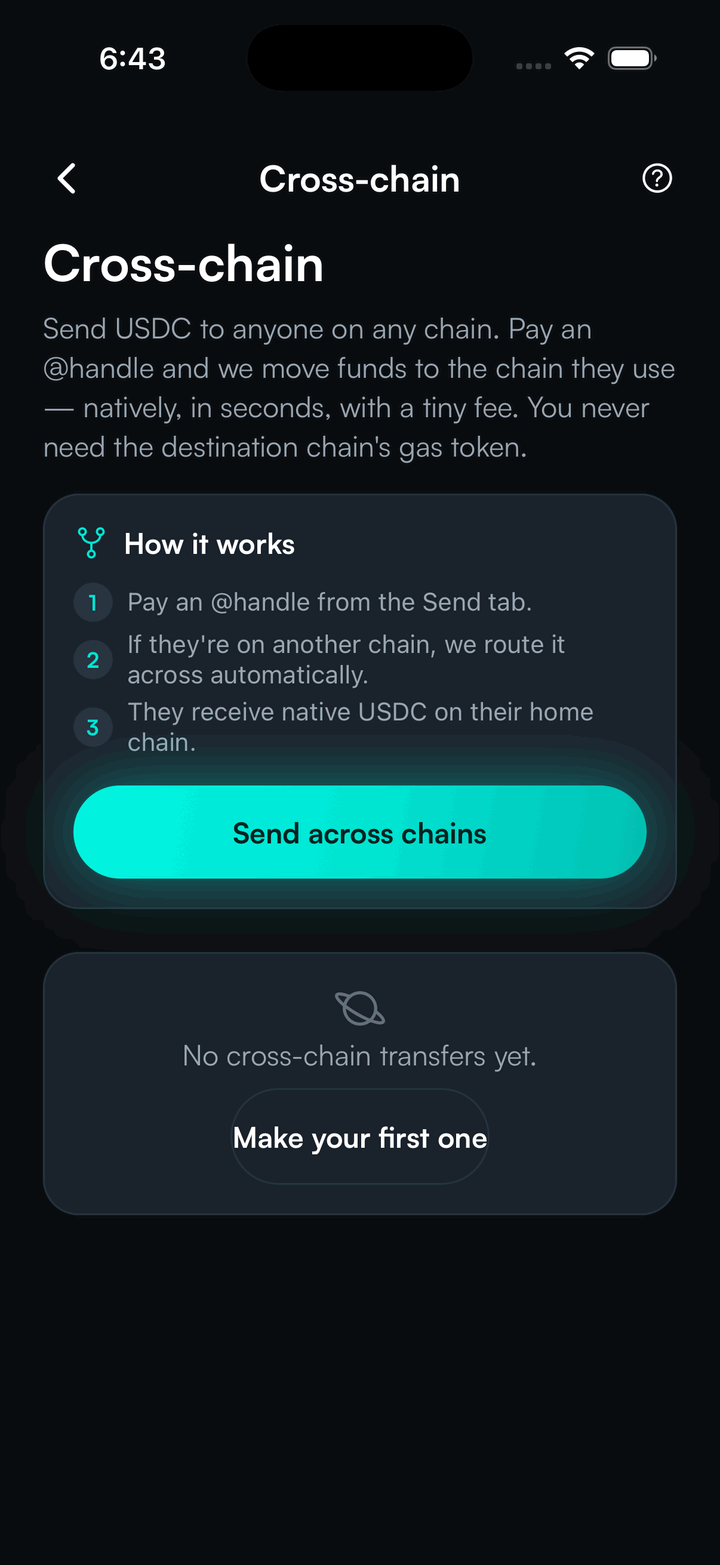
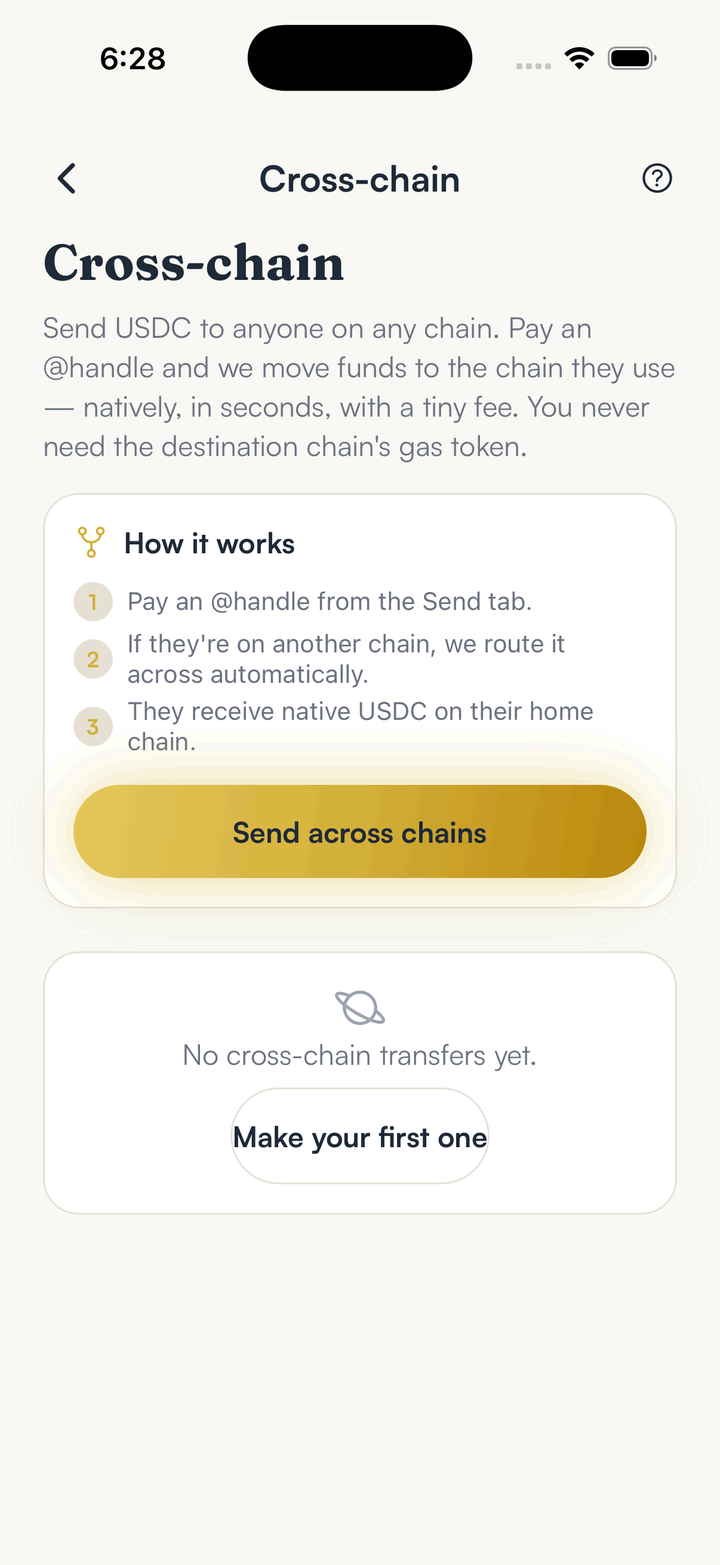
Open Cross-chain
It explains the route before you start: you pay an @handle, the app moves the funds to the chain the recipient uses, and they receive native USDC.
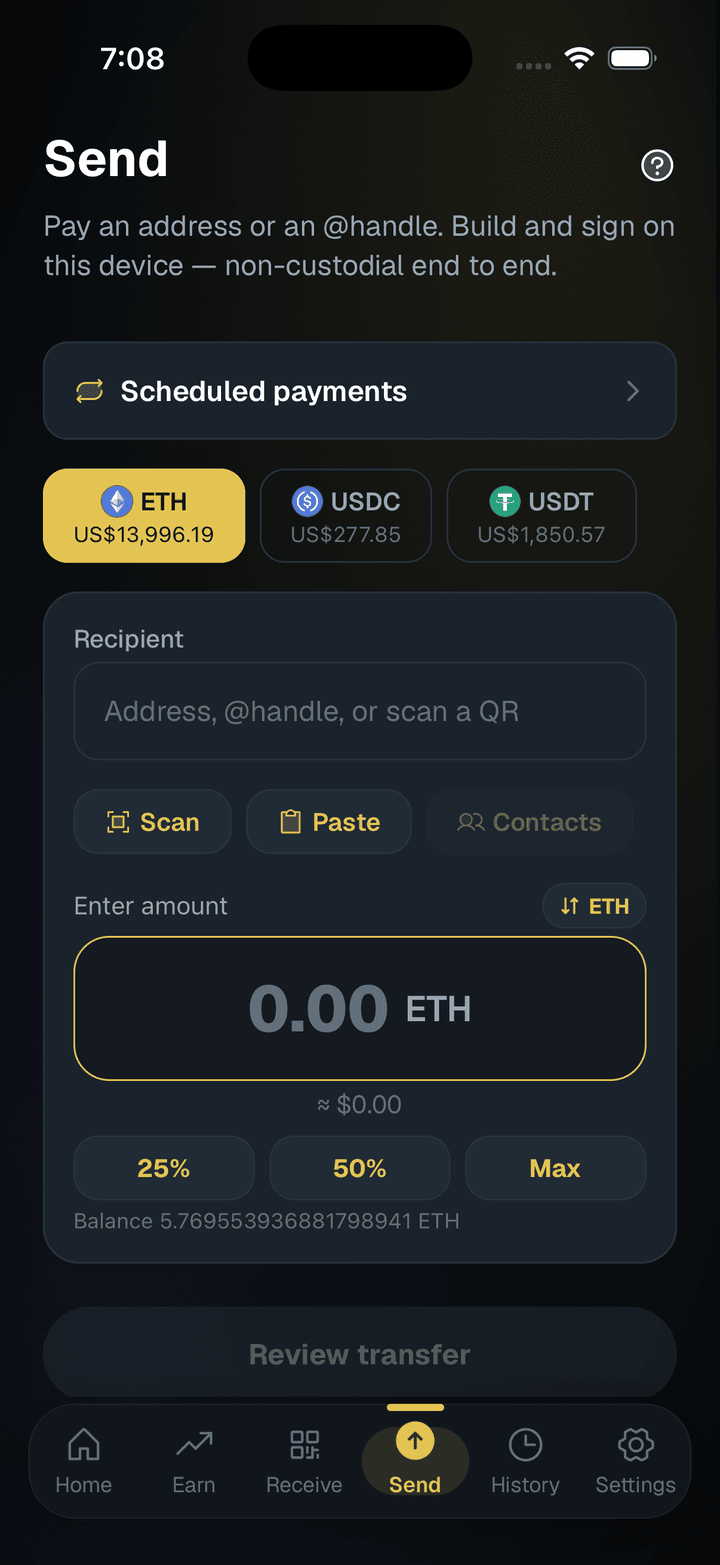
Or pay an @handle from Send
Choose USDC and type the recipient's @handle. If they are on another chain, the route is worked out for you and shown on the review sheet.
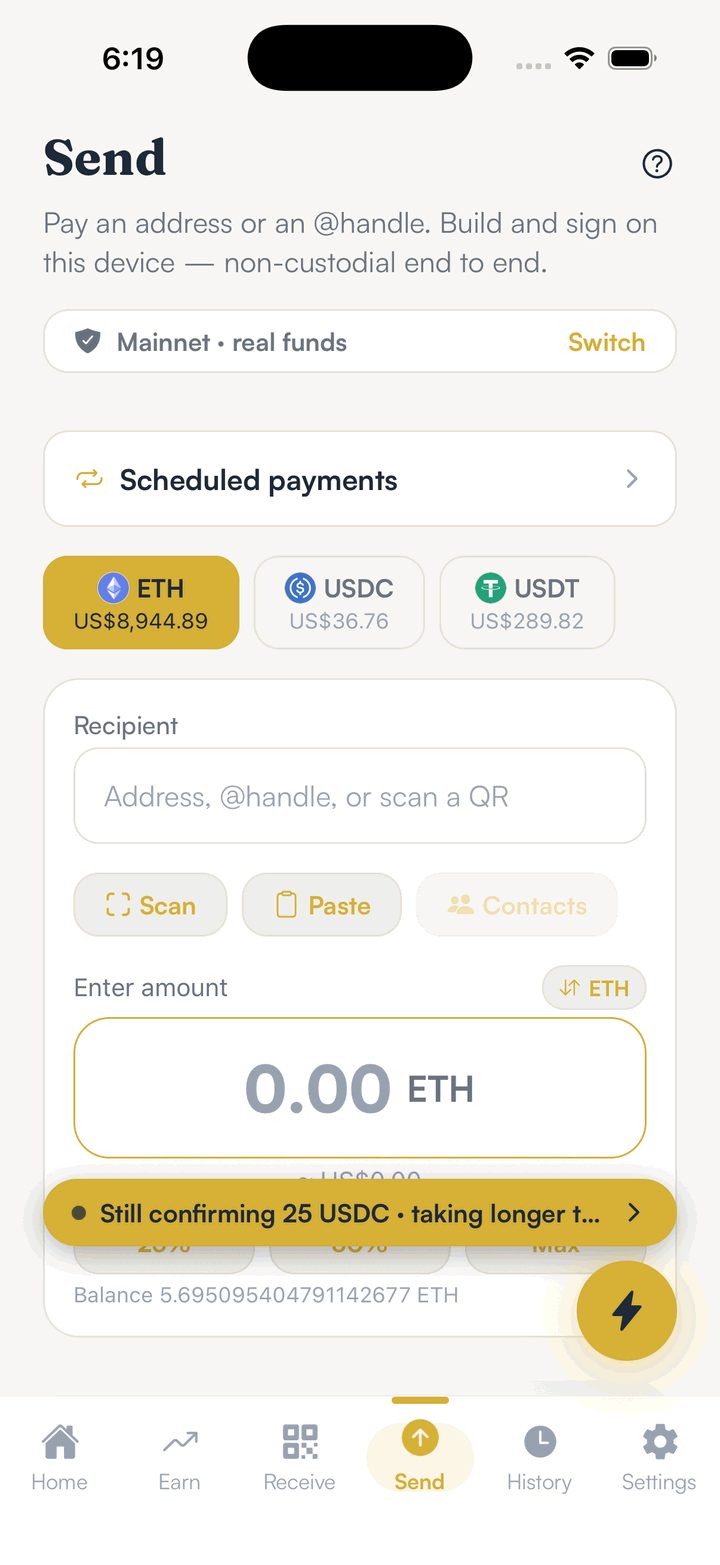
Review the quote and sign the burn
The quote includes gas on both sides and a service fee under 1%, shown before you sign. The burn is signed on your phone.
Follow it to the mint
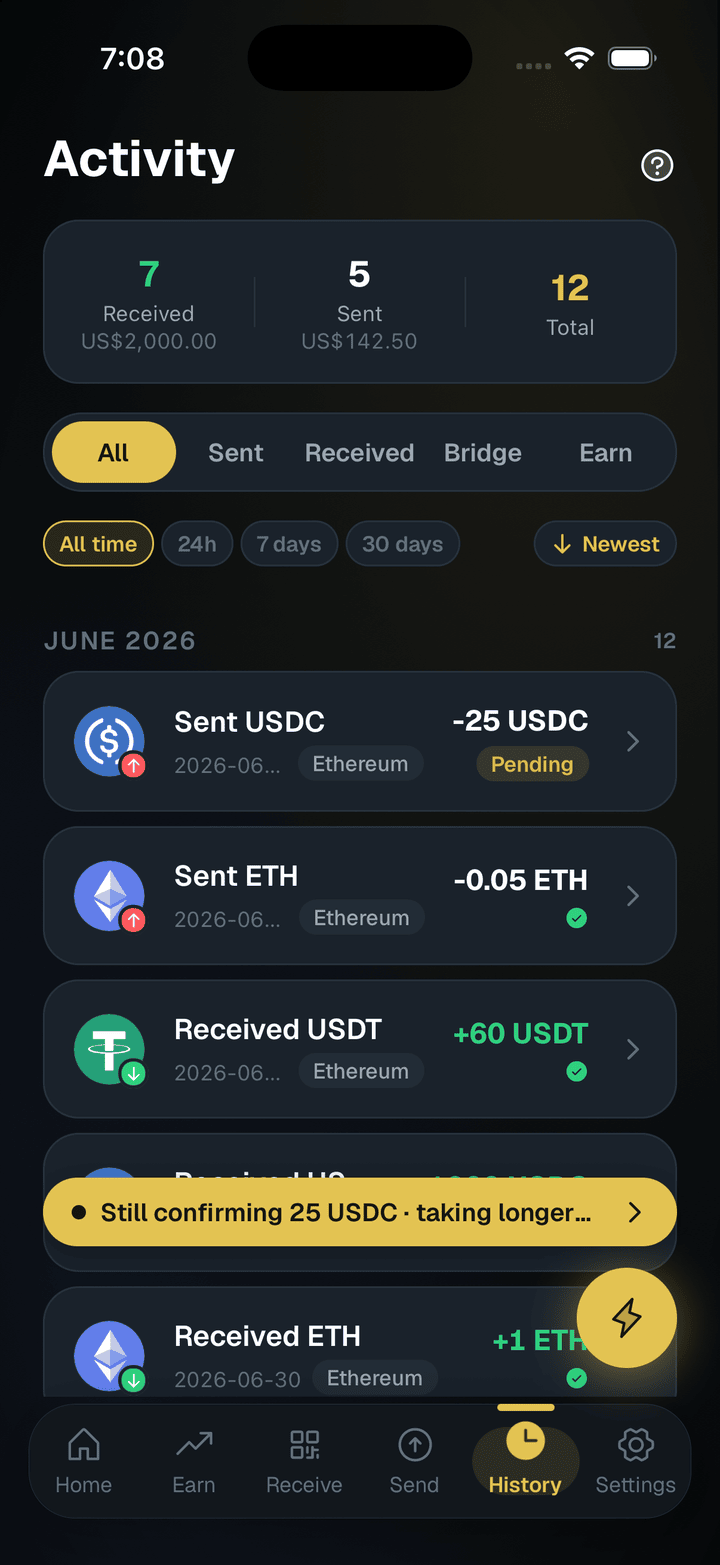
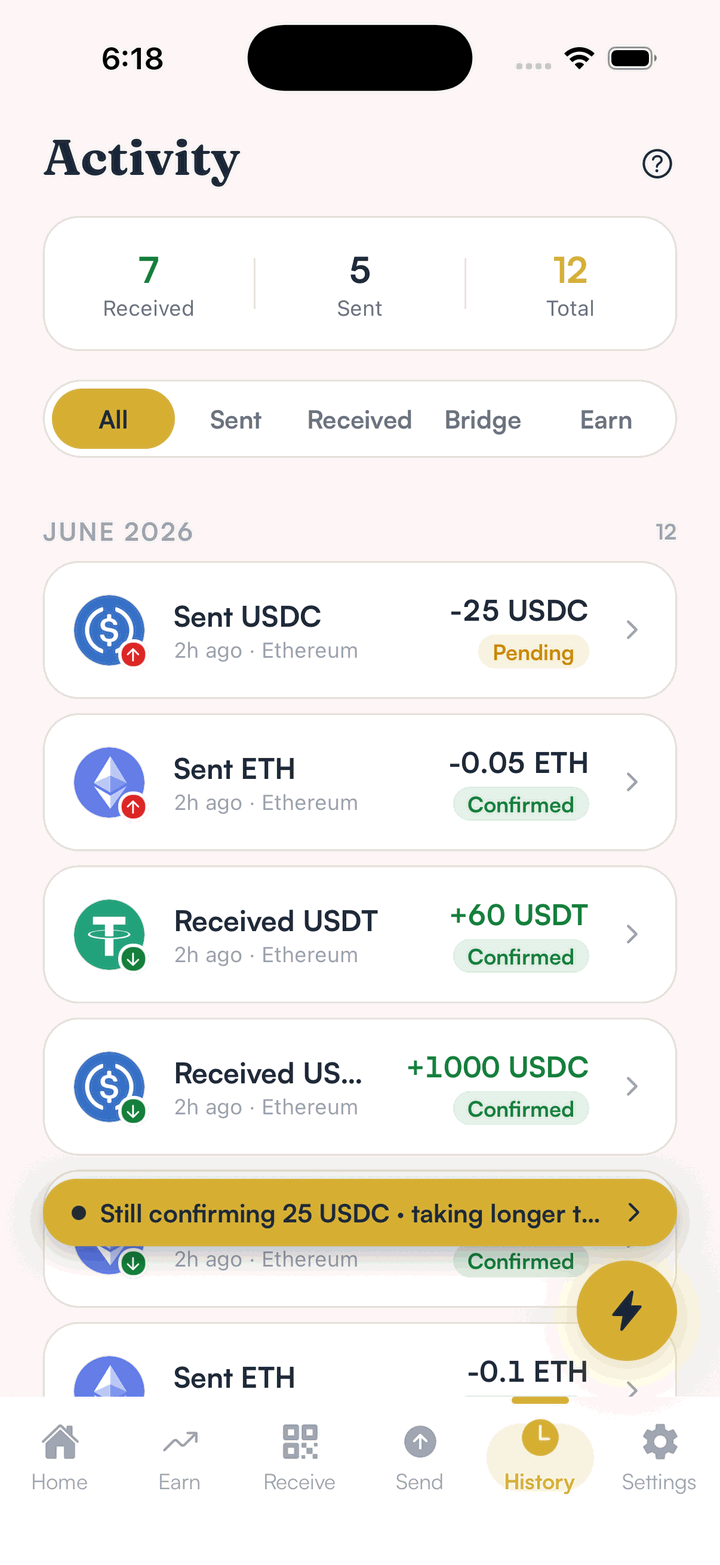
The transfer moves through Circle's attestation to the mint on the destination chain. Track it under the Bridge filter in Activity.
Hold your own keys, keep the yield, skip the middleman.
SpendTheBits is a fully non-custodial wallet for 13 chains, free on iOS and Android.