
From words to a seed, and from a seed to a tree
The first standard is BIP-39. It describes how a wallet makes random data, between 128 and 256 bits of it, and writes that data as a list of words with a built-in checksum [1]. Those are the words you back up.
The words are not used as keys directly. BIP-39 runs them through a function called PBKDF2, with the iteration count set to 2048 and the string "mnemonic" plus an optional passphrase as the salt [1]. The output is the seed. If there is no passphrase, an empty one is used [1].
This step matters for two reasons. First, it makes guessing slower, because each guess has to repeat that work. Second, the passphrase changes the seed completely. The same words with a different passphrase give a different seed and a whole different set of addresses.
The second standard is BIP-32. It describes a system for deriving a tree of key pairs from a single seed [2]. The seed is the root. Each branch can split again, and every key in the tree can be rebuilt from the root and the path to it.
This is what makes a single backup enough. BIP-32 notes that deterministic wallets do not require frequent backups [2]. Older wallets created fresh random keys as they went, so a backup from last month could miss keys made today. A tree has no such gap. Every future key is already implied by the seed.
BIP-32 has two kinds of branches. Hardened ones can only be derived with the private key. Normal ones can also be derived from a public key, which is useful for watching balances. The standard warns that a parent's extended public key plus any normal child private key is equivalent to knowing the parent's private key [2]. That is one reason the top levels of a wallet's path are hardened.
A map for every chain: BIP-44 and coin types
A tree is only useful if every wallet agrees where to look. BIP-44 gives that map. Its path has five levels: m / purpose' / coin_type' / account' / change / address_index [3]. The apostrophe means hardened derivation [3], and purpose is fixed at 44' [3].
The coin type is the key to multichain wallets. BIP-44 says it is a constant set for each cryptocoin, so each coin gets its own branch [3]. The registry of those numbers lives in a separate document, SLIP-44 [3]. There, Bitcoin is 0, Litecoin is 2, Ethereum is 60, XRP is 144, TRON is 195, Solana is 501 and Sui is 784 [4].
So a first Bitcoin address in BIP-44 style sits at m / 44' / 0' / 0' / 0 / 0 [3], while an Ethereum one sits under coin type 60 [4]. Same seed, different branch, unrelated-looking keys. Nobody looking at your Bitcoin address can link it to your Ethereum address from the keys alone.
Testnets share a single coin type, 1, across all coins [4]. That keeps test keys apart from real ones, even though they come from the same seed.
Accounts, change and the address index
The last three levels of a BIP-44 path organize keys inside one chain. The account level lets users organize funds the way they would use separate bank accounts, and accounts are numbered from index 0 upward [3]. You might keep spending money in one account and savings in another, all under the same phrase.
The change level has two values. BIP-44 uses 0 for the external chain, meaning addresses meant to be seen outside the wallet, and 1 for the internal chain, also known as change addresses [3]. Bitcoin-style coins need change addresses because a payment often spends more than it sends and returns the rest to the sender.
The final level is the address index, again numbered from index 0 upward [3]. Each new receiving address on a Bitcoin-style chain moves one step along this list. The standard also says software should not let you create a new account if the previous one has no transaction history [3]. That rule keeps a restoring wallet from having to search forever.
Why Solana and Sui follow a different rule
BIP-32 was designed for the curve that Bitcoin and Ethereum use. Solana and Sui use a different signature scheme, ed25519. For those, wallets follow SLIP-10, which generalizes the same idea to other curves [5].
A curve is the bit of math behind a signature. Different chains picked different curves for speed, security and history. A wallet does not get to choose. It has to sign the way each chain expects, so it needs a derivation method that fits each curve.
There is one big difference. SLIP-10 says that for ed25519 only hardened derivation from a private parent to a private child is supported [5]. Normal derivation from a public key does not work at all [5]. In practice, this means every level of a Solana or Sui path is hardened.
For you, the result is the same: one seed phrase restores those chains too. The difference only shows up when two wallets disagree on the exact path, which brings us to the most common restore surprise.
Same words, different addresses: the path problem
Restore your phrase into a second wallet and you may see an empty balance. Usually the funds are fine. The second wallet is simply looking at a different branch of the same tree. One wallet might put the account number at one level while another puts it somewhere else in the path. Each is valid. They just point at different leaves.
Wallets also stop scanning at some point. BIP-44 sets an address gap limit of 20, meaning discovery stops after 20 unused addresses in a row [3]. If you received money at an address far past a long run of empty ones, a fresh wallet may not find it on its own.
Some wallets let you pick a path by hand, often under an advanced or custom setting. Use that only if you know the path the old wallet used. Guessing at random can show you an empty branch and make things more confusing, not less.
Before you panic, check three things. Did you enter the passphrase, if you set one? Does the new wallet support that chain with the same path as the old one? And can you see your old address on a block explorer with the funds still there? If the money is on chain, the phrase still controls it. Our help article on restoring a wallet covers the common cases.
What one seed phrase means for your backup
The upside is simple. One seed phrase, written down once and kept safe, can rebuild every chain your wallet supports. You do not need a separate backup per coin. The downside is just as simple. Anyone who reads that phrase can rebuild all of it too.
So the phrase deserves your best storage, not your average storage. Paper or metal, more than one place, never a photo or a cloud note. Our guide to backing up a seed phrase covers the practical side.
In SpendTheBits, one BIP-39 seed derives wallets across Bitcoin with Lightning, Litecoin, Ethereum, Base, Linea, BNB Chain, Polygon, Avalanche, Solana, the XRP Ledger, TRON, Flare, Sui and Circle's Arc. The wallet uses one EVM address, derived from the seed, on every EVM chain it supports, so the same key controls that address on each of them. That is why the Send screen asks which chain to use before a send: the address alone does not say which network the money is on.
The seed phrase and private keys are generated and stored only on your phone, and every transaction is signed there. SpendTheBits stores public addresses only and never sees the seed. See the wallet page for what each chain supports, or social recovery for a second route back in if the written copy is ever lost.
In the app · 3 steps
See one seed at work in SpendTheBits
Every chain in the app comes from the phrase on your phone. Here is where that shows.
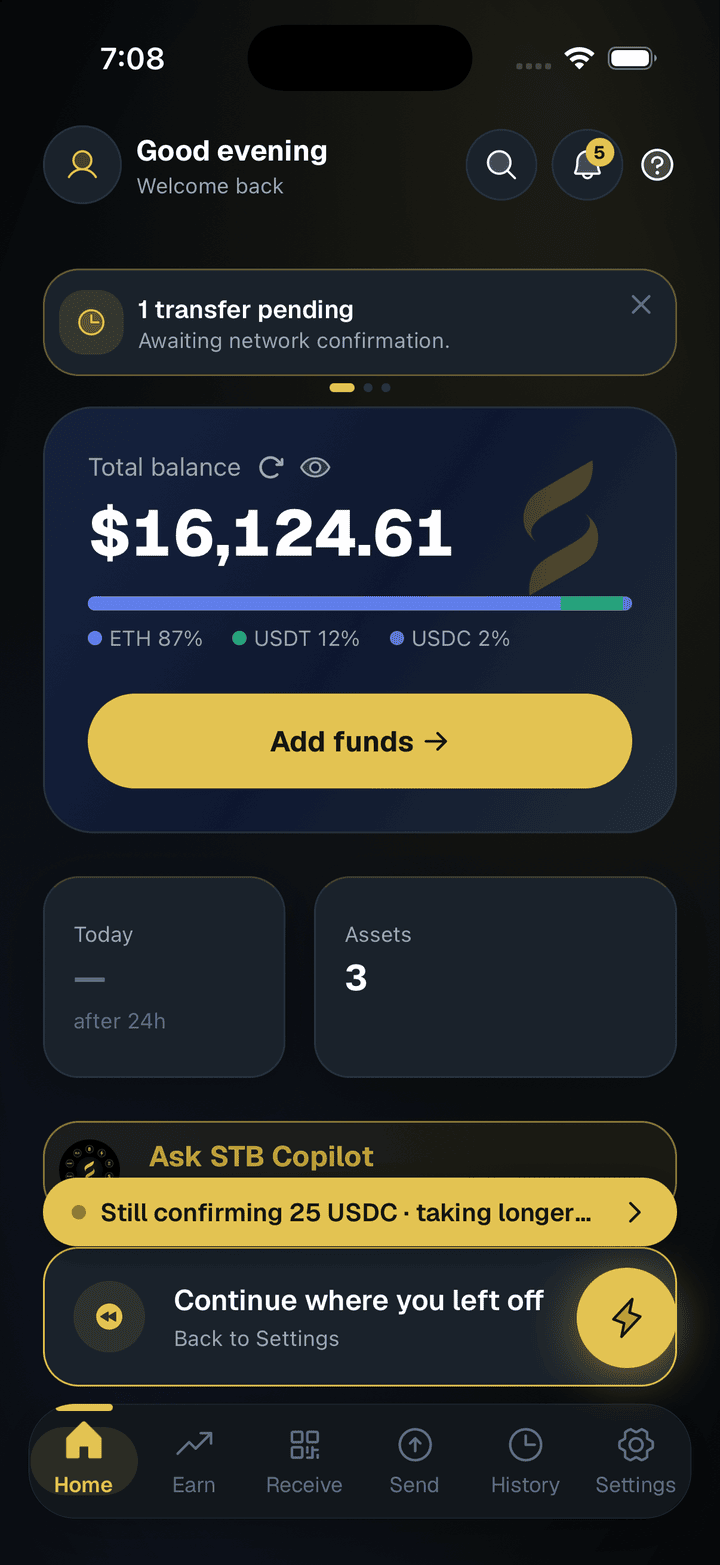
One home for every chain
Home shows your balances across the chains your seed derives, with USDC added up across chains into one number.
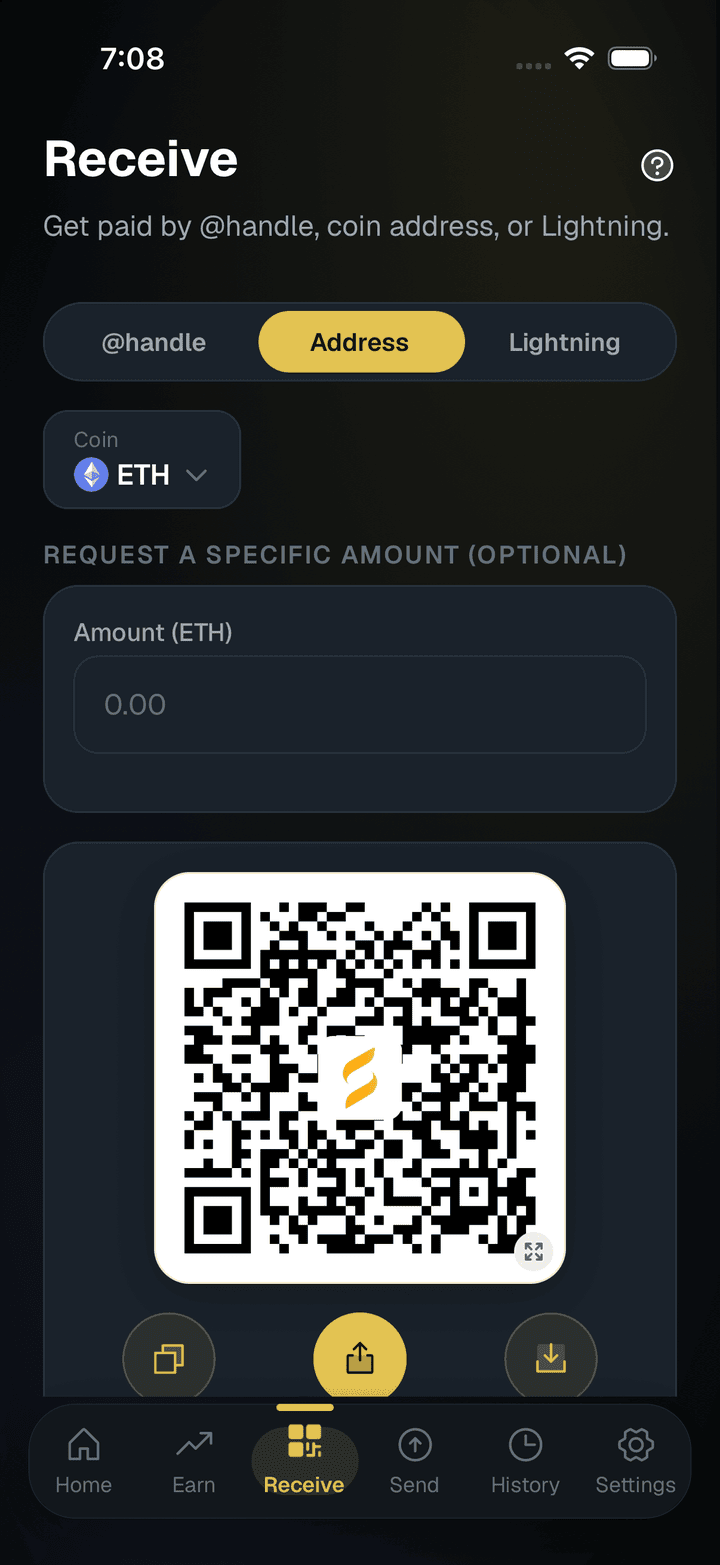
Pick the chain to receive on
Open Receive and choose the asset and chain. The address comes from your own seed.
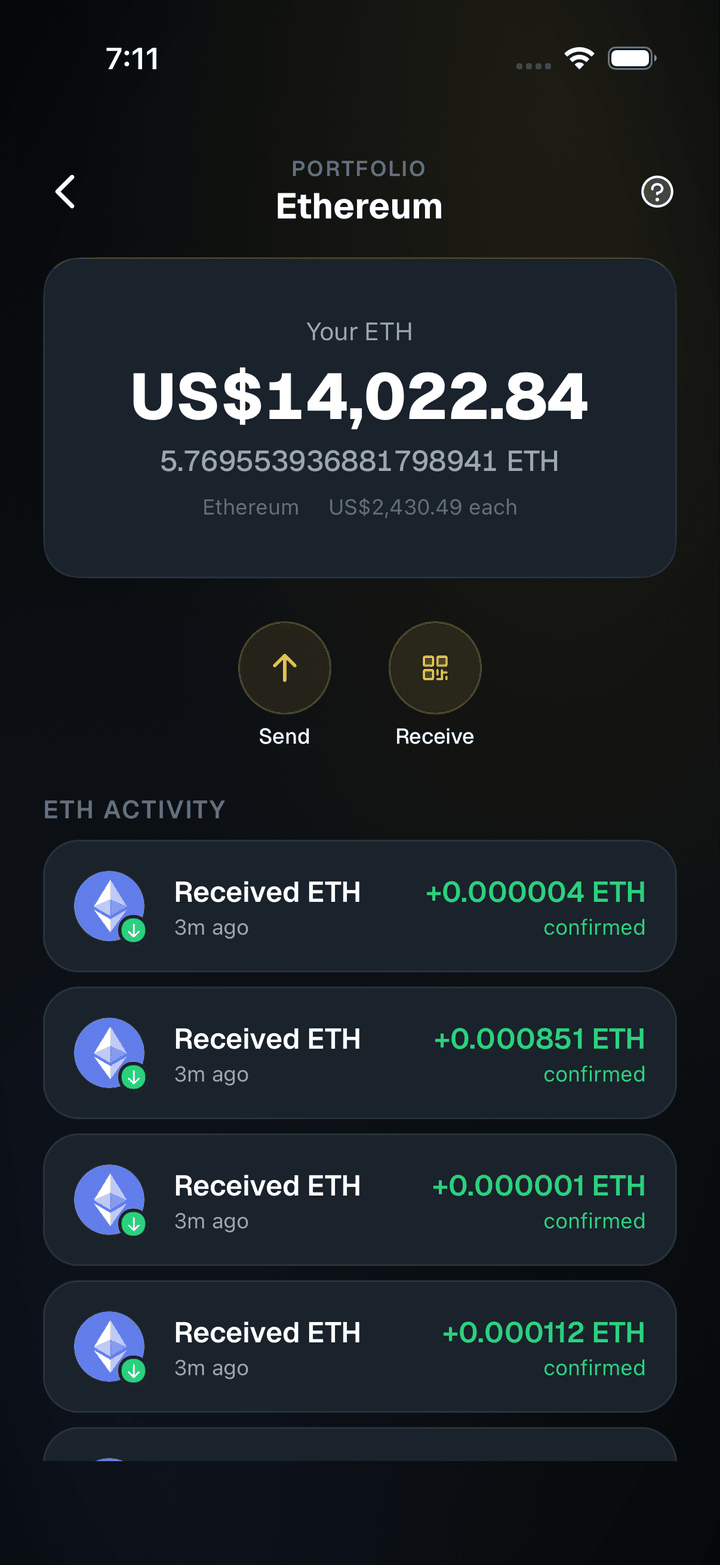
Check an asset
Tap an asset to see its balance and activity. Your EVM address is the same on every EVM chain, so the chain you pick when sending decides where money moves.
Hold your own keys, keep the yield, skip the middleman.
SpendTheBits is a fully non-custodial wallet for 13 chains, free on iOS and Android.