
Why every XRPL stablecoin needs a trust line
XRP is the ledger's native asset. Every account can hold it with no setup. Everything else on the XRP Ledger, including RLUSD and USDC, is an issued token, and the docs call these trust line tokens for a reason [13]. A trust line is a two-way relationship between your account and the issuer's account for a single currency code [13]. It records how much of that token you are willing to hold, and it is where your balance lives.
You create or change a trust line with a TrustSet transaction, whose LimitAmount field names the currency, the issuer's address, and the ceiling you will accept [3]. Until that line exists, a payment of that token to your address fails. This is the first RLUSD vs USDC fact worth internalising: neither token can land in an account that has not opted in.
The upside is that a trust line is an explicit allow-list. No stranger can dump a token onto your XRPL account the way a scam token appears on an EVM address, a point we make in our guide to spotting fake tokens.
The reserve math: 1 XRP to exist, 0.2 XRP per line
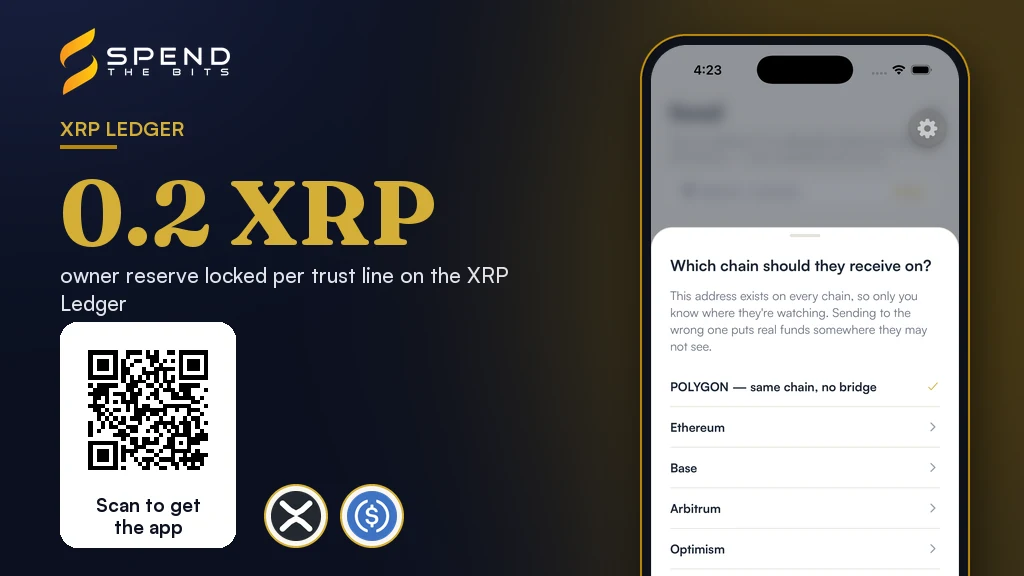
The XRP Ledger charges accounts a reserve so the ledger does not fill with junk. It has two parts. The base reserve is XRP an account must hold just to exist. The owner reserve is an increment charged for each object the account owns on the ledger, and a trust line is one such object [1].
As of today the base reserve is 1 XRP and the owner reserve is 0.2 XRP per item [1]. Those figures are recent: validators lowered them through fee voting on 2 December 2024, down from 10 XRP and 2 XRP, which had stood since 2021 [2]. An older article that says a trust line costs 2 XRP is stale [2].
So the cost of the RLUSD vs USDC decision, in reserve terms, is identical. One trust line locks 0.2 XRP [1]. Two trust lines, one for each token, lock 0.4 XRP on top of the 1 XRP base [1]. Locked is the right word: the ledger will refuse a transaction that would push your XRP below the total reserve, and the reserve is returned only when the object is removed [1].
RLUSD: a state-chartered trust company as the issuer
Ripple USD launched on 17 December 2024, and Ripple made a point of the legal wrapper: it chose to issue under a New York Department of Financial Services limited purpose trust company charter [9]. The token is issued natively on both the XRP Ledger and Ethereum [10]. Each RLUSD is backed one for one by U.S. dollar deposits, U.S. government bonds and cash equivalents, with monthly third-party attestations of the reserve [9].
For a holder, the issuer account behind your trust line is a regulated New York trust. Ripple's page adds that the DFSA in Dubai has also approved the product, and that BNY was named the primary custodian for the reserves in July 2025 [10].
The practical RLUSD vs USDC detail is the issuer address. A trust line is to a specific issuer, and a token called RLUSD from any other account is a different token that happens to share four letters. SpendTheBits hard-codes the official issuer for RLUSD so the wallet cannot be pointed at a look-alike.
USDC on XRPL: Circle's native issuance, no bridge
Circle brought USDC to the XRP Ledger on 12 June 2025, and the wording matters: it is issued natively on XRPL by regulated Circle affiliates, with no bridging required [11]. Circle's post lists the mainnet issuer as rGm7WCVp9gb4jZHWTEtGUr4dd74z2XuWhE [11]. Ripple's release from the same day confirms the joint launch and says Ripple intends to use USDC alongside RLUSD in its payments product [12].
That native status separates this USDC from the wrapped versions on some chains. There is no lock-and-mint contract holding collateral elsewhere. The issuer is Circle, the redemption promise is Circle's, and the ledger treats it as an ordinary issued currency. We cover why that distinction matters in native vs bridged USDC.
From the trust line's point of view, nothing changes. USDC on XRPL needs its own line to the Circle issuer, and that line costs the same 0.2 XRP of owner reserve as the RLUSD line [1]. RLUSD vs USDC on this ledger is, at the account level, two rows of the same shape.
Rippling, freezes and transfer fees: the issuer's levers
Issued tokens come with controls that XRP simply does not have. The first is rippling, the indirect movement of a token through intermediary accounts during a payment [4]. Issuers must enable DefaultRipple for their customers to pay one another, and a holder can set NoRipple on a line so their account is not used as a hop between two lines of the same currency [4]. A wallet should set NoRipple on your side for you. Ours does.
The second is freezing. An issuer can apply an individual freeze to one trust line, a global freeze to every line it has issued, or a deep freeze that also blocks the line from receiving [5]. Both RLUSD and USDC are regulated dollars, and both issuers keep freeze authority. That is not a knock on either token, it is what regulated issuance looks like, but it is a real RLUSD vs USDC similarity that self-custody does not remove. XRP itself cannot be frozen by anyone [5].
The third is the transfer fee. An issuer can set a rate that the sender pays on every peer-to-peer transfer, anywhere from zero up to one hundred percent, with the difference burned [6]. It never applies to XRP and never applies to payments made directly with the issuer [6]. Check the issuer's TransferRate before assuming a token moves free of charge.
Sending an issued token is not sending XRP
A direct XRP payment is the simplest thing the ledger does. It executes in one transaction with no intermediaries and typically completes in 8 seconds or less [7]. You can only make a direct payment when XRP is the currency on both ends [7].
A token payment is a cross-currency payment even when both sides use the same token. There must be at least one path between sender and receiver with enough liquidity, and the ledger can route through its own liquidity along the way [8]. For a plain RLUSD to RLUSD send between two accounts holding a line to the same issuer, the path is trivial. It only gets interesting when the recipient has no line, and the send fails, or when the currency changes en route.
That failure mode applies equally to RLUSD vs USDC, and it is the one to remember. If a friend asks you for USDC on XRPL and their wallet has never set up the Circle trust line, your payment will bounce. Ask first, or send XRP, which needs no setup. Our send guide and the pending-transaction help article cover the messages you will see.
How SpendTheBits holds both without holding your keys
SpendTheBits derives your XRP Ledger account from the same seed as your other twelve chains, and it supports both RLUSD and USDC on XRPL as their own balances. When you open Receive for either token, the app checks whether the trust line already exists. If it does not, it prepares the TrustSet, shows you the reserve it will lock, and asks your device to sign. Our servers never see the key, and the setup appears in your history as a labelled zero-amount entry so it is not mistaken for a payment.
The Max button on Send reads the live spendable figure from the ledger rather than guessing, because the reserve grows with every trust line you hold. In our production a holder with one trust line pressed Max and got a rejected send, because the app had only subtracted the base reserve. That is fixed.
The RLUSD vs USDC choice inside SpendTheBits is only ever which balance to hold: the app does not turn one into the other, and there is no counterparty inside it. You hold each as its own balance, send it to anyone with a matching line, and receive it from anyone who has one. For the wider picture, start with how to self-custody stablecoins, the everyday multichain page, and which chains and tokens are supported.
In the app · 5 steps
Receive RLUSD or USDC on the XRP Ledger in SpendTheBits
The trust line is a single tap in the app, and it only ever points at the official issuer.
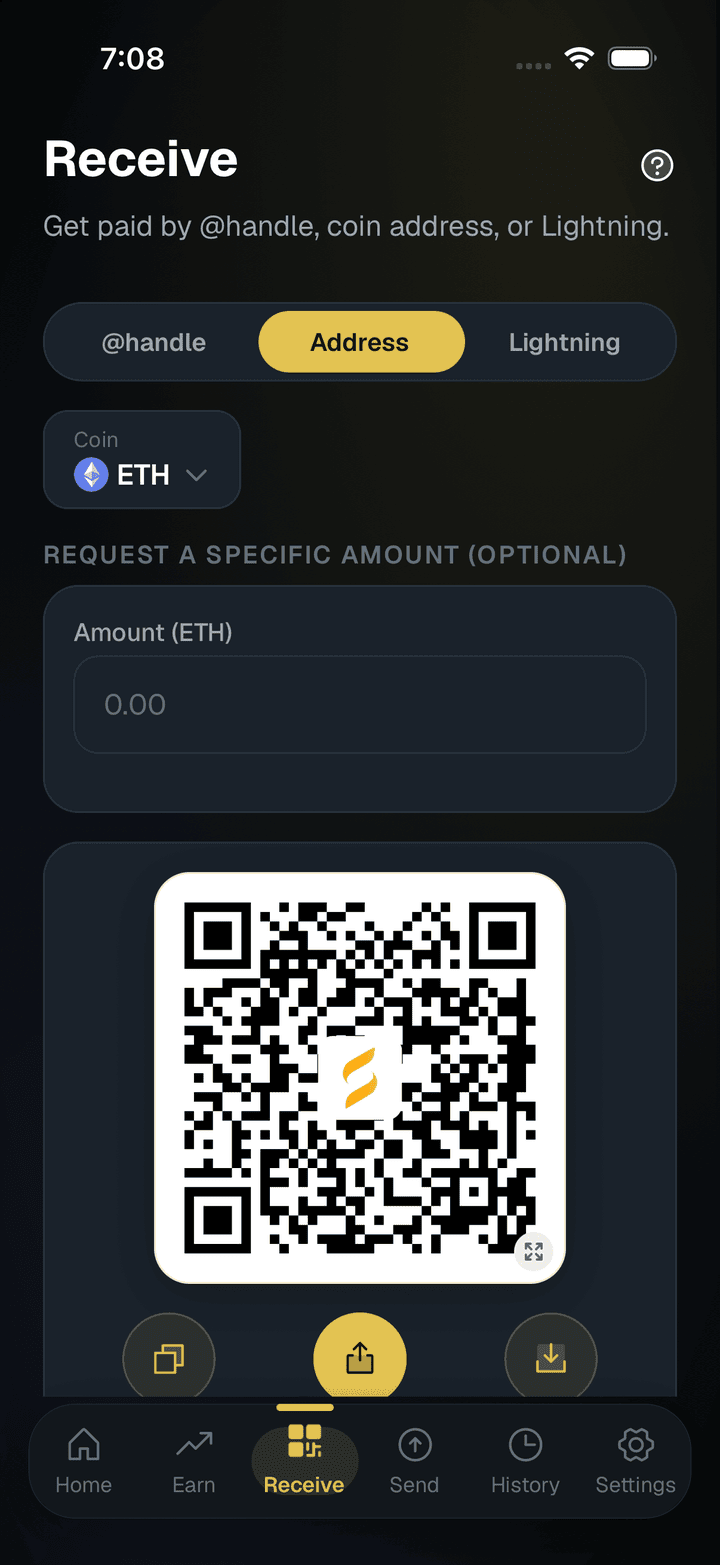
Open Receive and pick the token
Tap Receive and choose RLUSD or USDC on the XRP Ledger from the coin menu.
Set it up once
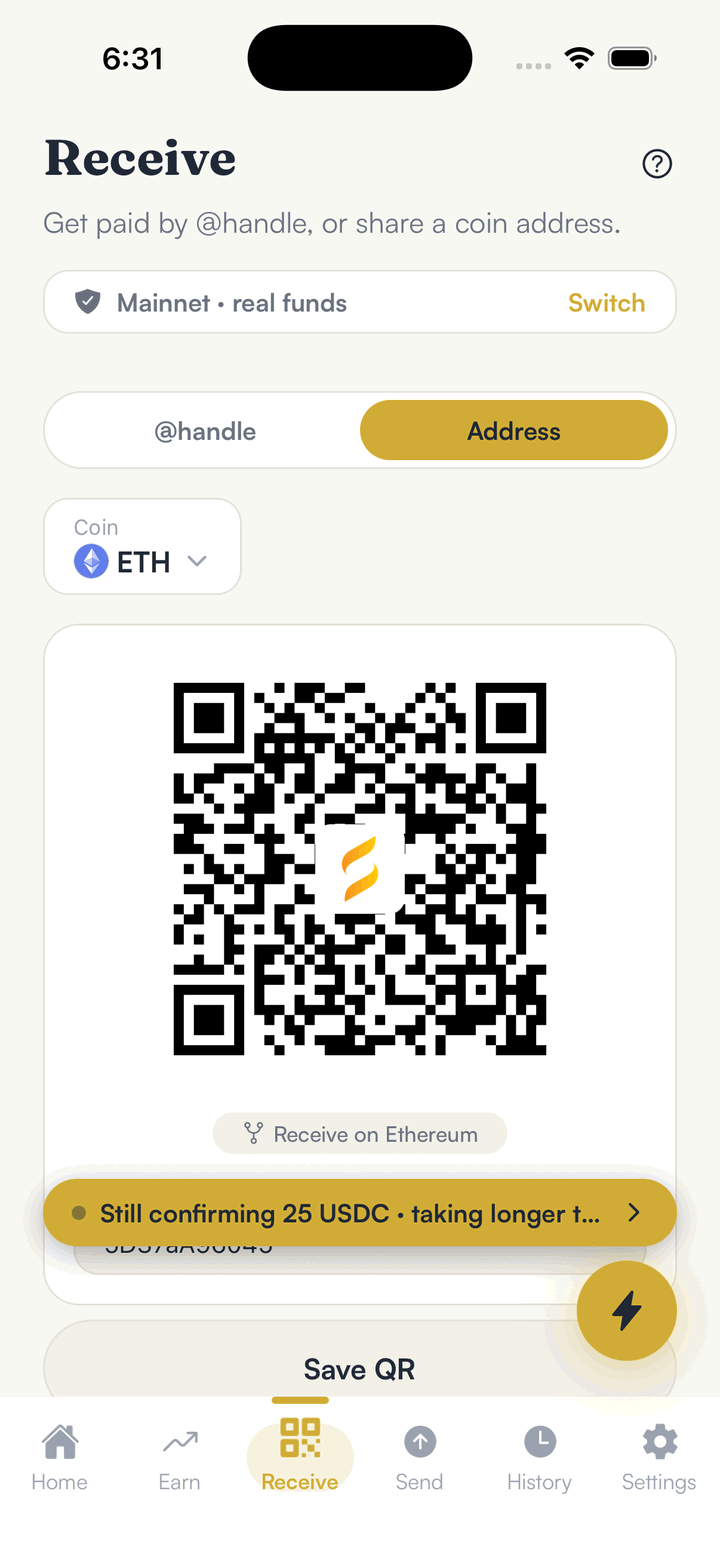
The first time, the app shows Set up to receive and explains the step: your XRP account trusts the official issuer once, with a signed TrustSet. No funds move, and a small XRP reserve is locked rather than spent.
Keep a little XRP
You need XRP for the reserve and the network fee. The reserve comes back if you remove the token later.
Share the address and watch Activity
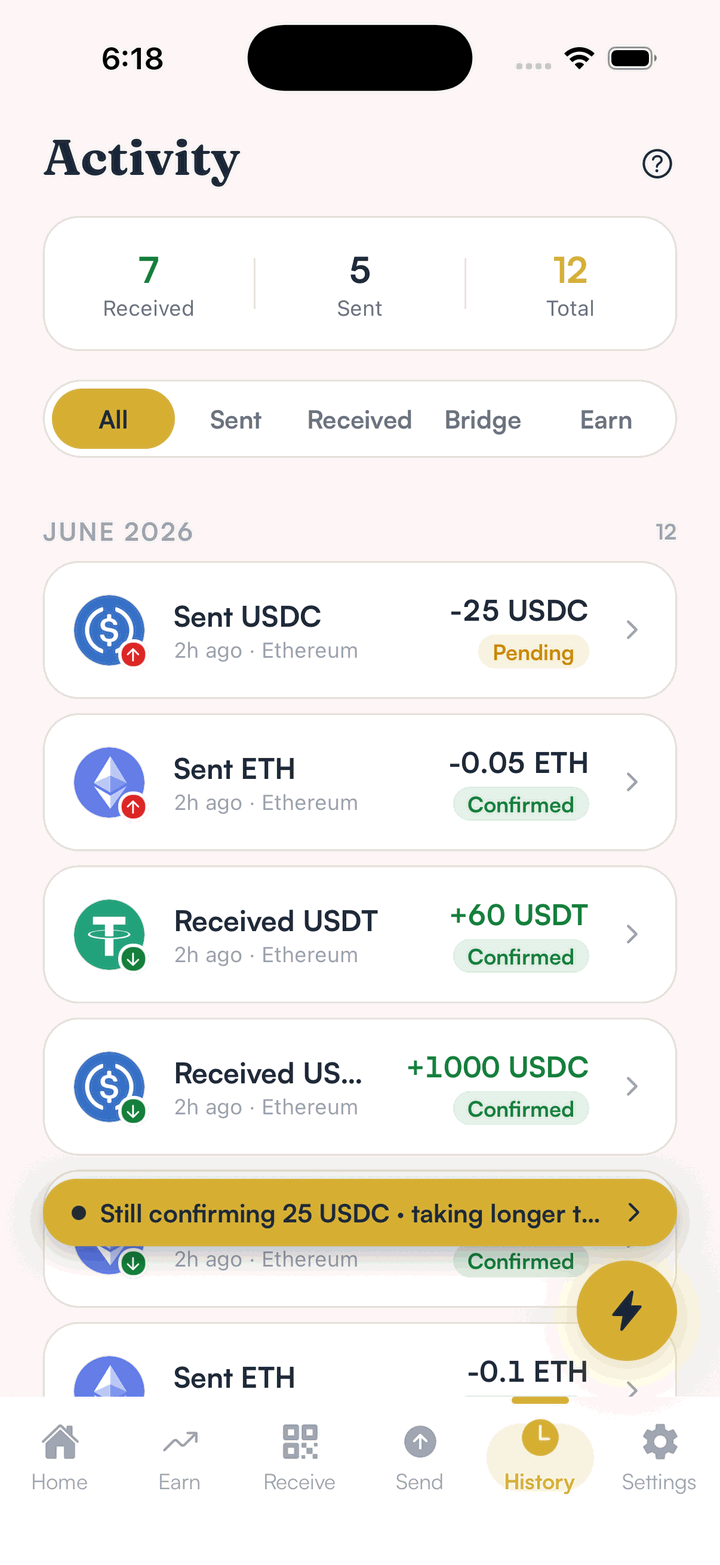
Once the trust line validates, the same screen shows your address and QR. The incoming transfer appears in Activity.
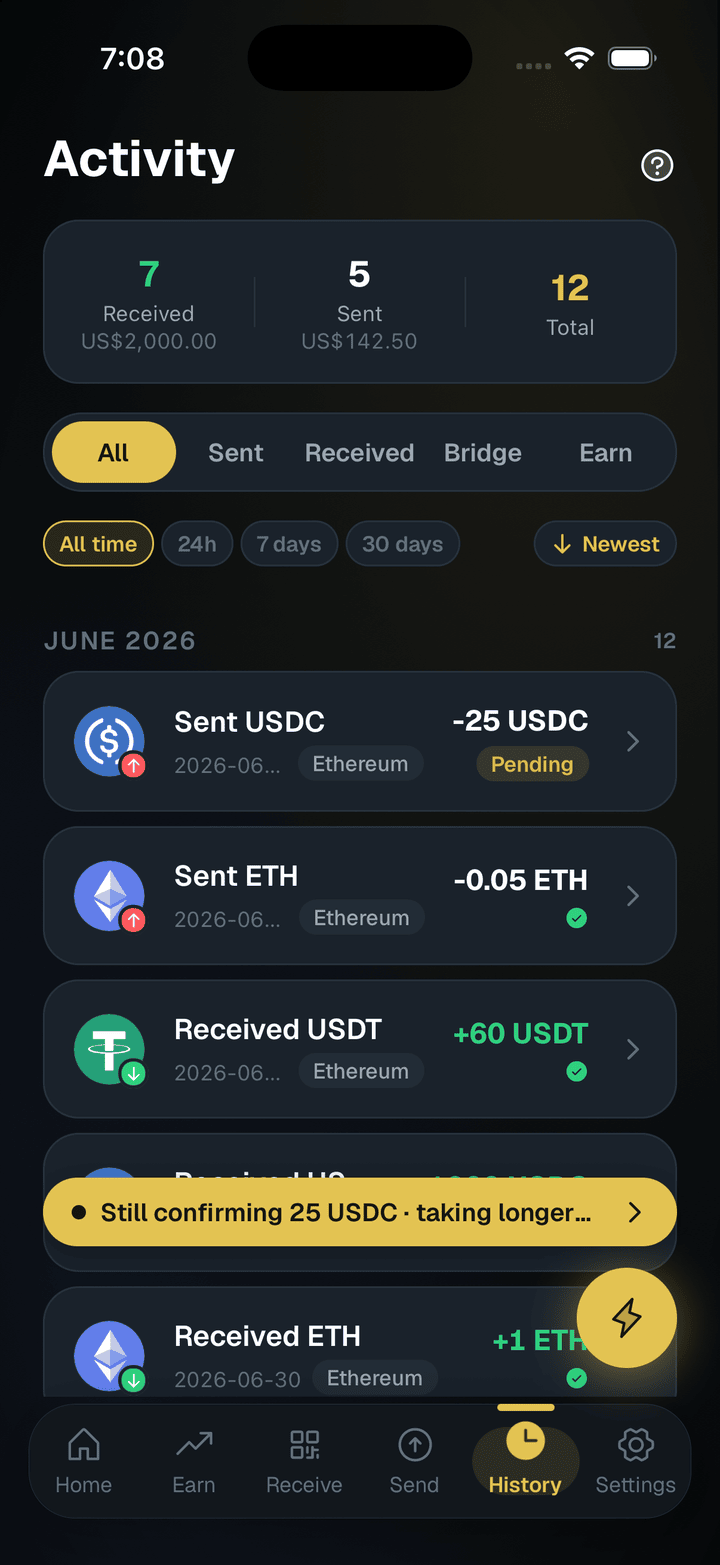
Check the transfer
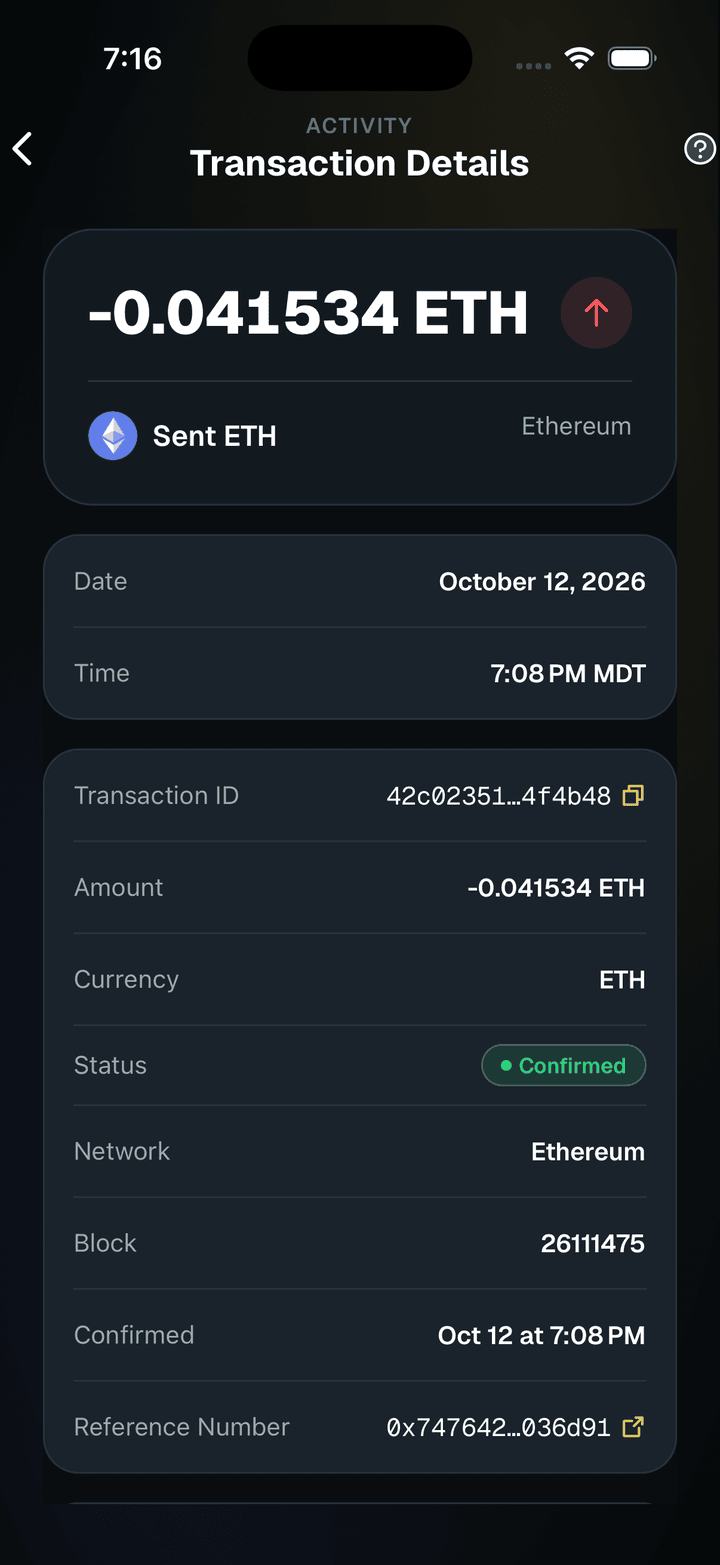
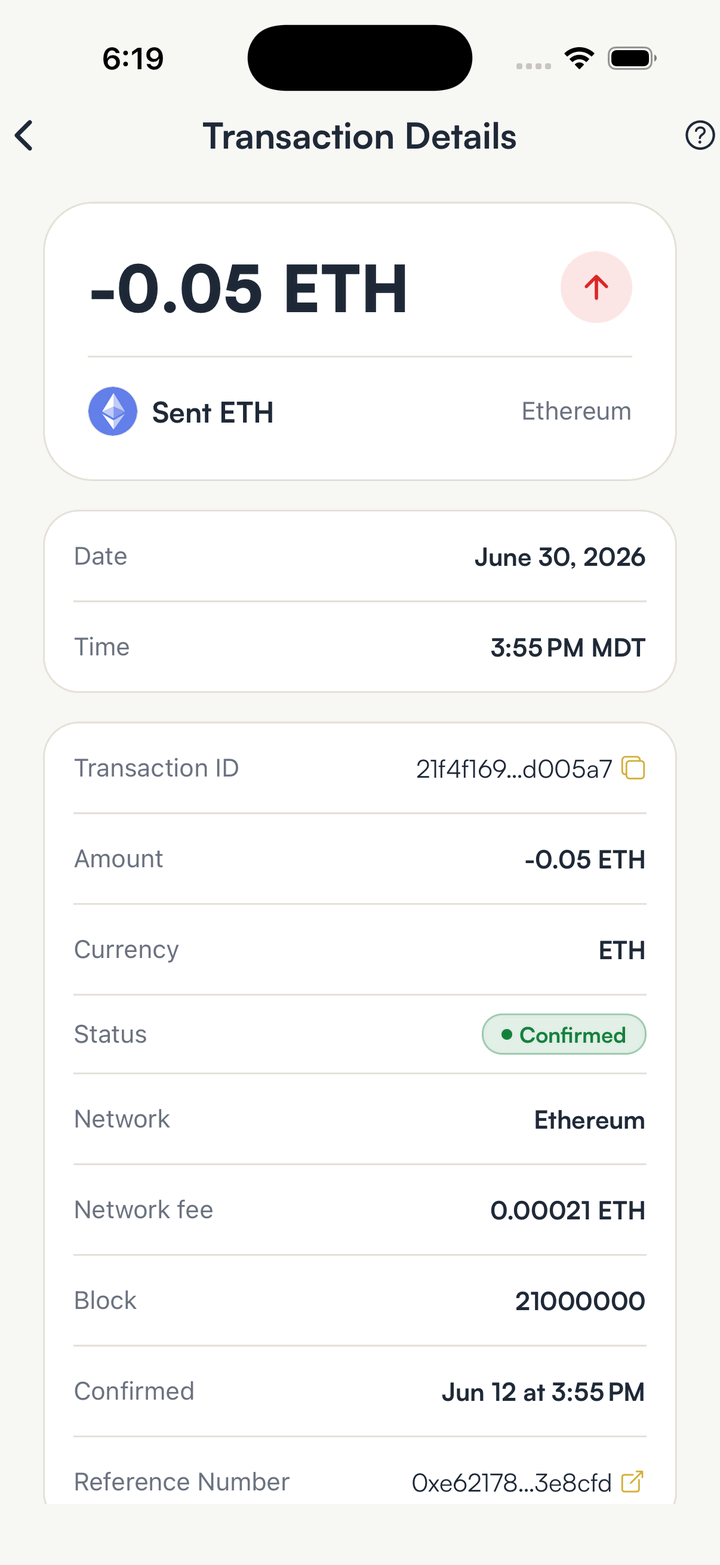
Open the row to confirm the amount, the network and the status.
Hold your own keys, keep the yield, skip the middleman.
SpendTheBits is a fully non-custodial wallet for 13 chains, free on iOS and Android.