

Why the same USDC costs different amounts to move
Someone has to be paid to run it, and that someone is the network, not the token issuer. The token is the same, but the toll road is different on every route.
Ethereum's own docs describe gas as the unit that measures the computational effort of an operation, and the fee as the gas used times the cost per unit of gas [1]. That fee is owed whether the transaction succeeds or fails [1]. The same logic, with different twists, shows up on every chain below, so it is worth holding on to this simple formula.
Two things make the total hard to guess. First, the price per unit moves with demand, so a quiet hour is cheaper than a busy one. Second, a token transfer uses more gas than a plain coin transfer, because it runs contract code. Ethereum's docs note that a basic ETH transfer needs a gas limit of 21,000 units, and smart contract calls need more [1].
The Ethereum docs add a detail that matters for USDC transfer fees: the fee is paid regardless of whether a transaction succeeds or fails [1]. They also say gas fees have to be paid in Ethereum's native currency, ether (ETH) [1]. On Polygon, the base fee is a network-determined fee that is burned, calculated based on how full the previous block was [3].
Ethereum: base fee, tip and the twelve and a half percent rule
On Ethereum, the fee you pay is split into a base fee and a priority fee, also called the tip. The base fee is set by the protocol and is the minimum for a transaction to be valid. The tip is what you add so validators want to include you [1]. The formula in the docs is units of gas used times the base fee plus the tip [1].
The base fee is not a guess. It comes from the blocks before yours, which makes costs more predictable. It rises or falls by at most 12.5% per block, depending on whether the last block was fuller or emptier than the target [1]. The base fee is burned, while the tip goes to the validator [1]. You can also set a max fee, and any unused part is refunded [1].
Gas on Ethereum has to be paid in ether, quoted in gwei [1]. Wallets usually fill in a recommended base plus tip for you, so you rarely set these numbers by hand [1].
Base's own docs say that typically the L1 security fee is higher than the L2 execution fee [2]. If the timing of your transaction is flexible, Base says you can save costs by submitting transactions during periods of lower gas on the L1 [2]. For USDC transfer fees on Solana, the docs say every Solana transaction requires a fee paid in SOL [4]. For USDC transfer fees on Arc, the docs say any relayer, paymaster, or funded wallet account must hold USDC, the native token of Arc [5]. They add that its smoothing keeps transaction costs stable and easy to estimate [5].
Base: an L2 fee plus an L1 data fee
Base is a rollup, so each transaction carries two costs [2]. The Base docs call them an L2 execution fee and an L1 security fee [2]. The L2 fee pays for running your transaction on Base. The L1 fee is the estimated cost of publishing the transaction data on Ethereum [2]. The docs say the L1 security fee is typically higher than the L2 execution fee [2].
If Ethereum is busy, the L1 part of a Base transaction rises, and the docs suggest that if your timing is flexible, quieter periods such as weekends can save money [2]. The L2 part uses the same EIP-1559 style adjustment as Ethereum, rising and falling with demand [2].
Base also set a floor. Its minimum base fee is 5,000,000 wei, which is 0.005 gwei, and the docs give a rough cost of about $0.002 for a typical 200,000 gas transaction at an ETH price of $2000 [2]. That is an illustration, not a quote.
Polygon and the Type 2 transaction
Polygon followed Ethereum's lead. The London hard fork brought EIP-1559 to Polygon and changed how gas is estimated and charged [3]. Before it, a transaction named one gasPrice and miners favored the highest bids, which made costs hard to predict in busy periods [3].
Now a Type 2 transaction splits that price into a base fee and a priority fee [3]. The base fee is set by the network from how full the previous block was, it is burned, and every transaction must pay it [3]. The priority fee is an optional tip for the validator. The fee actually paid is the base fee plus the tip, capped by the max fee you set [3]. Older Type 0 legacy transactions still work, but Type 2 is the recommended format [3].
Polygon also publishes a Gas Station service that returns safeLow, standard and fast estimates, plus an estimated base fee and a block time of 6 seconds in its sample response [3]. The sample numbers are only an example of the format.
Solana: a flat per-signature base fee and optional priority
Solana prices things differently. Every transaction pays a fee in SOL, made of a base fee and an optional prioritization fee [4]. The base fee pays validators for the cryptographic work of checking signatures, and it is 5,000 lamports per signature [4]. Half of the base fee is burned and half goes to the validator [4].
The prioritization fee is the part that moves. It equals the compute unit price times the compute unit limit, divided by 1,000,000, rounded up, and all of it goes to the validator [4]. It raises the odds that the current leader schedules your transaction ahead of others [4]. A micro-lamport is one millionth of a lamport, which is why that divisor appears [4].
Compute limits matter too. The default limit is 200,000 compute units per instruction, and a transaction can reach at most 1,400,000 [4]. For a plain token send, the base fee is often the whole story, and you can skip the priority part unless the network is crowded. As with Ethereum and Base, the fee is paid in the chain's own coin, here SOL, not in USDC [4].
Arc: gas paid in USDC itself
Its fee market builds on EIP-1559 but swaps the per-block recalculation for a moving average of block utilization, so short demand spikes do not cause sudden fee jumps [5]. The base fee is denominated in USDC, and the docs state a floor that targets about $0.001 per ERC-20 transfer under normal conditions [5].
The docs also describe a hard ceiling. The testnet figures list a maximum base fee of 20,000 Gwei and a minimum of 20 Gwei, and they note these may change before mainnet [5]. Priority fees exist, but for most transactions the docs say to set the tip to 0 [5]. Unlike Ethereum, Arc does not burn the base fee; both fees go to the block's beneficiary [5].
What this means for you is simple. Any funded wallet account on Arc holds USDC, since USDC is the native token there [5]. In our production test on 18 September 2026, a USDC send on Arc cost about 0.001 USDC in network fee, which sits right at that design target. For more on this model, see how USDC as gas changes wallet UX and what the Arc blockchain is.
How a wallet can make USDC transfer fees easier to read
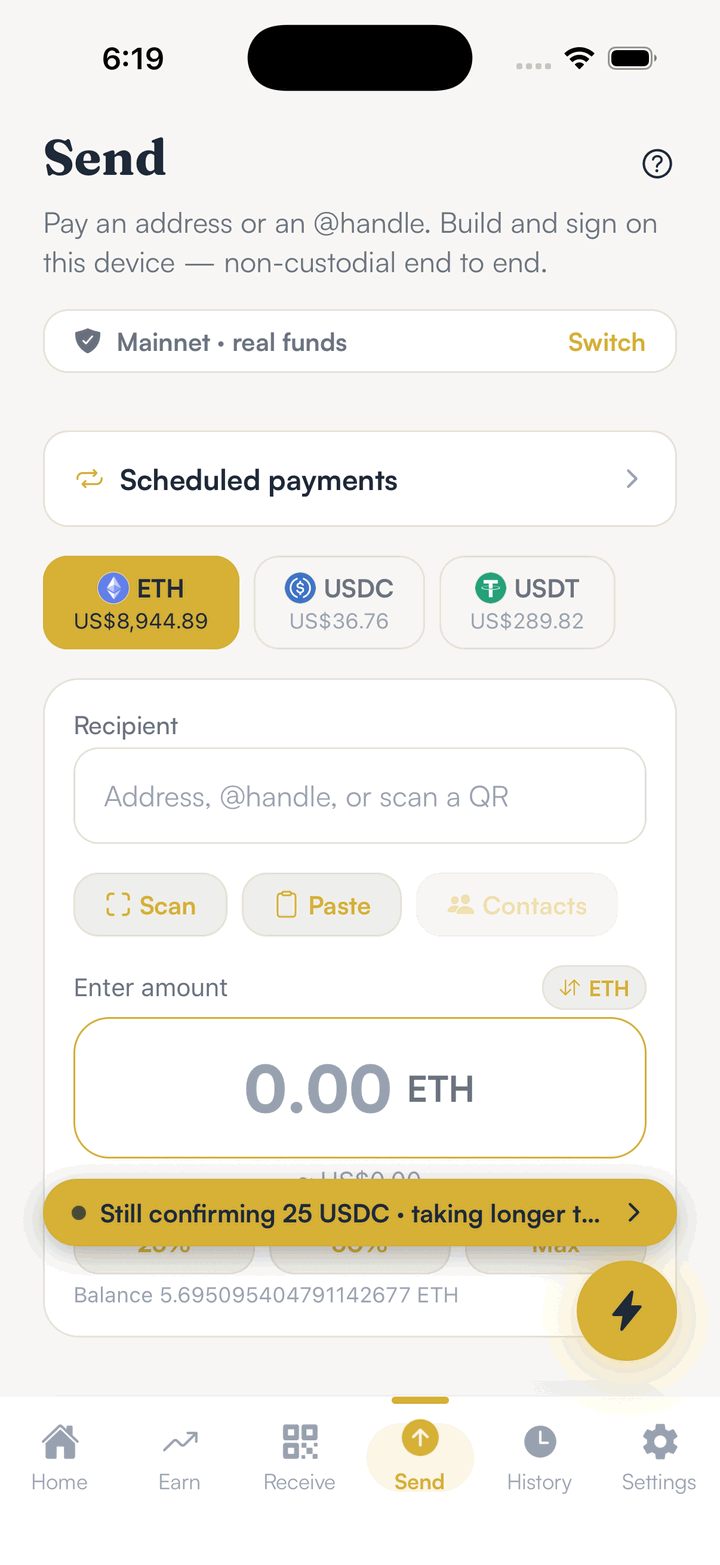
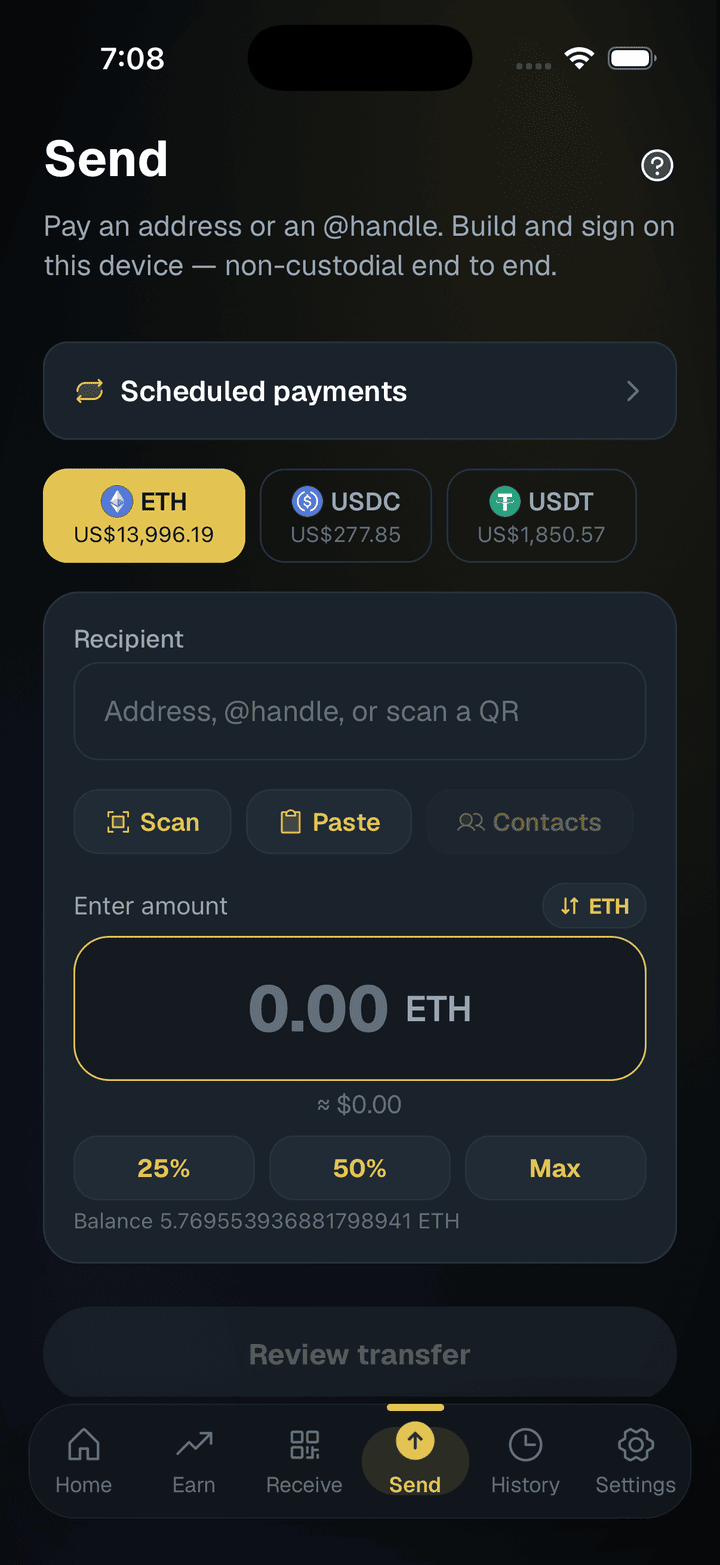
A good wallet should show the network fee before you send, so you can compare chains and decide. SpendTheBits does this on its Send screen, which also asks which chain to use before a send.
The wallet's own fee on top is small and plain. SpendTheBits adds a small send fee under 1% on EVM-chain sends above a minimum, and smaller sends are free. Network gas is separate and goes to the network. On Arc the network fee is paid in USDC, so no second coin is needed. For sends that feel fee-free elsewhere, read how gasless USDC transfers with paymasters work.
When the destination chain is cheaper, you can move funds first. For the basics of holding your own keys while you do this, see our guide to self-custody. Always check the fee shown before you confirm, since the in-app Fees screen is the source of truth.
In the app · 3 steps
See the cost before you send USDC
The chain you pick decides most of the fee. The app shows it before you sign.
Pick the coin and chain before you send
Send asks which coin to use, then shows the amount and the balance you have on that rail.
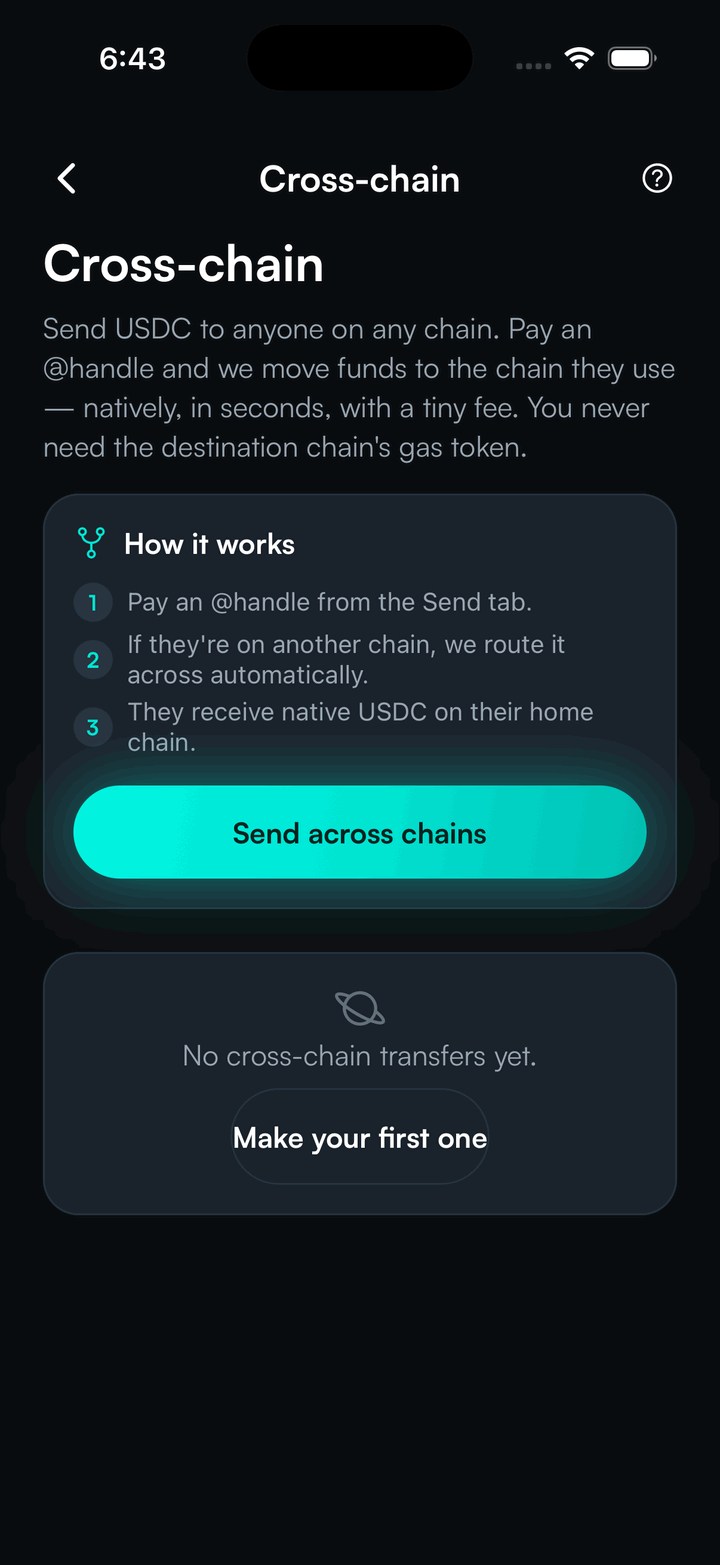
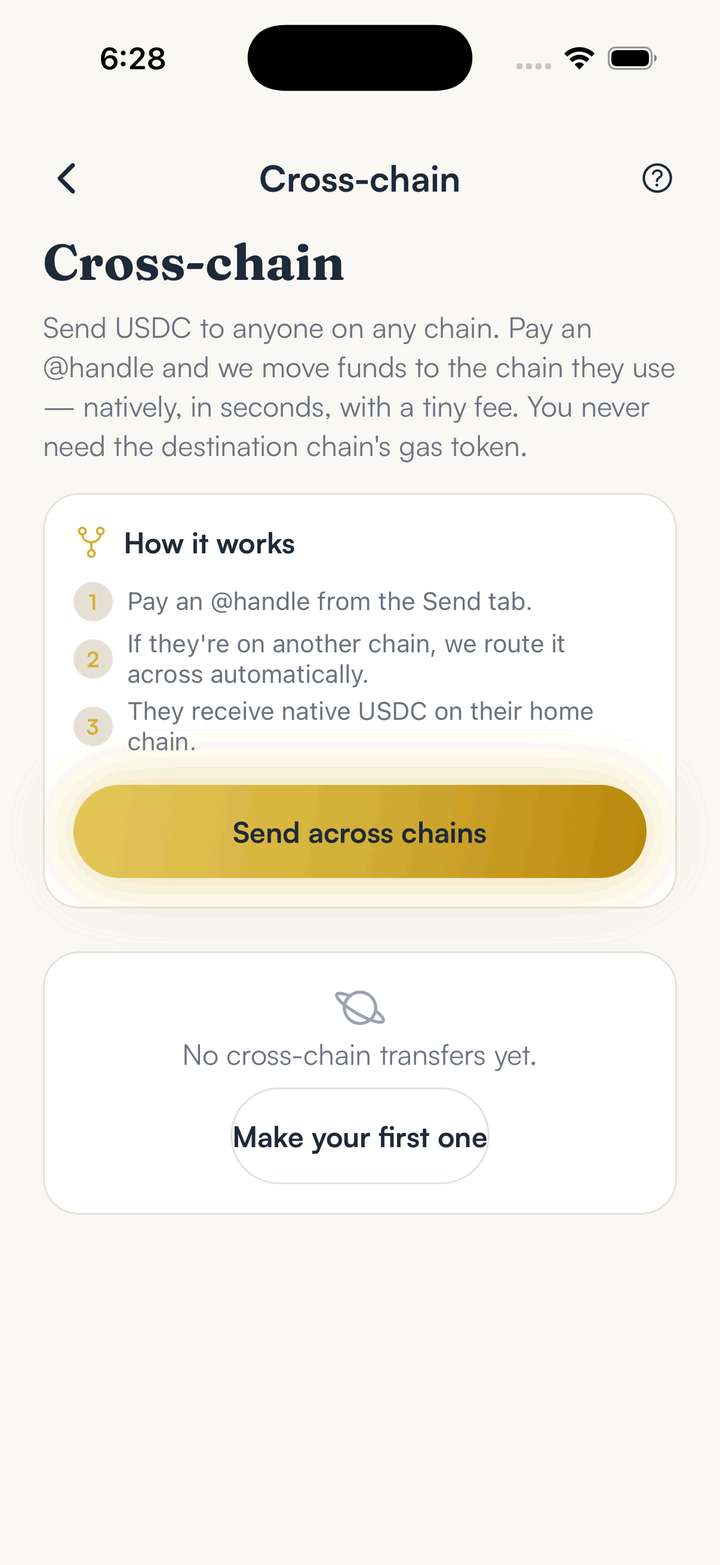
Bridge when the recipient is on another chain
Cross-chain moves native USDC so the recipient never needs that chain's gas token.
Check the record afterwards
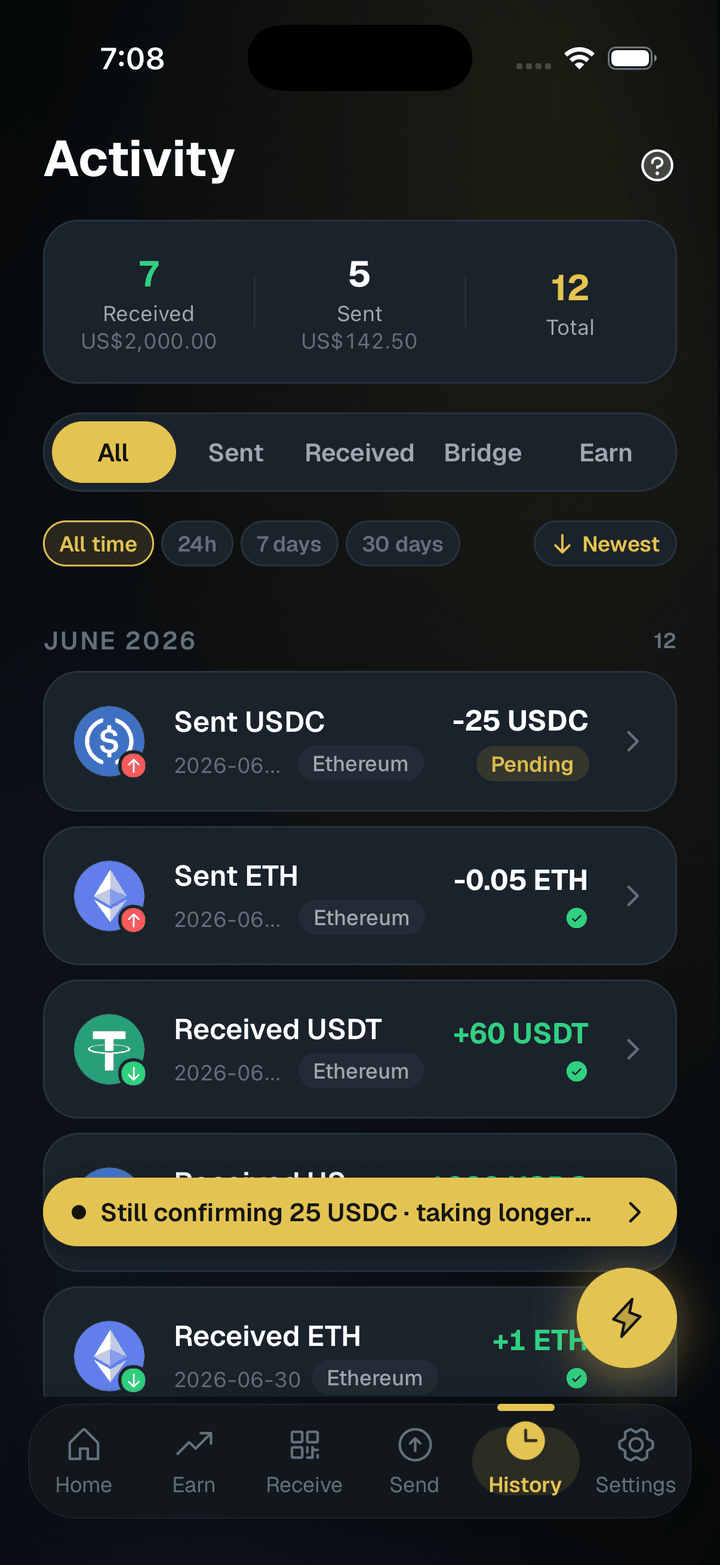
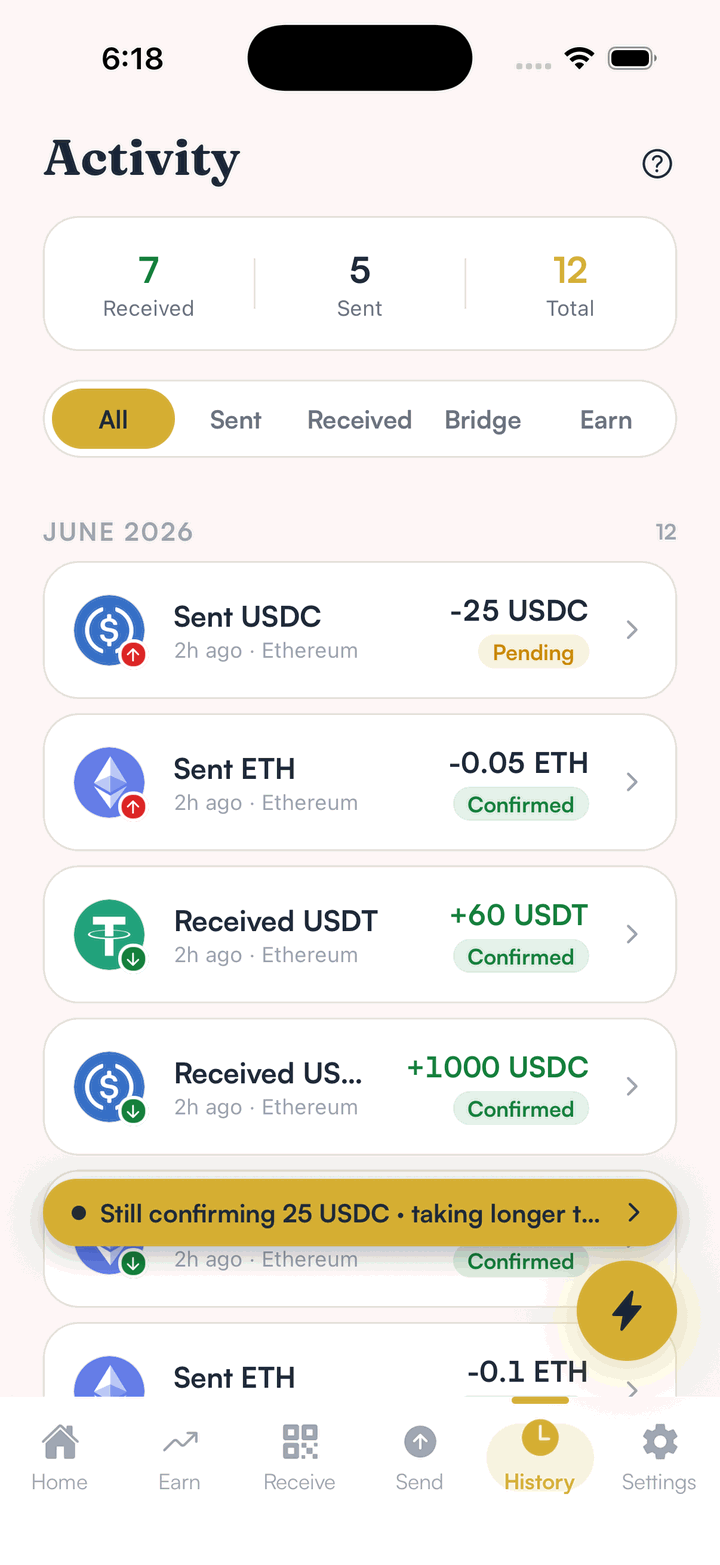
Activity keeps each transfer with its status.
Hold your own keys, keep the yield, skip the middleman.
SpendTheBits is a fully non-custodial wallet for 13 chains, free on iOS and Android.