
A Purpose-Built Layer-1 for Stablecoins
It focuses only on stablecoins instead of volatile assets that go up and down [1]. Circle built the Arc blockchain as a platform to run payments, lending, and treasury work at global scale [1]. Instead of relying on a volatile native coin, the platform supports USDC as its gas token [1]. It also natively supports other stablecoins like EURC and USYC [1]. This stablecoin-native model makes the chain very easy for regular users and businesses.
By building a dedicated Layer-1, the creators avoided the fee spikes that happen on older chains [1][3]. The platform uses a native gas setup where transaction fees are paid in USDC [1]. This fee system keeps transaction costs stable and simple to calculate [3]. It matches the speed of public ledgers with the steady feel of traditional finance [4][6]. You get fast settlement without the usual friction of holding multiple odd tokens.
The digital dollar USDC is created to represent United States currency on the internet [6]. To learn how to protect your cash, you can read our guide to self-custody stablecoins on our site. It shows how you can use your dollars freely while keeping your keys on your own device. You do not need to trust an exchange or a middleman with your funds. You are always in full control of your wealth.
Two-Phase Consensus and Sub-Second Finality
At the heart of the network is a two-layer architecture that separates consensus from execution [1][2]. The consensus layer runs Malachite, which is a fast BFT protocol [1][2]. This protocol uses a two-phase voting process consisting of a pre-vote and a pre-commit phase [2]. It requires more than two-thirds of the permissioned validators to agree before a block is committed [2]. Once a block is committed to the chain, it is final and irreversible [2]. This ensures that every transaction is processed in order and locked in forever.
This setup gives clear finality in under one second. There is no risk of chain reorganization [1][2]. This is much faster than older networks. For example, Ethereum can take twelve to fifteen minutes to make a transfer final [4]. Old layer-two chains can take seven days to let you withdraw your funds to the main network [4]. With this network, every transfer is either unconfirmed or fully finalized, removing all doubt [4]. This makes on-chain actions fast and highly reliable.
Merchants can confirm payments and hand over goods at a point of sale without waiting for more blocks [4]. You do not need to build complex recovery code or check sliding confirmation windows [4]. Your transfers settle instantly, which means there is no counterparty risk [4]. This matches the high standards of institutional clearing and global payments [4]. It makes digital dollars behave like real physical cash in hand.
Stable Gas Design with EWMA Smoothing
One of the biggest issues with standard blockchains is that transaction fees spike during busy times [3]. Because the Arc blockchain uses a moving average of block use to set its base fee, it remains highly stable [3]. Standard networks change base fees on every block. Arc does not do this. Instead, it blends recent use into a moving average [3]. This smoothing stops short demand spikes from raising prices. This keeps your costs low [3]. It makes transaction costs much more predictable for everyone.
Under normal network conditions, the system targets a base level of about 0.001 USDC for a standard transfer [3]. The protocol enforces a testnet minimum base level of twenty Gwei to keep transactions safe [3]. It also implements a maximum base level cap of twenty thousand Gwei as a hard ceiling [3]. Because the base fee does not burn, the validator gets the whole fee [3][5]. This keeps the network running smoothly and rewards those who secure it [3][5]. It ensures the system remains robust.
This fee smoothing makes cost estimation highly predictable for everyday transfers [3]. You can query the network and trust that the cost will remain stable for your submission window [3]. You can read our native vs bridged USDC analysis to see how this model compares to older chains. This helps you pick the right rail for your cash. Dollar-denominated fees mean transaction costs map directly to a known USDC amount without complex math [3]. It removes the headaches of accounting and tax tracking for small business owners.
EVM Compatibility and Technical Differences
Developers can deploy Solidity contracts and use standard Ethereum tools with no changes [1]. The execution layer runs Reth, a Rust-based client that processes transactions and maintains the blockchain ledger [1][2]. The network starts with the Osaka hard fork and adds advanced EIP-7702 features [5]. But the native asset is USDC instead of ETH. Building on this network requires following specific rules regarding value transfers [5]. These rules keep the chain safe for institutional use [1][5].
For example, you cannot send native transfers to the zero address or 0x0 [5]. You cannot burn assets. Sending funds to self-destructed accounts will fail [5]. Furthermore, the network enforces blocklist checks at runtime [5]. If a transaction involves a blocklisted address, the transfer reverts but still consumes gas [5]. For example, the protocol blocks value transfers directed to the zero address [5]. They make the platform much safer for everyone.
The PREVRANDAO opcode always returns zero on this chain [5]. Because of this, developers must use an oracle to get real random numbers on the chain [5]. Also, the system uses EIP-7708. It logs standard Transfer events for all native moves [5]. To understand how stablecoins keep your funds secure, you can explore is USDC safe on our platform. This guide explains how reserves and on-chain security work together to protect your digital dollars [6].
Launch Facts vs the Planned Roadmap
The Arc blockchain is currently live on mainnet, allowing users to send, hold, and bridge USDC [1][2]. The Fee Manager is ready. It keeps transaction costs steady by using USDC [2]. This ensures that transactions today get EWMA smoothing and fast finality [2][3]. You can start using these features now. You do not have to wait for new updates.
On the other hand, some major features are still on the roadmap and are not ready yet [2]. The Arc Privacy Sector is a planned private space to run smart contracts [1][2]. It is designed to compose synchronously with the public EVM but is not live yet [2]. Likewise, Stablecoin Services for payments and swaps are still in the planning phase [2]. These features are not available to users on the network today, so plan your builds accordingly.
This distinction is important because the planned Arc Privacy Sector and Stablecoin Services are not yet available [2]. If you want to move your assets between different chains safely, read our guide on how to bridge USDC between chains. This ensures your funds remain secure throughout the entire process. Our app does the hard work for every transfer. You can move money without worrying about complex chains.
How SpendTheBits Integrates Arc Network
We are excited to support the Arc blockchain directly inside our non-custodial wallet application. Our users can seamlessly hold, send, and bridge USDC on this network with gas paid entirely in USDC. In our test on 18 September 2026, a Polygon to Arc transfer took about one minute. We also measured that a USDC send on the network cost about 0.001 USDC, and the relayer's mint cost about 0.004 USDC. These fast times show how efficient the system is.
What happens if the main network goes down or stalls? Our app routes new payments to other chains. It can use gasless paymaster rails or our bridge. Any USDC you hold on the network is safe. It will be ready to move when the network is back. This setup guarantees that your payments never get stuck, even during major network issues. You can read how to send crypto to learn more about our simple and secure payment flows.
As a fully non-custodial wallet, we never hold your private keys on our servers. Every transaction is signed directly on your device, giving you total ownership of your funds. We charge a small bridge fee, under 1%, shown before you confirm. This ensures that you can use this revolutionary Layer-1 network safely. Managing your digital dollars is simpler than ever when you use our app on your phone. You get the full power of modern blockchain tech without any of the usual safety risks.
In the app · 7 steps
Move USDC to Arc and send it, in SpendTheBits
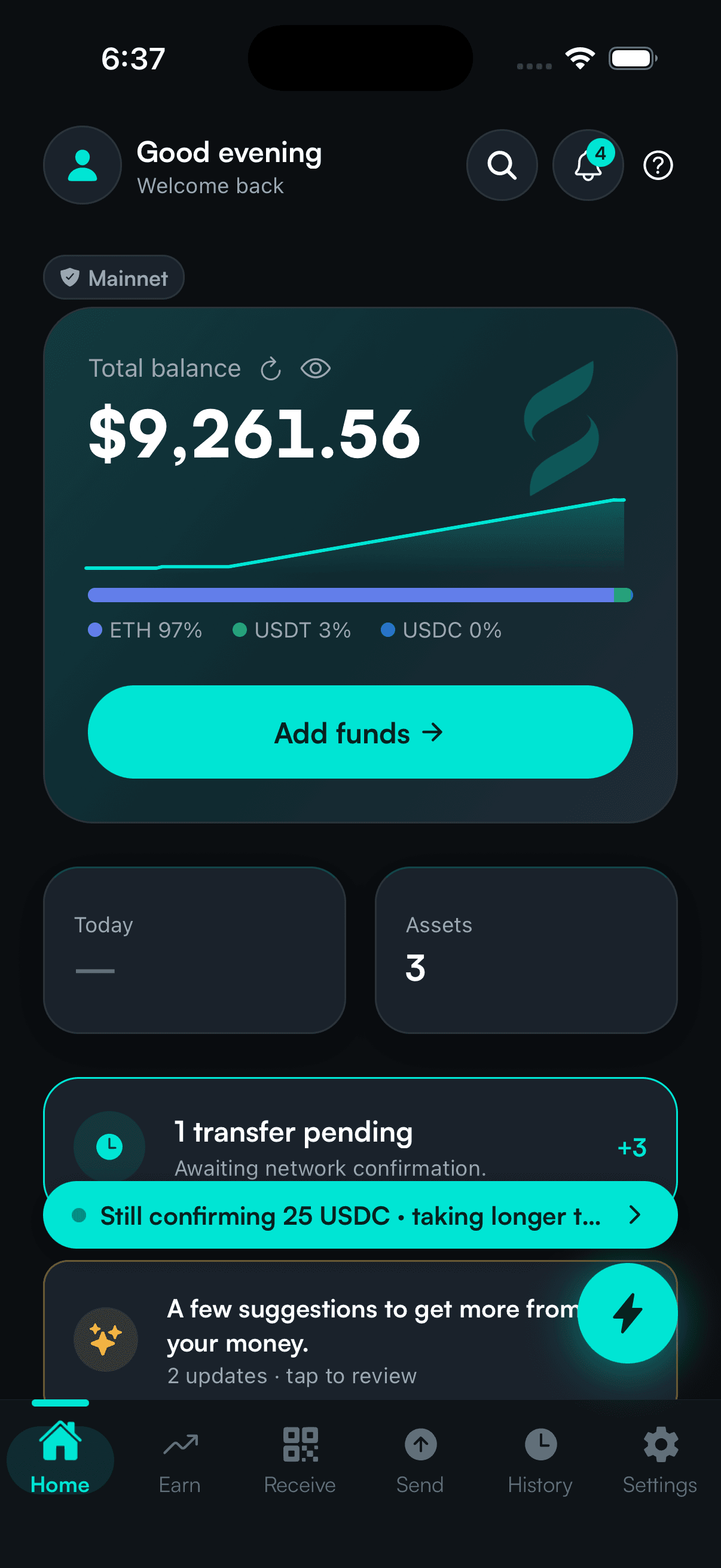
Every screen below is from our own mainnet test on 18 September 2026: 2 USDC from Polygon to Arc in about a minute, then a send on Arc for a network fee of about 0.001 USDC.
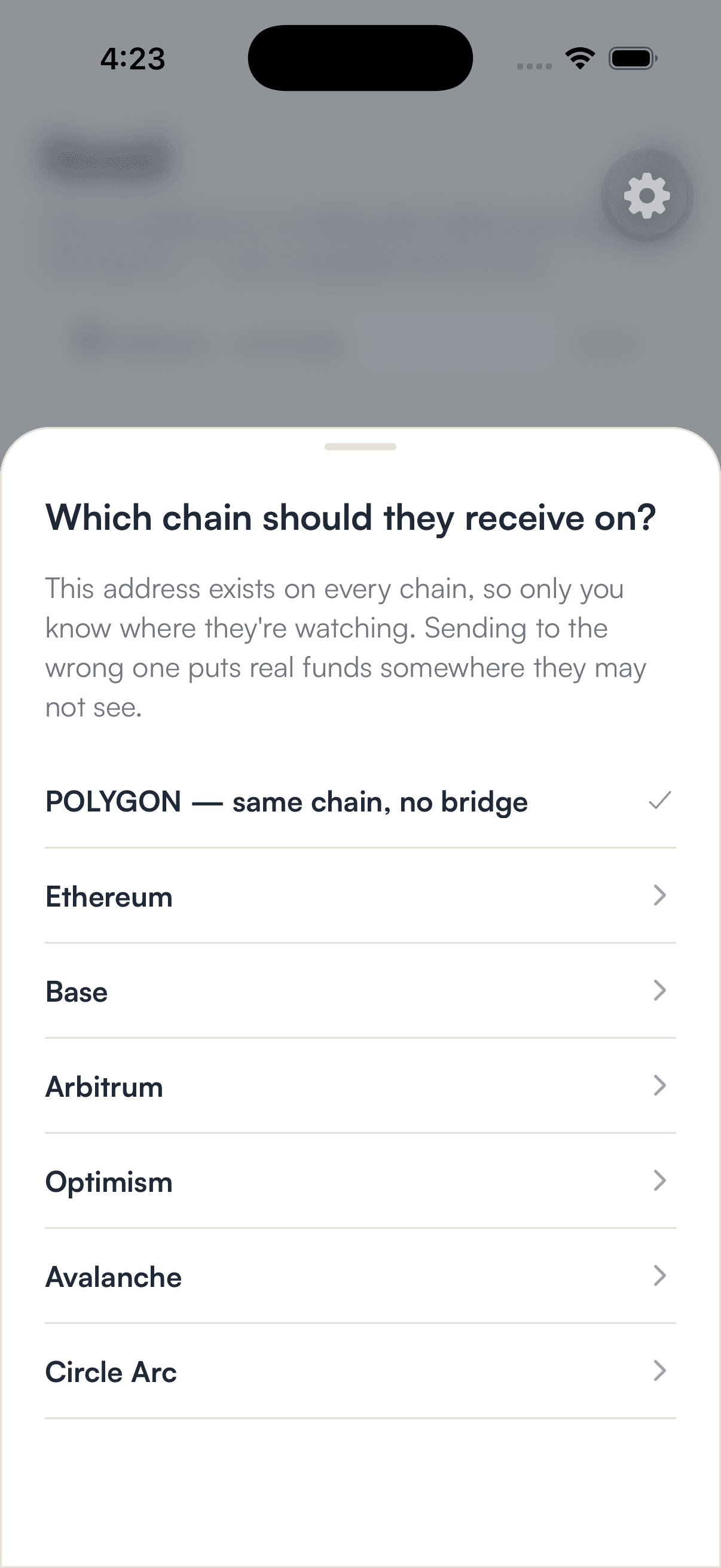
Choose Circle Arc as the destination
Start a USDC send and pick the chain the money should arrive on. Circle Arc sits in the same list as Ethereum, Base and the other supported chains.
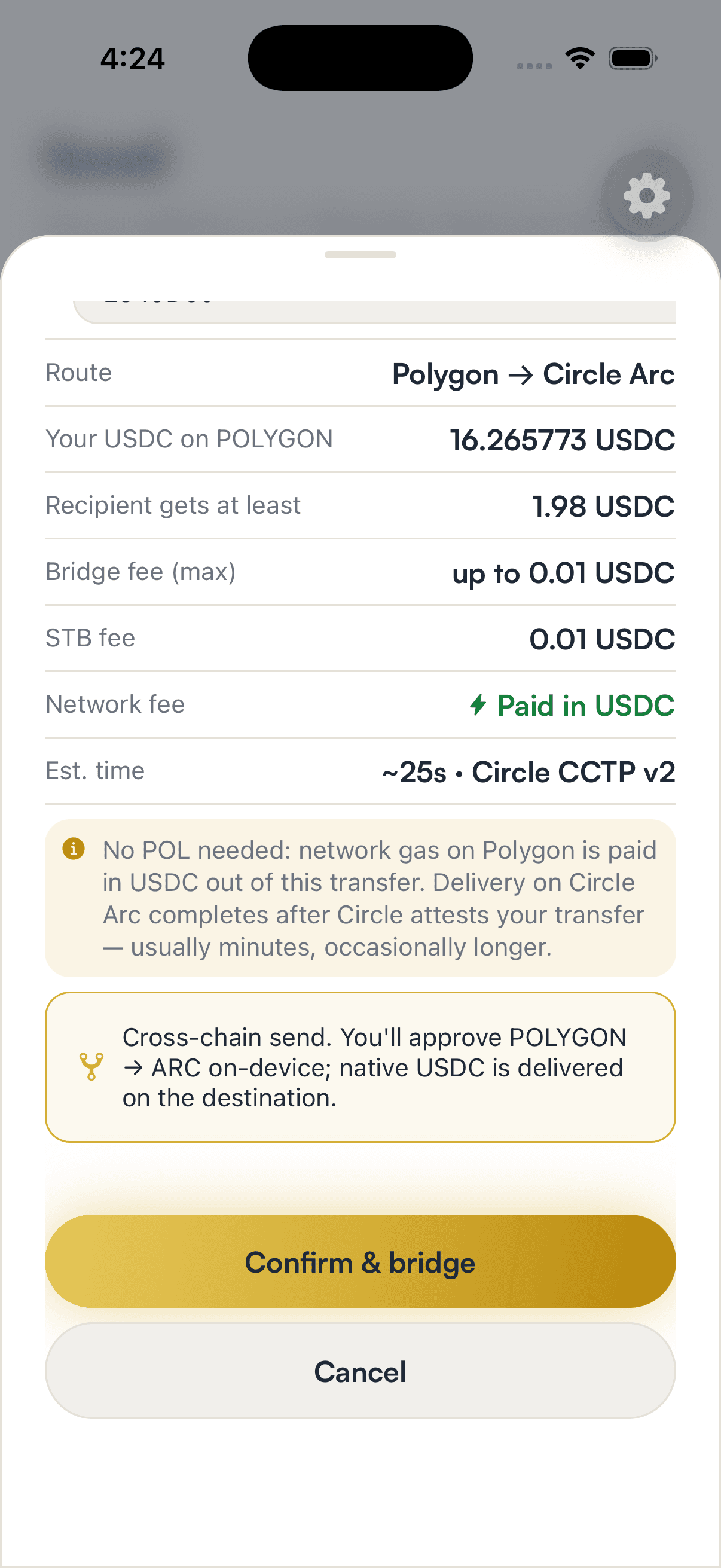
Review the cross-chain transfer
The review shows the route (Polygon to Circle Arc), what the recipient gets at least, and every fee. The network gas is paid in USDC out of the transfer, so you need no second coin.
Watch the burn, attestation and mint
Circle's CCTP burns the USDC on Polygon, attests the transfer and mints native USDC on Arc. The screen shows each stage as it completes.
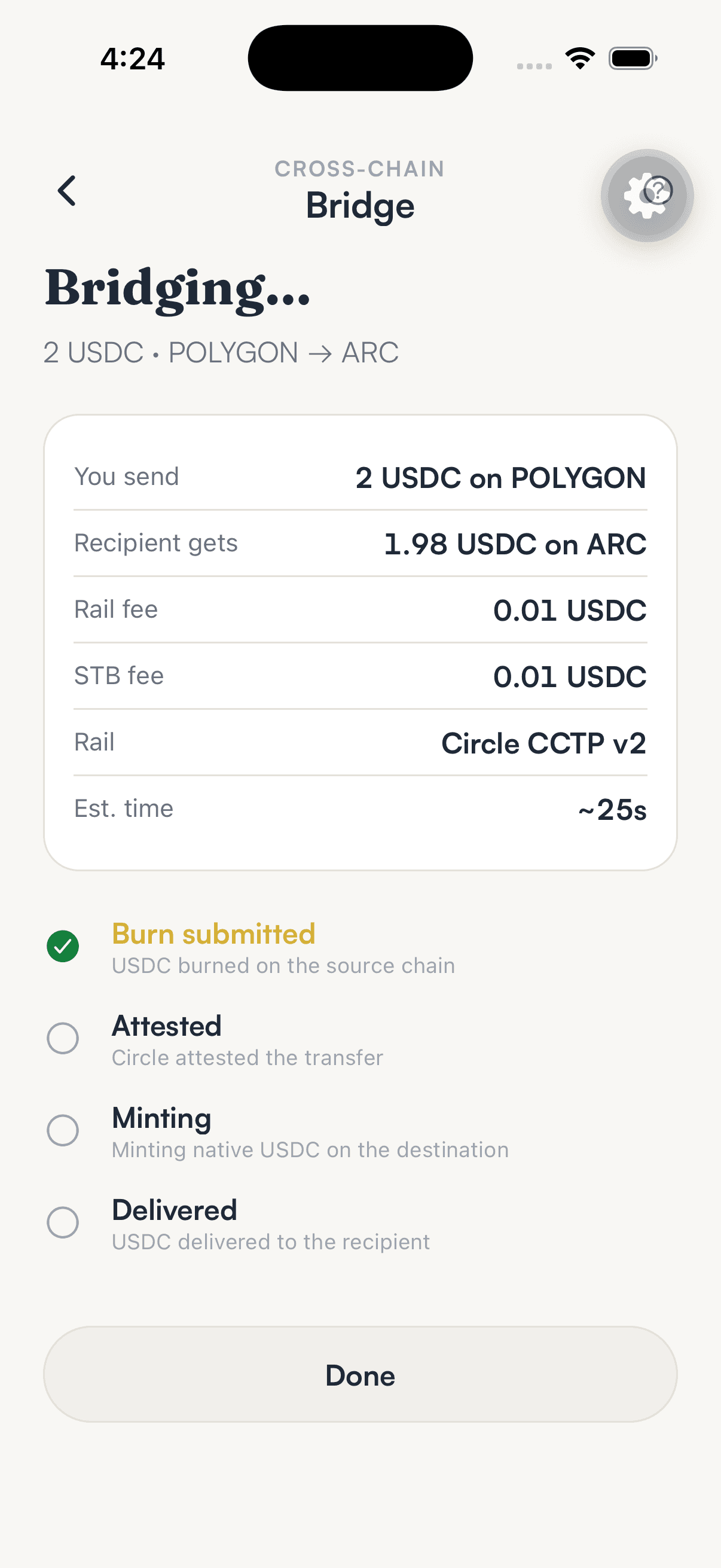
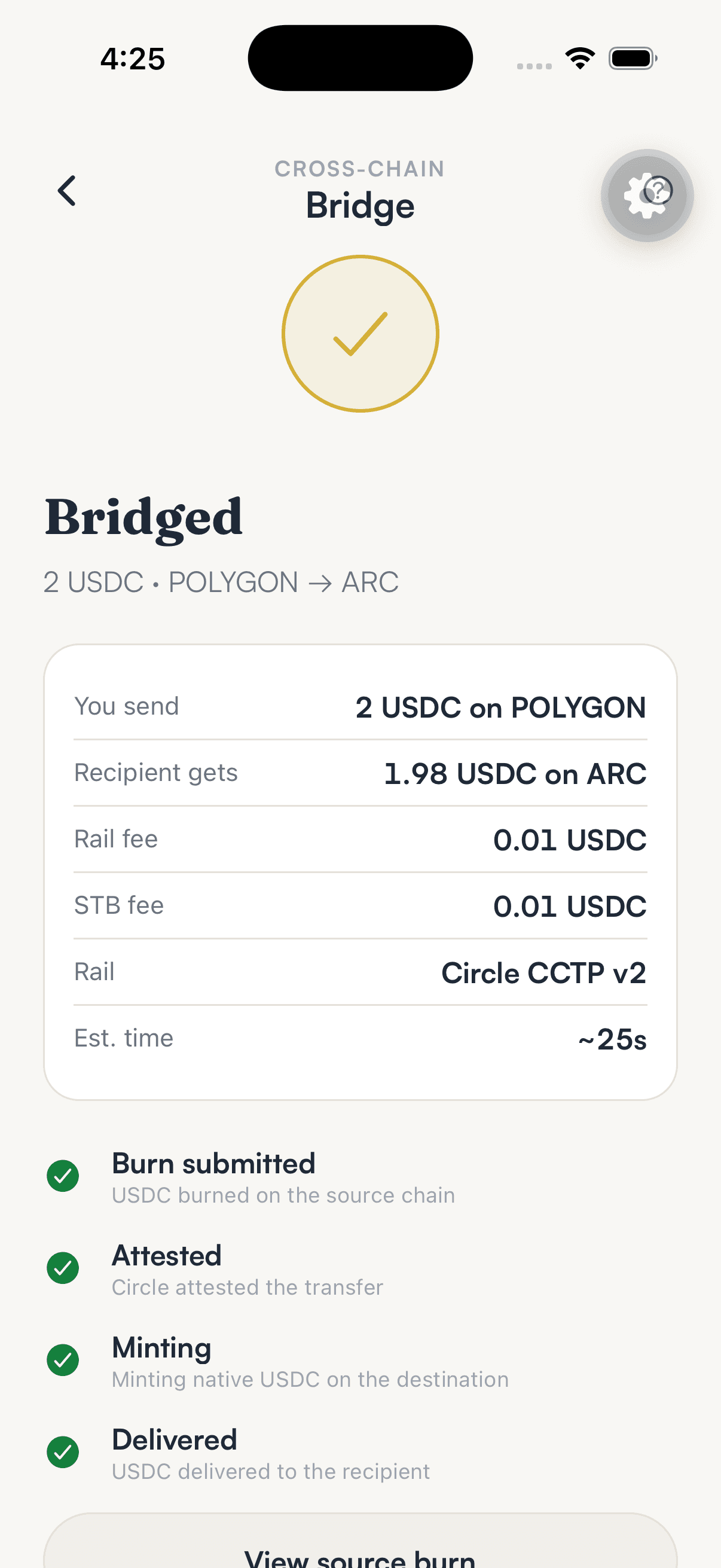
USDC arrives on Arc
In our test the transfer was done in about a minute, as native USDC on Arc rather than a wrapped copy.
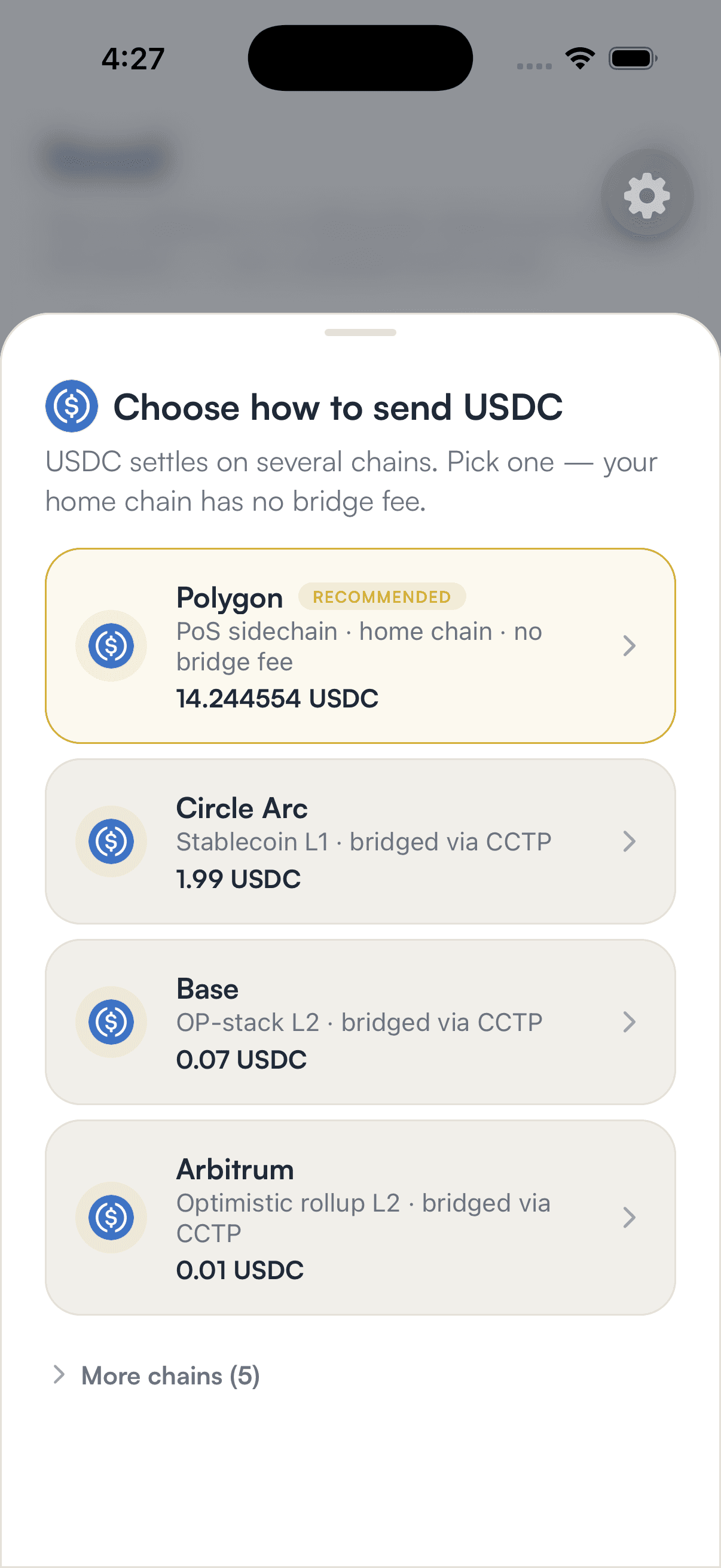
Send from your Arc balance
When you send USDC, the app asks which chain to pay from. Circle Arc appears with your balance there.
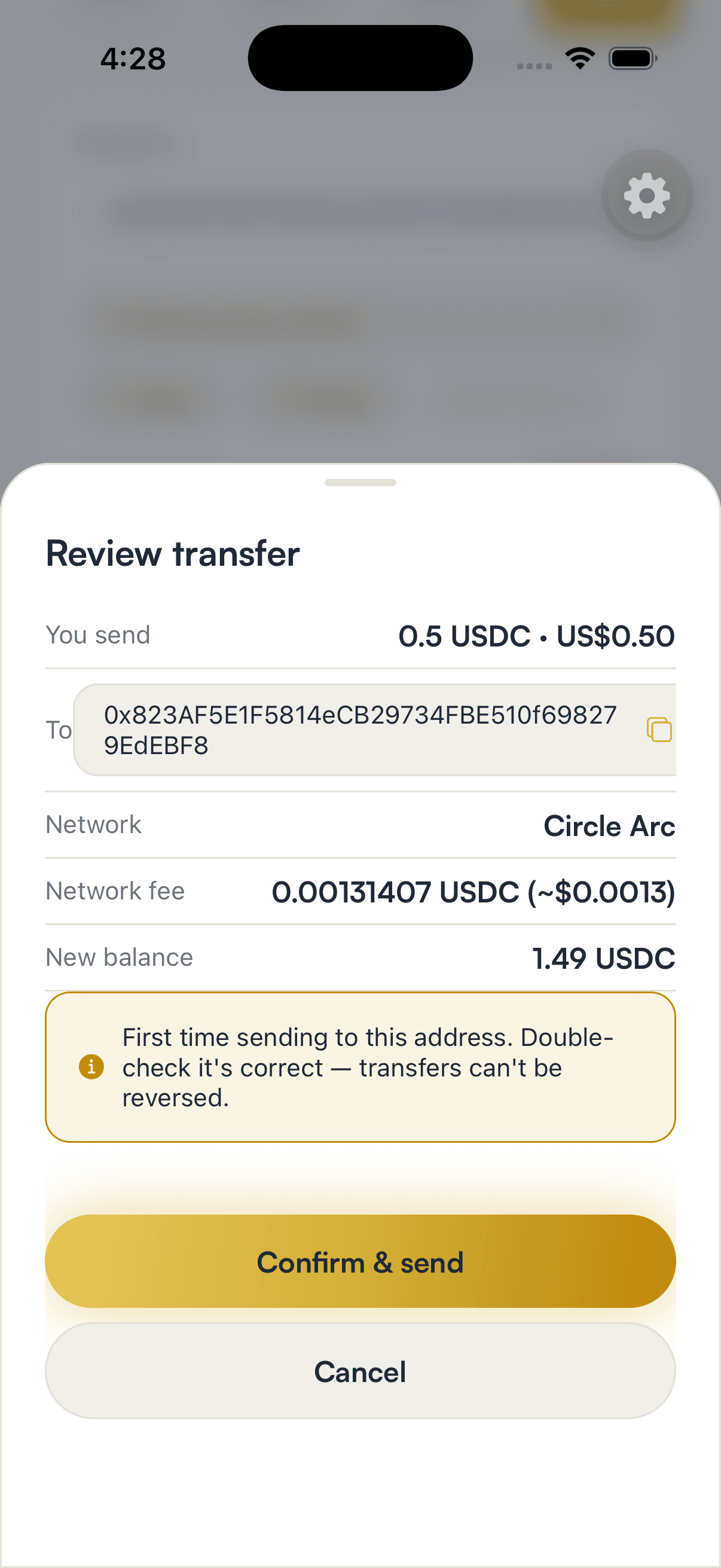
Check the fee, then sign
On Arc the network fee is quoted in USDC. This send quoted about 0.0013 USDC; the recorded fee was 0.00099 USDC. You confirm with Face ID and the phone signs.
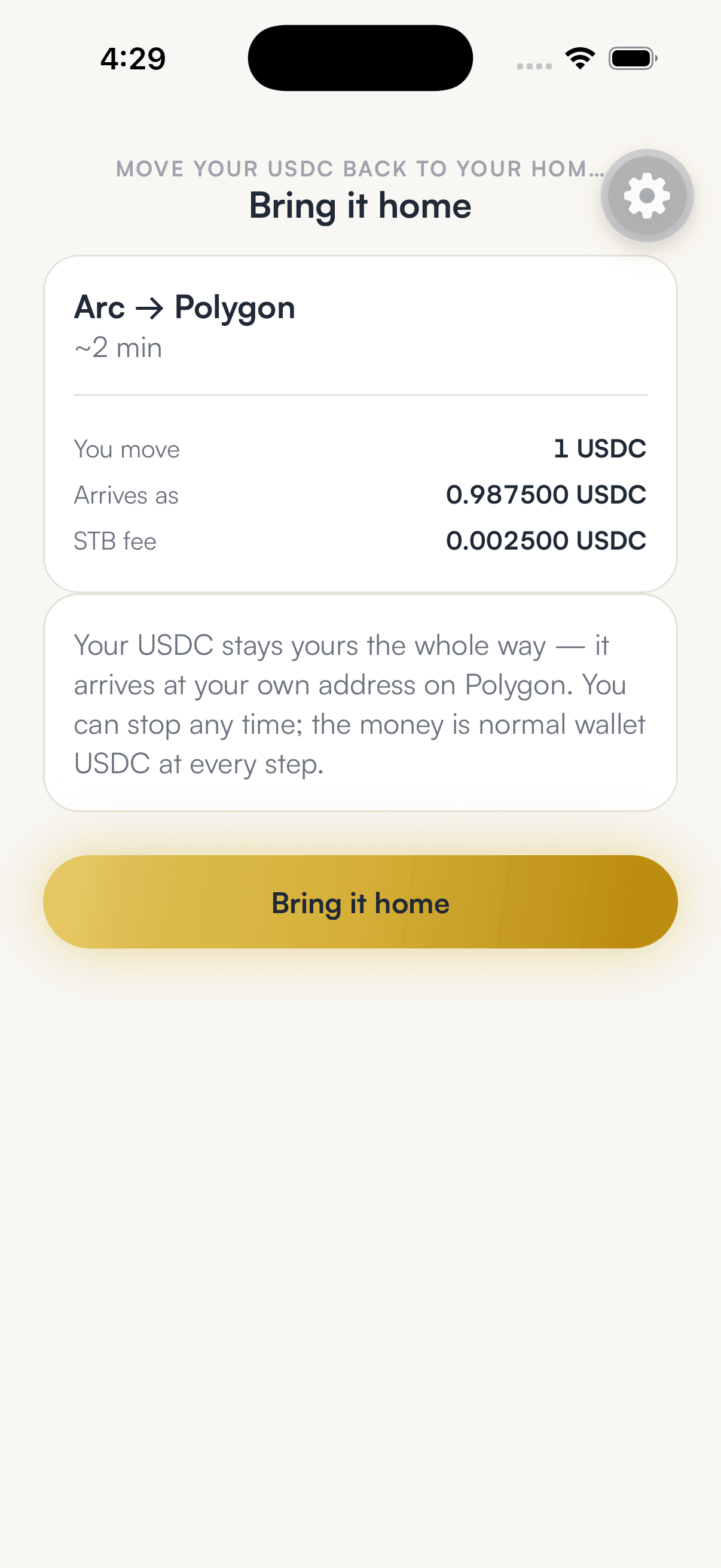
Bring it home whenever you like
Bring it home moves Arc USDC back to your home chain in one step, with the cost shown before you confirm.
Hold your own keys, keep the yield, skip the middleman.
SpendTheBits is a fully non-custodial wallet for 13 chains, free on iOS and Android.