
The native gas problem on standard networks
Standard block chains require you to pay for work in their native volatile asset [5]. If you want to transfer digital dollars on Ethereum, you must hold ether to cover the cost [5]. Without native stable gas on these chains, holding stablecoins is not enough. This rule creates a high barrier for new users who just want to make payments. They get stuck with balances they cannot move.
This setup makes for a bad user experience. People must manage several balances just to make simple transfers. They have to find a way to buy a second coin. This step often needs central sign ups or complex steps. For everyday users, tracking gas prices in gwei is too hard [5]. They just want to know the cost in a currency they know. The mental work of tracking volatile gas tokens turns simple payments into stressful events.
When you cannot pay fees, your funds are stuck. You must ask friends or use central platforms to get a tiny bit of gas. This block limits the use of stablecoins for daily payments. A modern payment network must offer a single asset experience. This allows people to send funds without worrying about volatile gas markets. We believe that payments must be simple, secure, and cheap for everyone, anywhere in the world. This approach is the only way to make digital cash work well.
How Arc implements stablecoin native gas
It builds USDC as gas directly into its core protocol [1][3]. On Arc, the native token is USDC rather than ether [3]. This means that every single transaction fee on the network is paid in the stablecoin you send [2]. Users do not need to worry about holding a second coin. This protocol layout makes the underlying chain work invisible to the everyday user. You simply hold your digital dollars and use them as you wish.
This protocol level setup relies on a dual interface system [3]. USDC on Arc features a native interface with eighteen decimals of precision for gas [2][3]. It also provides a standard ERC-20 interface with six decimals for transfers [2][3]. This design allows standard tools to work without change [3]. They can deploy existing contracts without making any major changes to their codebase.
Because Arc denominates its transaction fees in USDC, the pricing model provides stable and predictable gas costs [2]. You see your fees in clear dollar terms, making cost tracking simple [2]. To learn more, you can read what the Arc network is. This approach makes self custody payments highly intuitive. It removes the need to calculate exchange rates or keep track of residual native balances. It is a true single asset experience that feels like a standard bank account.
Stable fees via mathematical smoothing
On standard networks, gas prices can spike wildly in seconds when demand surges [5]. This volatility makes transaction fees unpredictable. It forces wallets to use complex fee estimation [1]. Arc solves this by replacing standard per-block base fee recalculations with a smoother mathematical approach [1]. The fee market on Arc replaces per-block base fee recalculation with an exponentially weighted moving average of block utilization [1]. This ensures that fees do not jump during brief traffic spikes. The network remains stable and usable even when busy.
This smoothing mechanism blends recent block utilization into a running average [1]. Under normal conditions, the protocol targets a low base fee of about 0.001 USDC for a transfer [1]. These clear boundaries give users total peace of mind when sending transactions. You can predict exactly what you will pay before you click send.
This smoothing ensures that short-term demand spikes do not cause sudden fee jumps [1]. Developers can quote transaction costs to their users with total confidence [1]. By keeping costs predictable and dollar-denominated, the network provides an enterprise-ready environment [1]. Users can plan their payments without fearing sudden network congestion. This makes it ideal for businesses that need to track expenses accurately. You never have to worry about sudden cost swings that disrupt your daily work.
The complexity of paymaster workarounds
Other networks attempt to allow stablecoin gas payments through paymasters [4]. These systems let you pay with stablecoins, but they introduce extra complexity. They also add extra costs. For instance, the Circle Paymaster charges a ten percent surcharge on gas fees on Arbitrum and Base to cover operational costs [4]. This surcharge makes everyday transactions more expensive for the end user. It is a costly way to solve a simple problem, forcing users to pay more for basic movements.
The permissionless paymaster is an onchain smart contract that requires no offchain APIs and can be integrated by any developer [4]. These smart contracts must manage native balances behind the scenes to ensure transactions go through [4]. This extra layer of infrastructure creates more points of failure. Users might also have to set up complex approvals before they can even use the paymaster [4]. This can result in slower execution times when the network is busy, leading to pending transactions that frustrate users.
For a deeper comparison of these designs, you can read our guide on paymasters. While paymasters help, they cannot match the efficiency of a native model. A native gas asset removes the need for third-party relayers. It also removes heavy smart contract execution overhead. This makes native stablecoin payments much cleaner and cheaper. It represents the best standard for modern stablecoin transaction design. Paying directly is always better than using a middleman.
Real-world performance in SpendTheBits testing
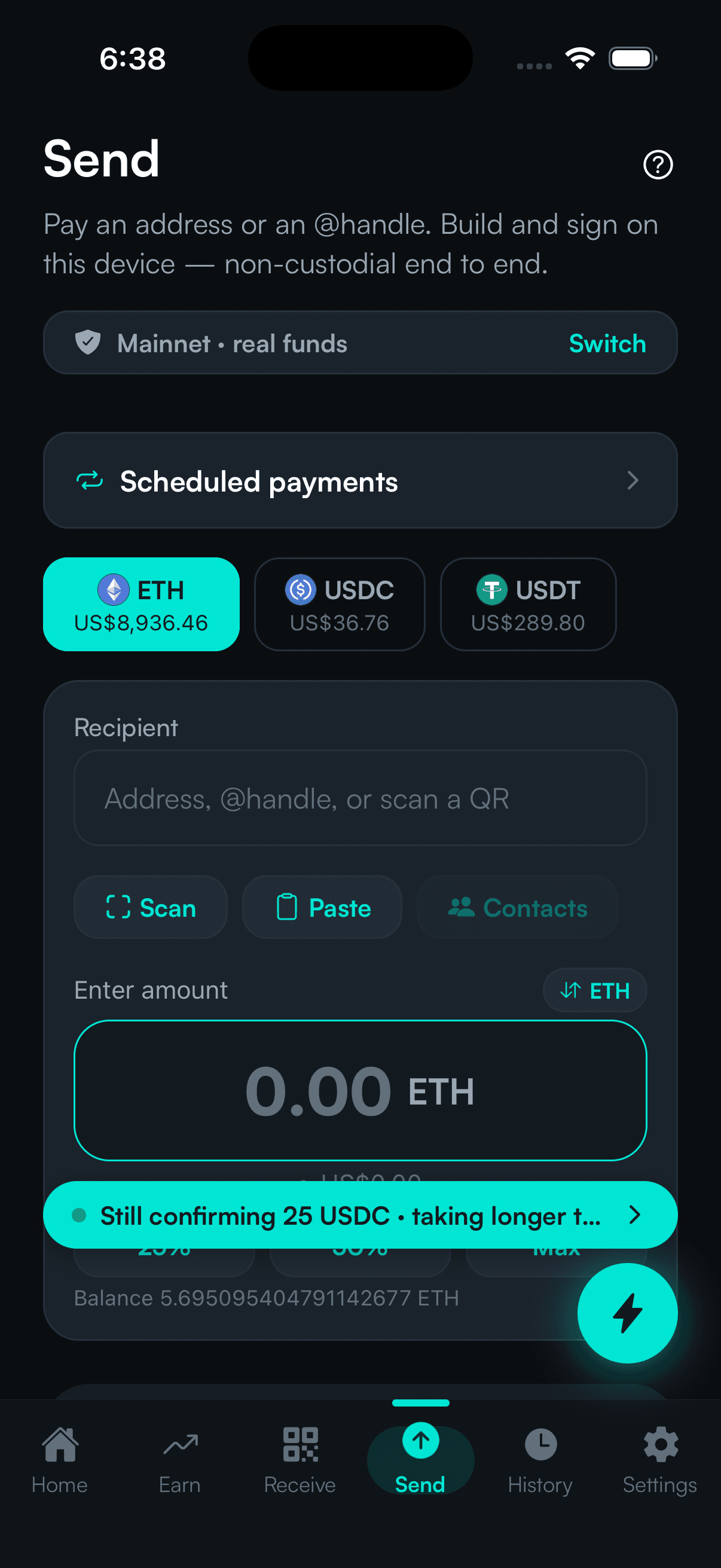
We wanted to see how this native gas design performs in a real wallet. Our team conducted production testing within the live SpendTheBits application on 18 September 2026. SpendTheBits is a fully non-custodial wallet. This means the private keys remain entirely on your device. We signed each test transaction locally before broadcasting it. The backend only prepares public data and never sees our keys, ensuring absolute custody. You retain complete ownership of your funds at all times.
In our production test on 18 September 2026, we tested a bridge from Polygon to Arc. It finished in about one minute. SpendTheBits handles this bridge smoothly, charging a small fee, under 1%. The relayer's mint on Arc cost about 0.004 USDC in gas during our test. During production testing, we found that bridging from Polygon to Arc was completed in approximately one minute. It proves that cross-chain transfers can be fast and reliable.
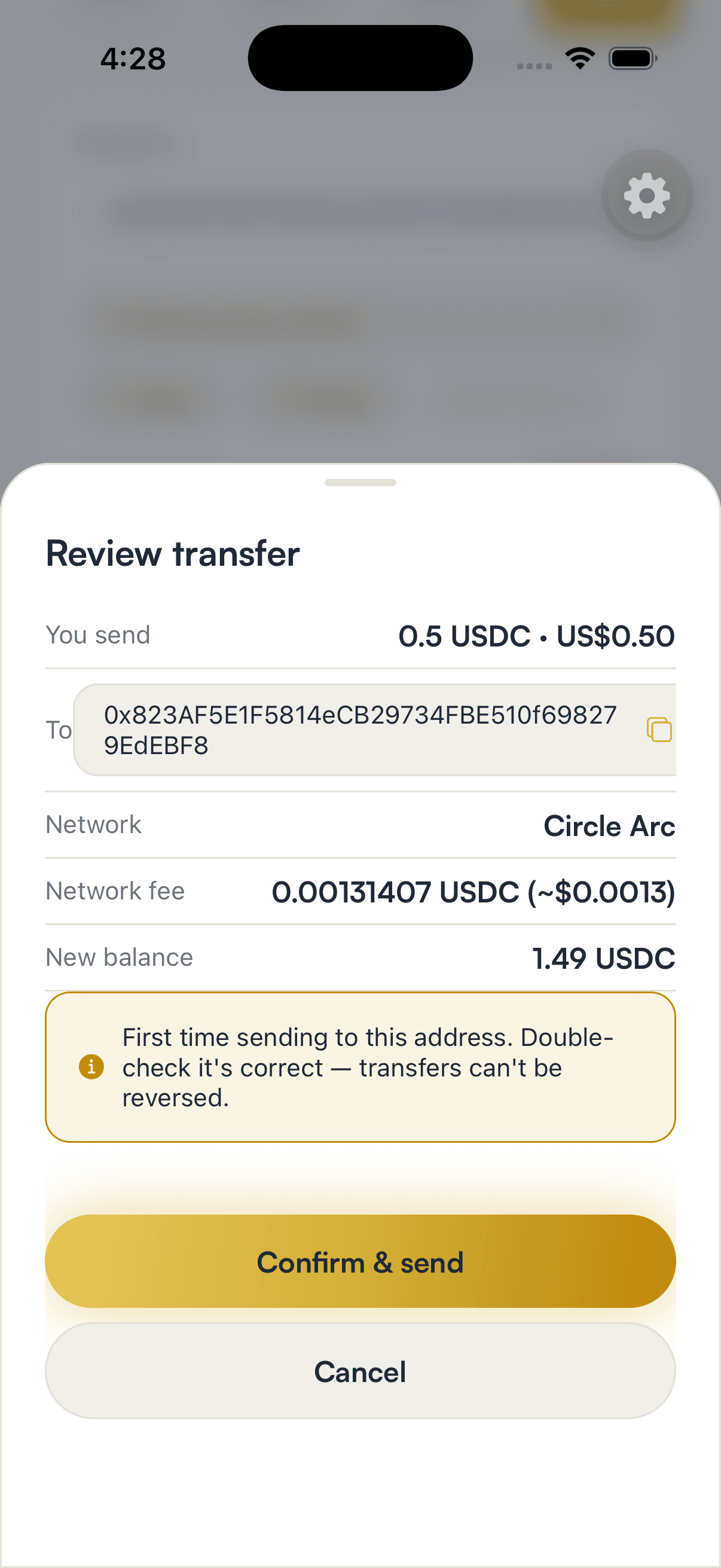
Our testing included performing a USDC send transaction on Arc. In our production test on 18 September 2026, a USDC send on Arc cost about 0.001 USDC in network fee. This matches the protocol's target floor [1]. We observed that a USDC send transaction on the Arc network cost about 0.001 USDC in network fees. No second coin was needed at any point. The payment was fast, easy, and entirely in stable digital dollars. It is a massive leap forward for mobile payments. It shows that single-asset transactions are the future of digital cash.
The future of intuitive self-custody payments
Combining native stable gas with a non-custodial wallet changes how people interact with digital assets. Users no longer need to be blockchain experts to manage their funds safely. They can simply back up their seed phrase and begin transacting immediately. To understand the safety benefits of this setup, read how to self-custody stablecoins. Retaining full ownership of your keys protects you from centralized failures. It ensures that you are always in complete control of your wealth.
By eliminating the requirement to hold multiple tokens, we make digital dollars accessible to everyone. The option to pay with USDC as gas on Arc ensures that transactions remain cheap and predictable [1][2]. This is crucial for microtransactions, payroll, and global transfers. To see how this compares with other stablecoin types, read our analysis on native vs bridged assets. This helps users select the best network rail for their needs. It makes global money transfers practical for everyday transactions.
The future of peer to peer payments relies on removing technical friction while preserving true ownership. With a non-custodial architecture, you retain absolute control over your digital assets at all times. By pairing this security with native stablecoin transaction fees, we get the best of both worlds. It delivers the speed of traditional finance with the trustless security of the blockchain. This integration sets a new benchmark for what modern self-custody wallets should achieve. It is the payment standard we have all been waiting for.
In the app · 4 steps
Send USDC on Arc with no second coin
On Arc the network fee is paid in USDC, so a wallet holding only USDC can still send.
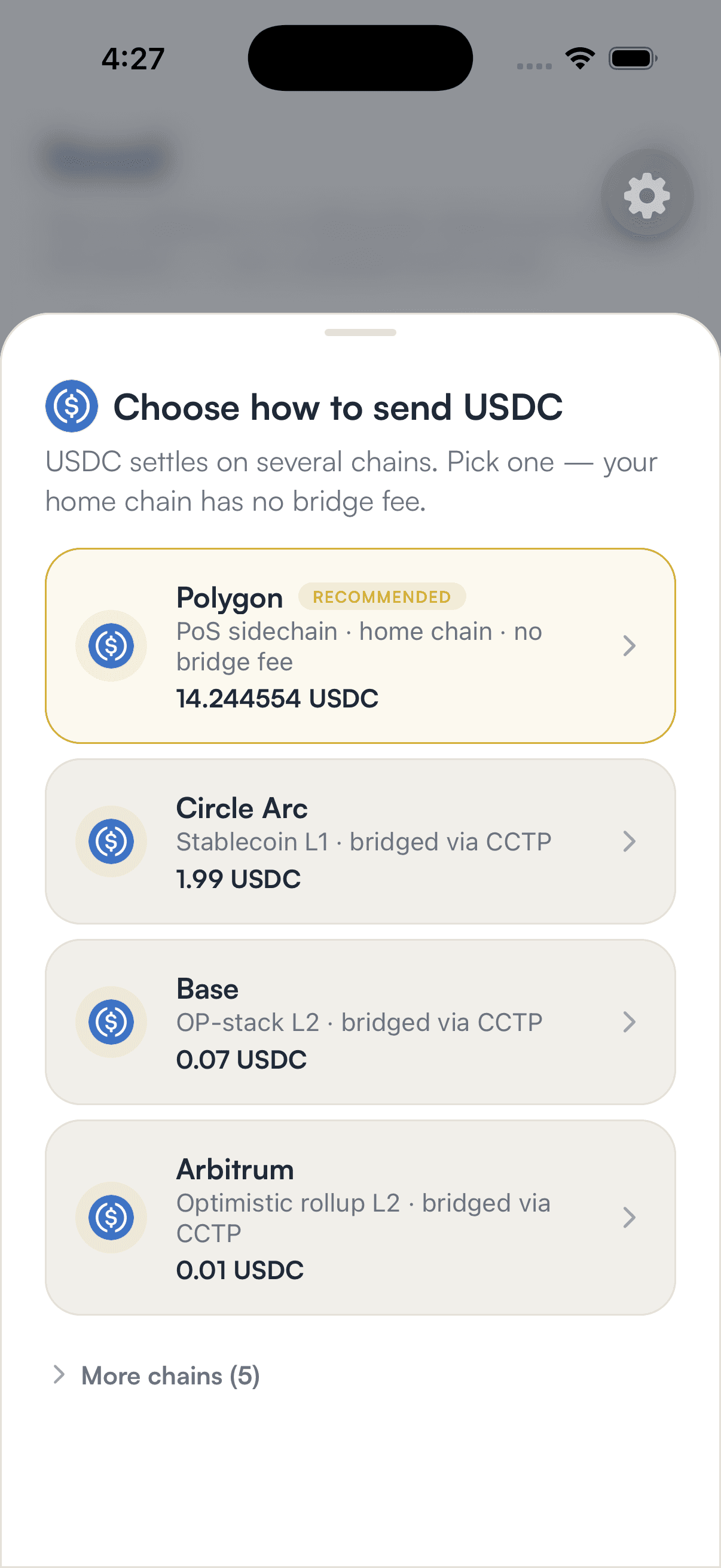
Pick Arc for your USDC
Choose Arc as the chain when you receive or move USDC.
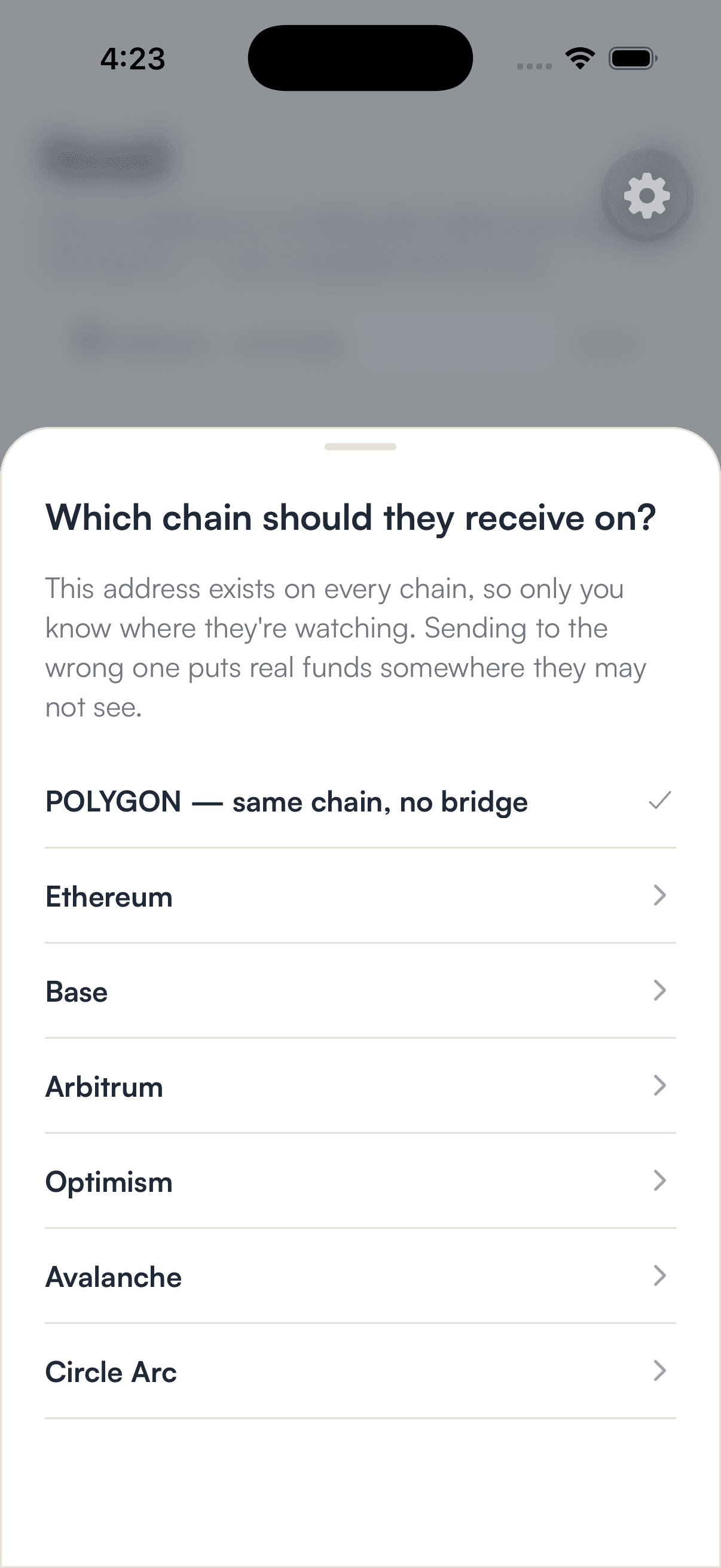
Bring USDC over if it is elsewhere
Bridge USDC from another chain and review the route before you sign.
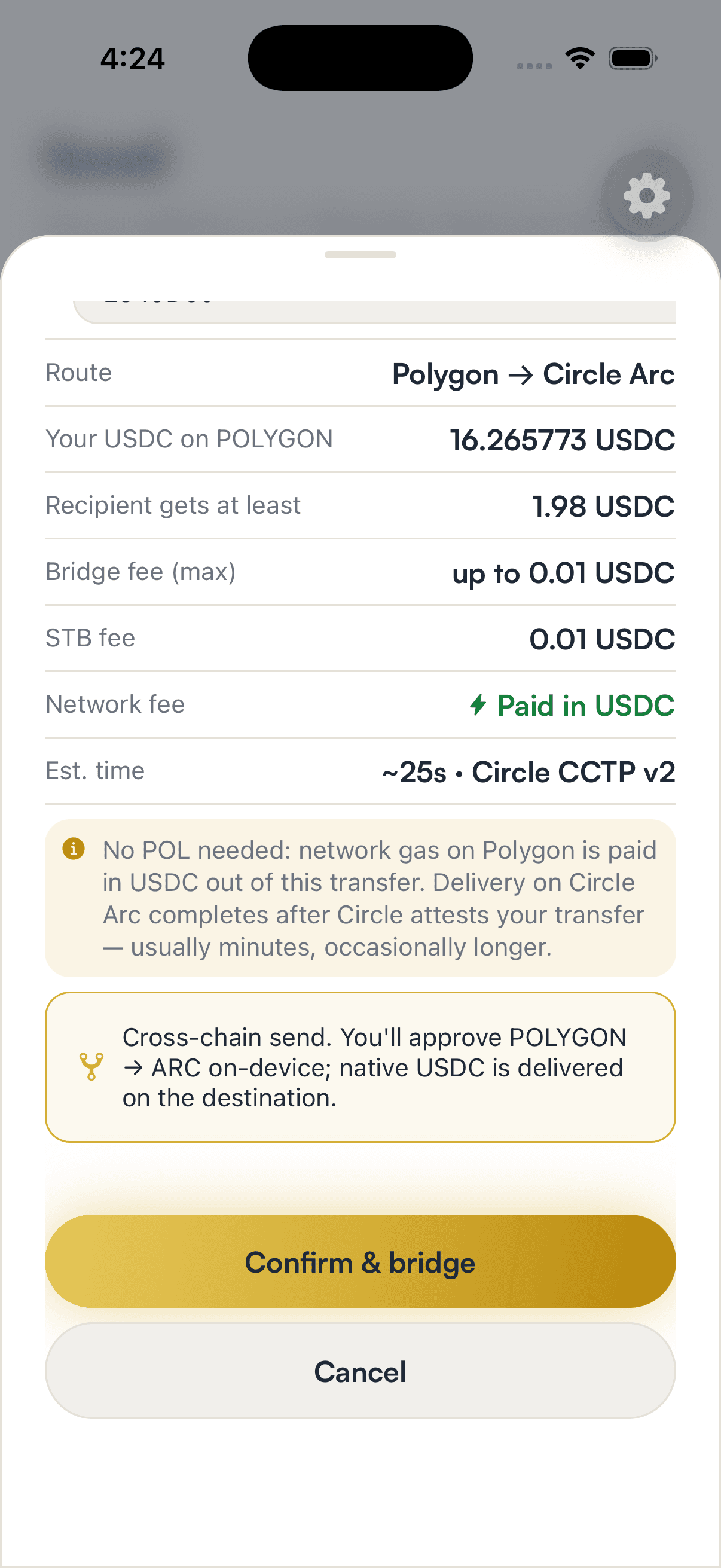
Choose the Arc rail when you send
Pick USDC on Arc as the rail for the payment.
Review the fee in USDC
The review shows the network fee in USDC, so there is no gas token to top up.
Hold your own keys, keep the yield, skip the middleman.
SpendTheBits is a fully non-custodial wallet for 13 chains, free on iOS and Android.