

The Protocol Architecture for Agentic Commerce
The x402 protocol offers a negotiation flow where servers communicate that payment is required to access a resource and clients provide proof of payment [5]. The x402 protocol provides a clean way to do this using standard web codes [5]. When a tool asks for a paid resource, the server replies that payment is required [5]. It lists the price and the accepted networks [5]. The tool then signs a quick payment payload to get the resource [5]. This negotiation happens in a single request and response cycle [5]. It makes automated web tasks easy to build and run.
This new flow works very well for automated machine tasks. It lets software tools negotiate and pay in one quick loop [5]. Since it uses open web standards, any client can use it [5]. Builders do not have to set up complex card systems or user accounts. They can choose x402 on Arc to keep their fees low [1]. The tool just signs an offchain message to prove it can pay [5]. This removes the friction of old web payment flows.
Old payment systems carry high fixed fees and take too long to settle [5]. They do not work for tiny payments under one cent [5]. Using stable coins on a fast network solves this issue [1][5]. It allows software tools to pay for exactly what they use in real time [1][5]. Builders can charge per prompt or per database search [4][6]. This makes micro-payments a real option for modern web services.
Deterministic Finality on the Arc Blockchain
Software tools need fast and sure payments to run complex tasks. Old chains use probabilistic settlement, which forces your system to wait for many block checks [2]. If a block changes, your payment might fail [2]. Arc uses Malachite consensus to give you deterministic finality [2]. This means every transaction is either final or unconfirmed on commit [2]. There is no middle state and no risk of a chain change [2]. It gives you absolute certainty from the very start.
This fast settlement makes a huge difference for automated workflows. While Ethereum can take up to fifteen minutes to finalize, Arc does it in under one second [2]. This speed removes the risk of waiting for funds to clear [2]. Tools can execute many sequential steps in a row with total peace of mind [2]. They do not need to pause or poll the chain between each step [2]. It simplifies the whole process for builders and users alike.
Sub-second finality is perfect for online shops and metered APIs [1][2]. A seller can deliver the data as soon as the block commits on the chain [2]. Developers only have to track two simple payment states in their code [2]. This makes the software much easier to write and test [2]. It also meets the high standards of regulated financial firms [2]. You get speed and safety at the same time without extra wait times.
The Critical Role of Facilitators
A facilitator acts as a helpful layer for verifying and settling x402 payments [3]. Instead of running your own blockchain node, you let the facilitator do the heavy work [3]. It checks payment signatures and submits them to the network [3]. This means your web server does not need direct blockchain tools [3]. It reduces the work you have to do to accept payments. You can focus on building great features instead of managing network nodes.
Using a facilitator means you do not have to hold gas coins to pay fees [6]. The facilitator submits the transactions and monitors the chain for you [3]. It makes sure the payments are valid and reports the results back [3]. This setup keeps the payment flow clean and uniform across different web services [3]. You can quickly build and test against the CDP Facilitator, which lets you move from testnet to mainnet with the same provider [4]. It keeps your backend simple and easy to maintain.
This flow is very useful when you use x402 on Arc for stable coin settlement. The buyer signs an offchain message that does not cost any gas [5]. The seller then sends this signed message to the facilitator [3]. The facilitator submits it and pays the network gas [6]. It is a smart way to process high volume without high costs. It keeps the user experience smooth and fast for every transaction.
Comparing Circle and Coinbase Facilitators
Choosing your facilitator determines which chains you can support. Circle's hosted service lets you accept USDC on Arc, Base, and Polygon PoS [6]. This service requires an API key, but you can start with a free trial [6]. It screens both parties before any money moves on the chain [6]. This built-in screening keeps your service compliant without extra tools [6]. It is a solid choice for modern apps that need to scale quickly.
Sellers can reach buyers across EVM and Solana networks by accepting ERC-20 and SPL tokens [4]. It works on Base, Polygon, Arbitrum, World, and Solana [4]. It has processed over one hundred million transactions and twenty-eight million dollars in volume [4]. It offers a free tier for the first one thousand transactions each month [4]. After that, each transaction costs a tiny fraction of a dollar [4]. This limits its use for certain projects.
If your project uses x402 on Arc, you must use Circle's service [6]. This choice is important because of how these chains settle. Base and Polygon have reorganization risks, while Arc settlements are completely final [6]. This means you do not have to worry because every transaction in a committed block is immediately and irreversibly settled [2]. Choosing the right partner helps you build a more stable payment system for your tools.
Multi-Chain Wallet Support and Self-Custody
Operating in the web economy requires a very secure wallet. SpendTheBits provides a fully non-custodial wallet that keeps you in control. The seed phrase and private keys stay on your own device. The backend only stores public data and cannot touch your funds. This keeps your stable coins safe from third-party risks. It is a true self-custody stablecoin wallet built for daily use. It ensures you have full ownership of your assets.
Managing assets on different chains can be hard. SpendTheBits solves this by using one EVM address across all supported EVM networks. You can hold, send, and bridge stable coins with ease. Before you send, the app asks which rail you want to use. Every address is screened to keep you safe from scams. This makes multi-chain management simple for any user. It reduces the risk of sending tokens to the wrong network.
Moving funds between chains is also easy. You can bridge USDC between chains using the built-in Circle CCTP tool. The app burns the tokens on the source chain and mints them on the destination chain. SpendTheBits charges a small bridge fee, under one percent, which is shown before you confirm. This helps you keep your funds active on the fastest chains. It is a smooth way to manage your liquidity.
Accepting Agent Payments in Production
With SpendTheBits, any @handle can sell a resource over x402 at x402.spendthebits.com. Our 402 lists Base first, because that is what most x402 clients pay on today, and offers Arc right after it. Any client that names Arc settles through Circle's Facilitator Service, while Base, Polygon, Arbitrum and Solana settle through Coinbase's CDP facilitator. Our guide on how to get paid by AI agents walks through the setup. It opens up new revenue paths.
In our production test on 18 September 2026, a Polygon to Arc bridge finished in about one minute. In our test, a USDC send on Arc cost about 0.001 USDC in network fee. We also measured that the mint on Arc cost about 0.004 USDC in gas. These low costs are perfect for micro-payments. You do not have to worry about high fees cutting into your profits. It is cheap to run. The application can pay an x402 URL directly from the Send or Scan screen.
If Circle reports a payment is still settling, we treat it as pending, never failed. This keeps the flow moving. To learn more, check our guide on native versus bridged stablecoins. It shows how these assets work across different chains. Using x402 with the Facilitator Service is a convenient way to accept payments in USDC on Arc without operating a relayer [6]. It is ready for you today. It is built to help your business grow.
In the app · 4 steps
Get paid by an agent in SpendTheBits
Your handle is the endpoint an agent pays. Here is where to find it and where the money shows up.
Claim a handle
The handle is the address agents pay. It is also your Lightning address, so one name covers both.

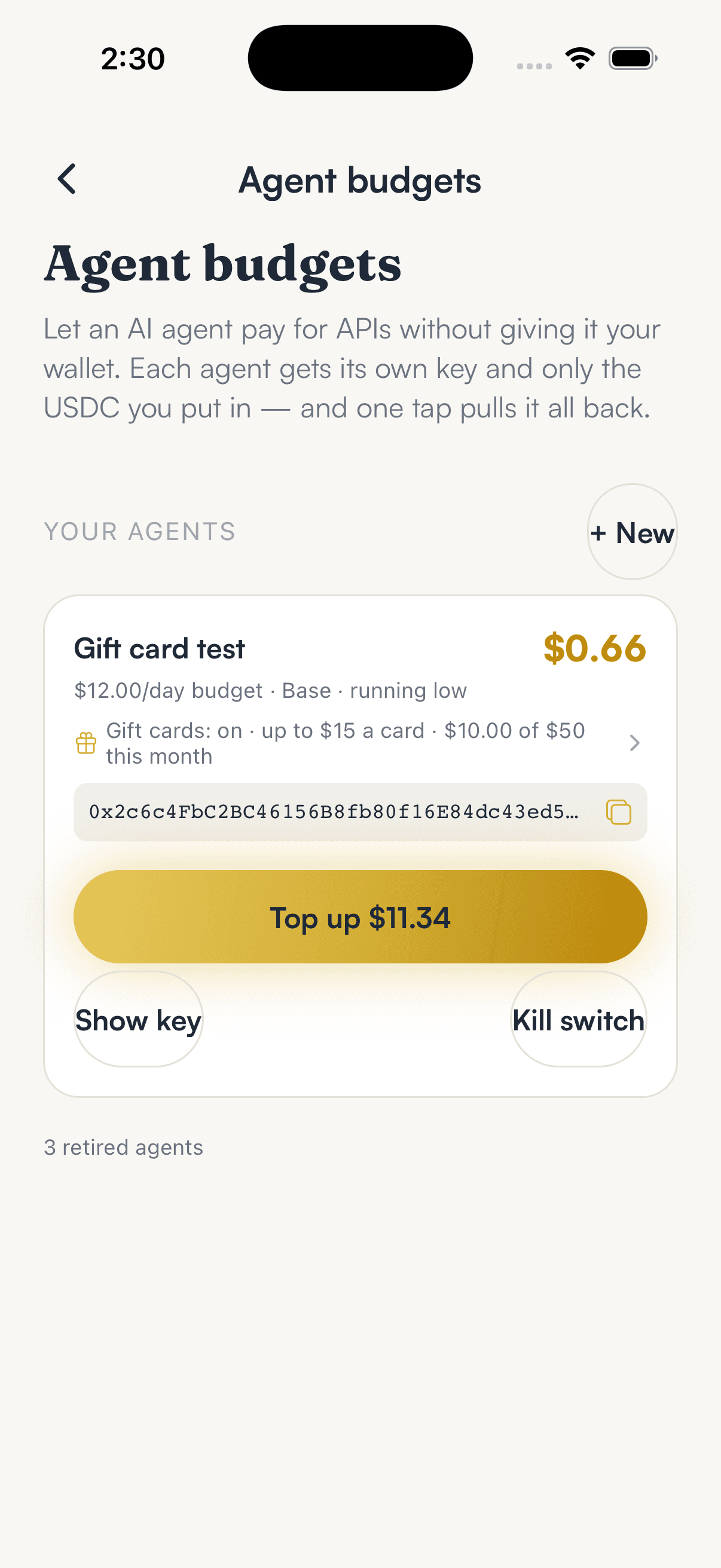
Set what an agent may spend
Each agent gets its own key and only the USDC you put there, with per-card and monthly caps you set.
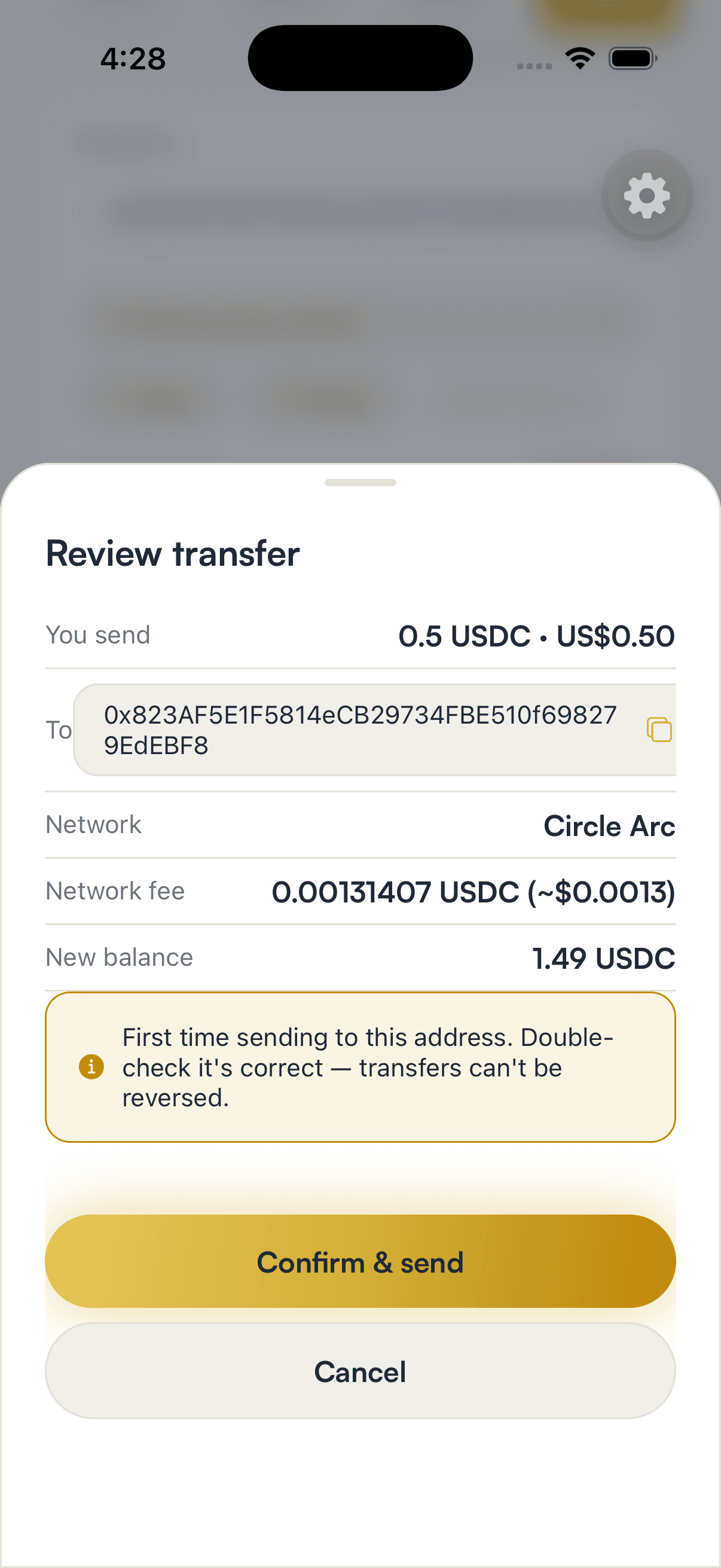
Review a payment on your device
Anything that moves your own funds is reviewed and signed on the phone, never by the agent.
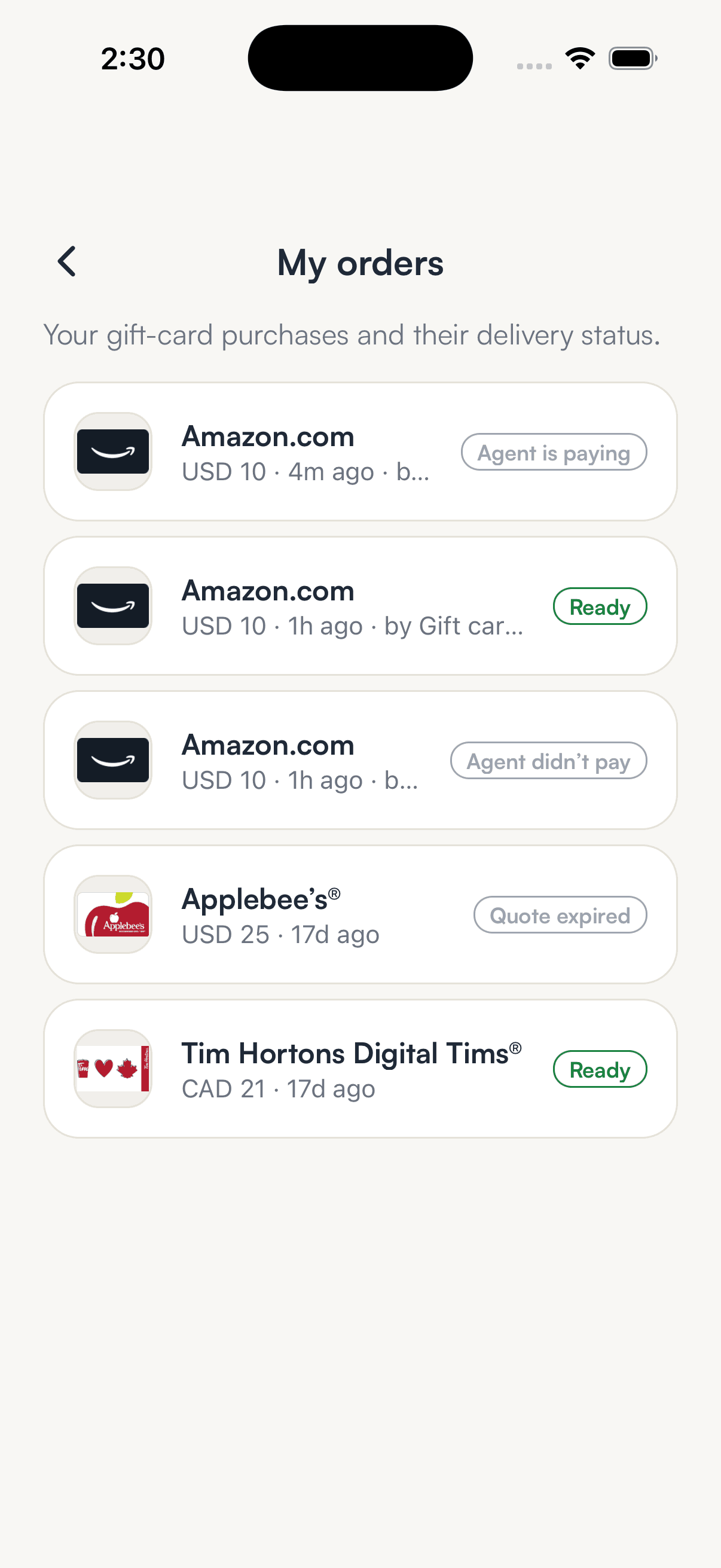
See what the agent bought
Orders an agent placed are labelled as theirs, so your own activity stays readable.
Hold your own keys, keep the yield, skip the middleman.
SpendTheBits is a fully non-custodial wallet for 13 chains, free on iOS and Android.