
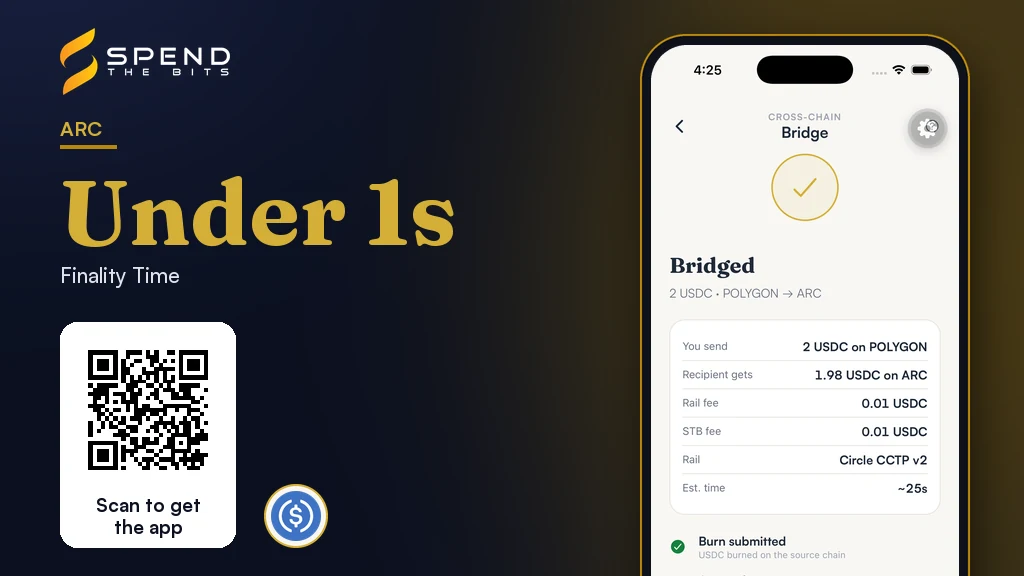
How the Consensus Layer Works on Arc
To get this speed, the network splits consensus and execution into two layers [2]. This smart design keeps tasks clean and highly optimized [2]. The consensus layer runs Malachite, which is a high-performance engine [2]. This is a fast way to run Byzantine Fault Tolerant consensus [2]. It needs more than two-thirds of validators to sign a block before it is committed [1][2].
Once those validator votes are in, the block is written to the ledger [2]. Transactions on Arc are simple and direct. They are either not done or fully done [1]. There is no middle state to worry about. There is no middle ground or waiting period [1]. With this smart setup, the network gets deterministic finality in under one second [1][2]. This means every payment in a block is done and cannot be changed [1].
This design makes building financial apps much easier for developers. You do not need to write complex code to handle chain reorganizations [1]. You do not have to wait to update your data or send customer webhooks [1][2]. This is why we support Arc natively in our self-custody wallet app. It lets your firm hold and send stablecoin funds with no fear. Settled deals cannot be undone.
How Arc Compares to Ethereum Layer One
We can compare this sub-second performance to how Ethereum works on layer one. Ethereum uses proof-of-stake to secure its network [3]. Validators must stake thirty-two ETH of capital to vote on blocks [3]. Time on Ethereum is split into slots of twelve seconds and epochs of thirty-two slots [3]. One validator node is randomly selected to propose a block per slot [3].
Getting true finality on Ethereum takes two full epochs of validator check signs [1]. This consensus process typically takes about twelve to fifteen minutes to complete [1]. If you run a shop, you cannot make your clients wait fifteen minutes to check a payment [1]. It slows down your checkout and ruins the user experience. Firms need fast payment checks. Layer one cannot do this well on its own.
Ethereum also suffers from minor reorganization risks before Casper finalizes the blocks [3]. If validator nodes disagree on the tip, the chain can split temporarily [3]. In contrast, Arc has zero reorganization risk [1][2]. Once a block commits, it is set in stone forever [1][2]. This is deterministic finality. It keeps shops safe from double-spend threats and slow deals.
The Challenge of Staged Finality on Rollups
Yet, they bring in complex, many-step finality paths that make financial workflows hard [4]. Base has four distinct stages of transaction safety [4]. First is flashblock inclusion, which takes about two hundred milliseconds [4]. While this is fast, it is only a preconfirmation and does not represent true finality [4]. There is still a tiny probability of a reorganization [4].
The next stages involve L2 block inclusion and posting transaction batches to Ethereum [4]. Full batch finality on the layer one network takes about twenty minutes [4]. Moving funds off the rollup is even slower [4]. Standard withdrawals to Ethereum must wait for a long dispute window [4]. This window is five days for single-proof games or one day on the fast path [4]. This delay is necessary to let validators check for fraud [4].
These long waiting windows lock up business liquidity and disrupt cash flow. Arc does not use these multi-day delay windows because it is not a rollup [1]. There are no batch steps or challenge periods to wait for [1]. It gives you true, irreversible settlement in under one second [1]. This makes it great for fast business payments that need to clear right now with no risk.
Direct Payment Routing and Testing Results
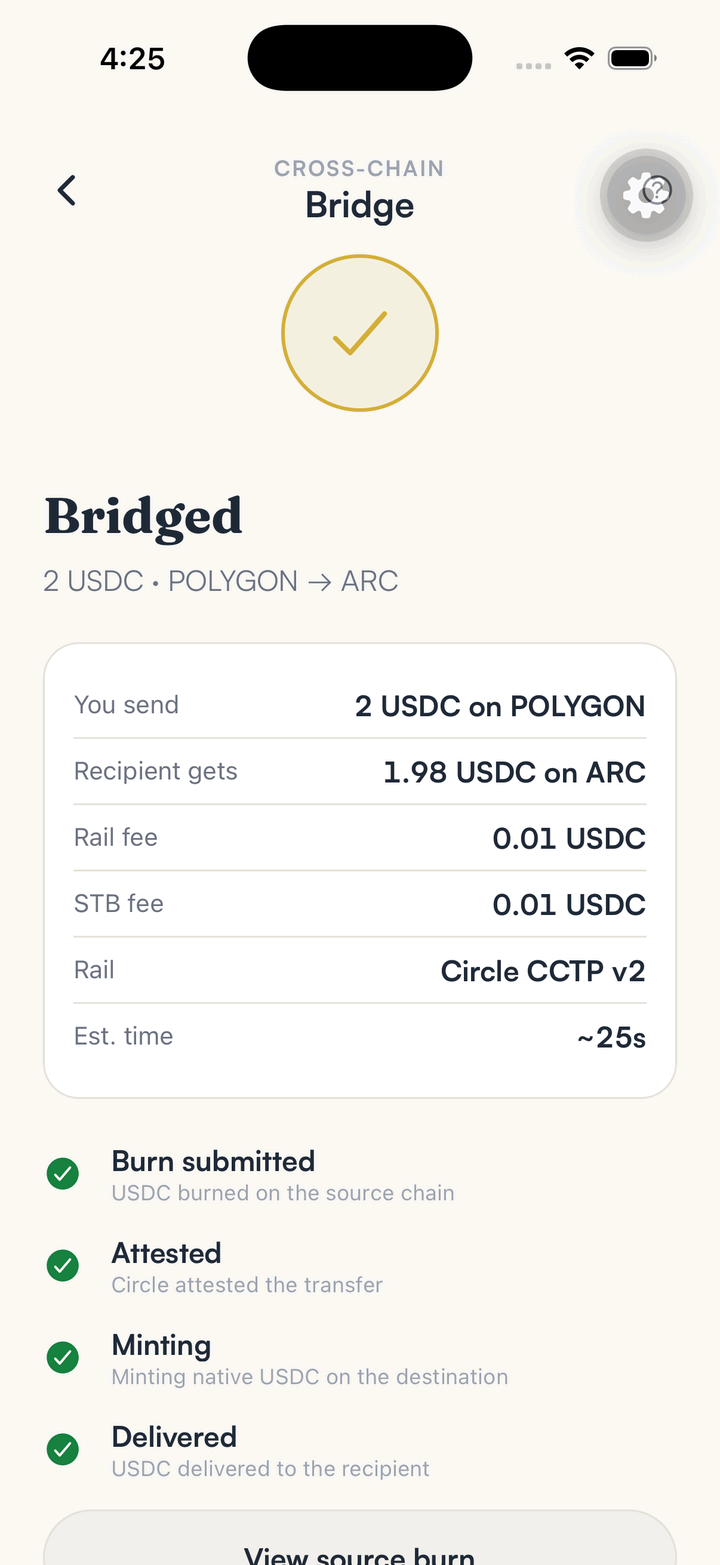
We wanted to see how these different systems perform in real-world scenarios. We ran a production test on 18 September 2026. In our test, a Polygon to Arc bridge in SpendTheBits took about one minute to finish. This tool uses Circle CCTP to move native stablecoins safely between chains. You can learn how to bridge stablecoins across chains in our detailed step-by-step guides.
Once your funds are settled on Arc, transactions are fast and fees are incredibly low. In our production test, we measured that a USDC send on Arc cost about 0.001 USDC in network fee. Our test also showed that the relayer's mint on Arc cost about 0.004 USDC in gas. These predictable costs are great for small retail payments. You do not lose your profit margins to unpredictable network spikes.
This sub-second settlement speed completely changes how we think about digital payments. You can read our comparison of on-chain versus Lightning payments to see other instant options. But Arc gives you the full smart contract power of the EVM combined with sub-second speed. This is a huge step for web shops, billing sites, and cash heads who need speed.
Testing reveals how different layers handle transaction safety. On Base, a transaction goes through multiple steps before it is safe [4]. After two seconds, the sequencer builds the transaction into a layer-two block [4]. It then distributes this block to validator nodes [4]. This stage offers a near zero probability of a reorganization [4]. In fact, only a single block has ever reorganized in the history of the network [4]. This represents an incredibly small fraction of all processed transactions [4].
Why Settlement Speed Matters for Your Treasury
Waiting for incoming payments to clear is hard for any business. Bitcoin invoices often expire in ten to twenty minutes due to exchange rate swings [5]. If a blockchain network is slow, sellers must take on financial risk [1]. They might hand over physical or digital goods before a block officially clears [1].
With deterministic finality, you can ship goods or grant software access right away [1]. The transaction is either completely done or it has failed [1]. There is no risk of a late rollback or chain split [1]. This makes automated billing systems much simpler to run. Webhooks can trigger digital delivery the exact moment the payment lands [1][2].
Treasury teams can also run complex, multi-step workflows in rapid succession. They do not have to wait for hours between each step of a transaction flow [1]. Managing cash across different accounts becomes simple and predictable. To learn more about stablecoins, check our guide on native versus bridged assets. It helps you select the right secure tokens for your daily business operations.
Slow, old payment windows bring big counterparty risk to firms that work around the world [1]. Institutional clearing and cross-border transfers on legacy networks take too long to resolve [1]. With rapid settlement, trades and urgent margin calls resolve with immediate certainty [1]. This speed matches the high expectations of modern financial infrastructure [1]. Treasury teams can also build complex on-chain workflows [1]. For example, they can chain a swap and a bridge transfer together [1]. These steps execute sequentially because they do not require confirmation delays [1].
A Secure Non-Custodial App for Your Business
To use these fast networks safely, your business needs a secure wallet. SpendTheBits is a fully non-custodial wallet app. Your seed phrase and keys are generated and kept only on your own physical device. Our backend never sees your private keys and cannot move your funds. Read our guide to self-custody to see how this setup keeps your firm assets safe.
Our app supports Arc natively for holding, sending, and bridging USDC stablecoins. You pay gas fees in USDC. You do not need to hold a second native coin to pay. We also include robust security tools to protect your treasury. For example, you can set custom daily spending caps on how much can be sent in twenty-four hours.
To raise a spending limit, you must wait through a forty-eight hours safety lock. Combining self-custody with deterministic finality gives you a fast, secure, and highly resilient payment setup. It provides the ultimate security and speed for modern digital commerce.
Corporate teams also get advanced recovery options to protect their assets. SpendTheBits has a safe social recovery setup to split the seed phrase into guardian shares. This setup uses specialized secret sharing technology to safeguard the master key. The backend server only holds encrypted ciphertext and never sees your actual backup phrase. Owners can initiate or cancel the recovery process at any time. This shield keeps your firm in control of its funds if a physical tool is lost.
In the app · 4 steps
Send USDC on Arc in SpendTheBits
Arc is a chain choice like any other in the app. Here is the path from picking it to seeing the payment settle.
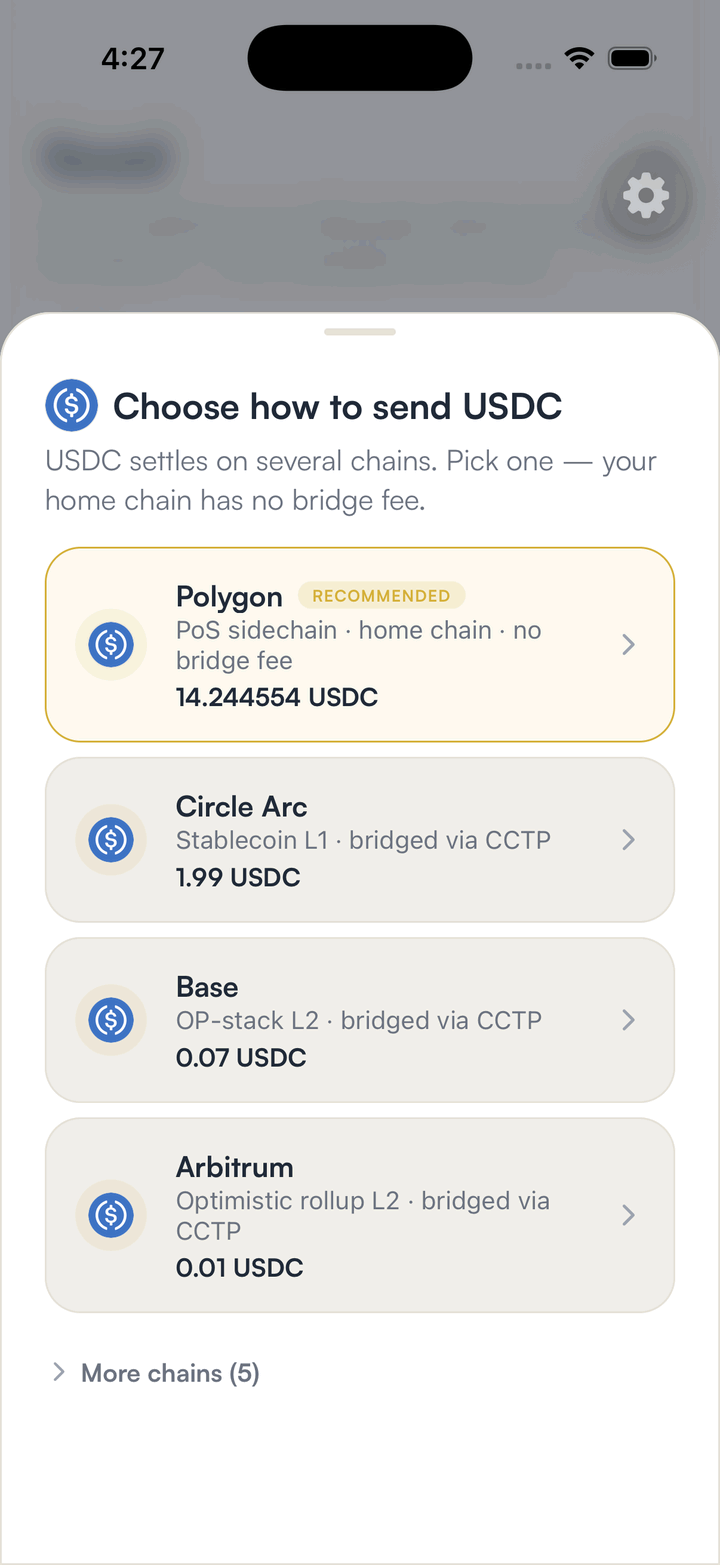
Pick the chain and the rail
Choose Arc as the network for USDC, so the fee and the payment are both in dollars.
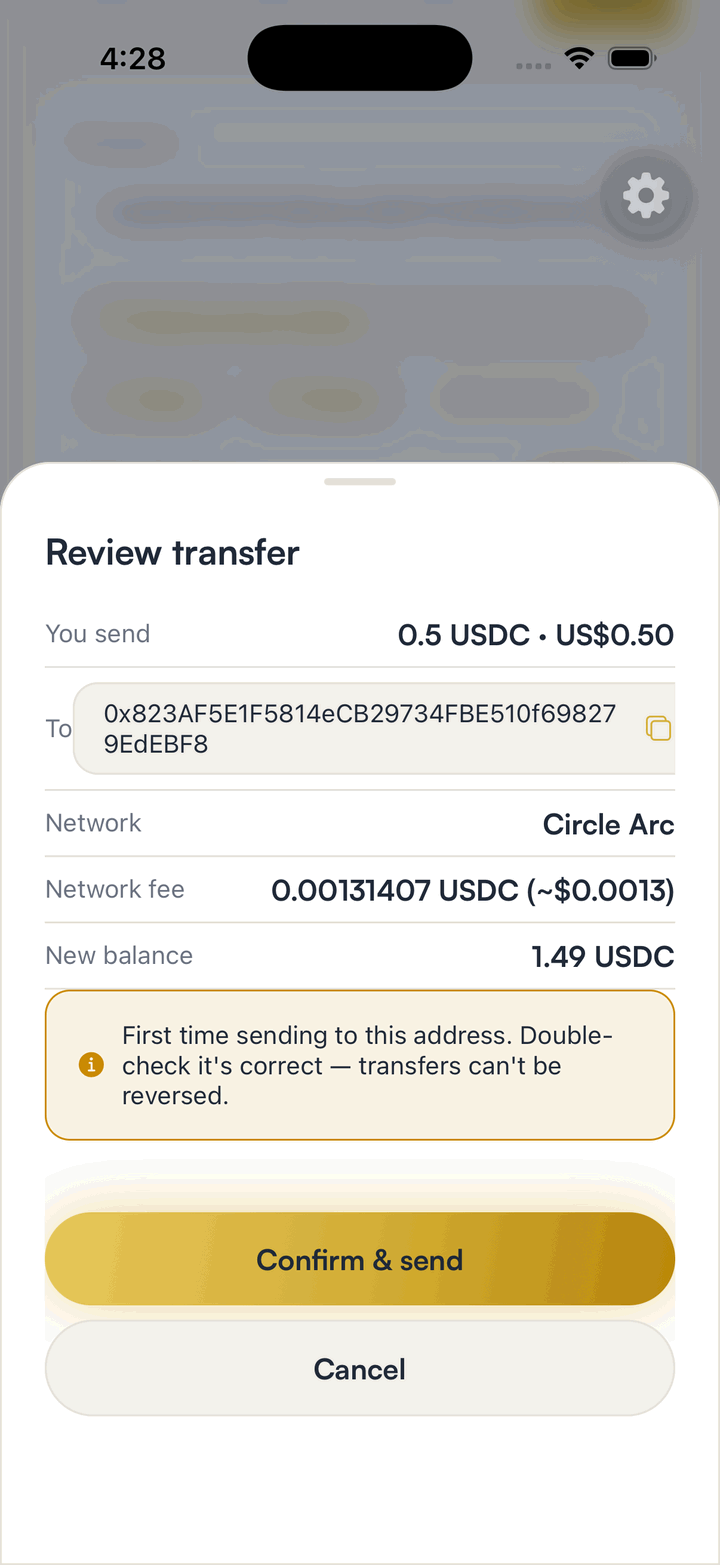
Review before you sign
The review shows the amount, the network and the fee in USDC. You sign on the device.
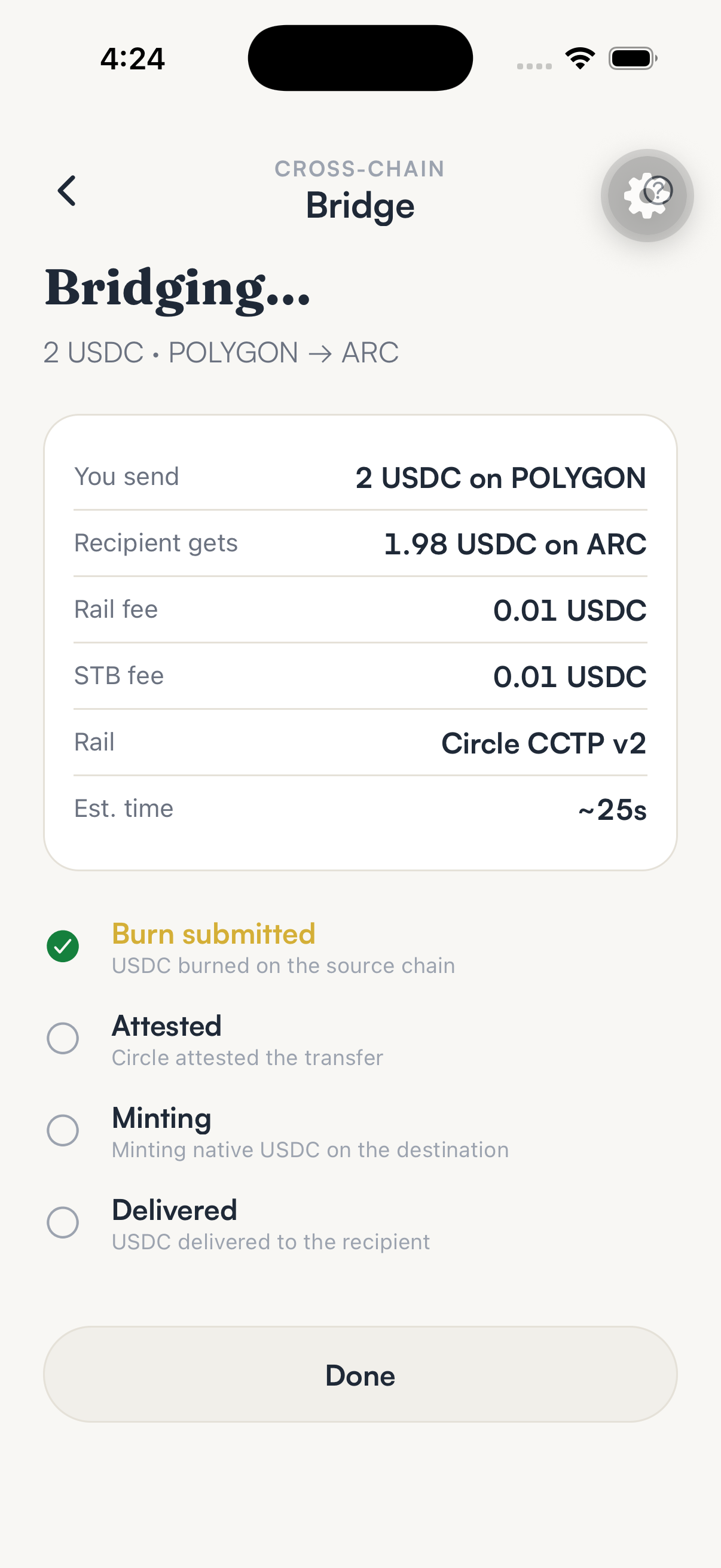
Move USDC in from another chain
If your USDC sits elsewhere, bridge it to Arc first and watch each stage.
Confirm it landed
The arrival screen shows what reached Arc and where to find it.
Hold your own keys, keep the yield, skip the middleman.
SpendTheBits is a fully non-custodial wallet for 13 chains, free on iOS and Android.