

Understanding the FAssets Bridge Infrastructure
To understand the bridge, we must look at how it works. The FAssets system powers the creation and backing of FXRP [1]. It is a trustless bridge for chains that do not have smart contracts [2]. The system uses two main tools on the Flare network [2]. These are the Flare Time Series Oracle and the Flare Data Connector [2]. They work together to verify all transactions [2]. This ensures that every operation is recorded and checked on the public ledger [2].
The oracle provides fast and decentralized price feeds on-chain [2]. The data connector checks transactions on other networks like the XRP Ledger [2]. This means no single person or firm controls the bridge. It relies on mathematics and open code to keep funds safe. You can bridge your assets without asking for anyone's permission [2]. This is perfect for families and long-term holders who want maximum safety. It provides a level of security that traditional bridges cannot match.
This setup is fully decentralized and open to all users [2]. Your funds are backed by a mix of solid assets on Flare [2][5]. Pool collateral on Flare or Songbird provides an extra layer of backing for failed redemptions [5]. Math on the blockchain replaces trust in corporate promises, showing the power of open networks. Anyone can audit the system status at any time.
The Key Roles of Agents and Collateral Pools
The bridge depends on a few key players to stay healthy. First, we have agents who manage the native XRP on the ledger [2]. When you mint FXRP, these agents hold the underlying coins [2]. They must lock up their own collateral as a guarantee [2][5]. This collateral is usually a stable asset like USDC or USDT [5]. Governance approves these tokens to keep the system safe [5]. This over-collateralization ensures that every token remains fully backed even during market drops [2][5].
Next, there is a public pool where anyone can add FLR tokens [2][5]. This collateral pool acts as an extra safety net for everyone [5]. If the price of an asset drops too fast, the pool protects the system from failure [5]. People who add tokens to this pool earn a share of the fees [2][5]. They receive pool tokens as proof of their share [5]. This rewards the community for keeping the system stable. Anyone can participate and help secure the network assets.
There are also liquidators and challengers in this ecosystem [2]. Liquidators burn tokens to restore balance if an agent's collateral gets too low [2]. Challengers watch for bad transactions on the native chain [2]. If an agent tries to steal funds, challengers submit proof to the system [2]. This keeps all agents honest and protects your hard-earned assets. It is a complete shield against bad behavior. The network remains secure through these constant checks and balances. This prevents single points of failure.
The Role of the Core Vault in Capital Efficiency
Many old bridges are not very efficient with capital. They require agents to lock up too much collateral. This makes bridging too expensive for normal users. To solve this, Flare uses a tool called the Core Vault [2]. This vault is a shared account on the XRP Ledger [2]. It lets agents store assets without needing extra collateral [2]. The system-wide collateral ratio settings are defined by governance [4]. This keeps the whole framework stable and reliable for all users.
The Core Vault uses a multisig setup under formal governance [2]. No single agent has control over this pool [2]. Instead, multiple trusted signers must approve any movement of funds [2]. This setup makes the bridge much safer than a single-wallet design. It also frees up capital so agents can back more assets [2]. This keeps costs low for everyone who uses the system. It is a smart way to manage assets. The community benefits from this efficient design.
This shared design makes redemptions faster and smoother for everyone [2]. When you want your native coins back, the vault has assets ready to send, reducing wait times [2]. It combines top security with speed, showing how smart contracts work with older blockchains. The pool ensures liquidity is always available to bridge back, upgrading capital efficiency over isolated vaults.
The Practical Steps for Minting and Executing
Minting FAssets involves wrapping tokens from connected blockchains for use on the Flare blockchain [3]. First, you send a payment on the XRP Ledger [3]. You must send this payment directly to the Core Vault address [3]. To identify your transfer, you must use a memo or a destination tag [3]. These parameters tell the system who should receive the new tokens on Flare [3]. It is a fast and direct process that connects both ecosystems seamlessly. This design removes the need for trusted intermediaries [1].
A destination tag is a short number that maps to your Flare address [3]. If you use a memo, you can write your recipient address directly in the payment [3]. Once your native transaction is done, an executor finalizes the mint on Flare [3]. The executor submits proof to the system and gets a small fee [3]. Once verification is complete, the corresponding FAssets are minted as ERC-20 tokens on Flare [2]. It is automated and fast. It takes only a few simple steps.
The system has built-in limits to protect against any issues [3]. There are caps on how much you can mint each hour or day [3]. If a minting amount is equal to or larger than the specified threshold, a delay is automatically triggered [3]. On the main network, a mint of 4M XRP or more has a 2 hour delay [3]. This delayed minting is exclusive of the hourly and daily windows [3]. It prevents hacks and protects users.
Redeeming Your Assets and Default Protections
You can redeem your FXRP for native XRP at any time [1][4]. To do this, you send your tokens to the Asset Manager contract on Flare [4]. The system then selects redemption tickets to process your request [4]. It uses a first-in, first-out queue to match you with an agent [4]. The agent has a set time to pay you on the native chain [4]. This guarantees that your assets remain redeemable whenever you choose. The entire flow is governed by smart contracts.
If an agent does not complete the payment on the underlying chain within the required time, the system allows the redeemer to receive compensation [4]. If they do not pay in time, you can get proof of non-payment [4] and submit this proof to the smart contract [4]. The system then pays you from the agent's collateral [4], giving you the full value of your assets plus a premium [4]. This protects your capital from lazy or unresponsive agents.
To prevent exploitation from bad addresses, agents can use the Flare Data Connector to verify the validity of the redeemer's address [4]. If a user provides an invalid address, the agent can prove it was blocked [4]. This proof fulfills the agent's duty so they do not lose collateral [4]. The FAssets system uses the payment proof to track underlying balances and release collateral [4]. When a proof expires and cannot be retrieved, the agent can buy back the collateral using native tokens [4]. Afterward, the remaining assets are freed [4].
Using SpendTheBits to Manage Your Assets Securely
We aim to make this advanced bridging technology simple. If you want to learn how to receive cryptocurrency, our tools are ready. With our Get FXRP feature, the app automatically structures the minting transaction with the proper memo and parameters, eliminating manual errors.
We manage all the technical details so you do not have to worry. In SpendTheBits, you can mint FXRP in whole ten-XRP lots. We set aside about two XRP from your payment to cover the network's minting and executor fees. Our wallet is a secure self-custodial app that keeps your keys on your device. We never hold your funds, nor can we freeze or move them. You retain control over your private keys.
Once you have your tokens, you can use our app to earn interest on USDC stablecoins. If you want to redeem back to native XRP, that feature is also live. Moving FXRP on Flare requires a tiny bit of FLR for gas. You can track all assets across chains on our supported networks list. These tools help you navigate decentralized finance with ease while keeping your assets secure. You get full utility without compromising on custody.
In the app · 5 steps
Turn XRP into FXRP in SpendTheBits
Get FXRP prepares the XRP Ledger payment for you, with the right memo, so a typo cannot lose the mint.
Open the Earn tab
Earn lists the assets you can put to work. FXRP has its own tab next to USDC and USDT.
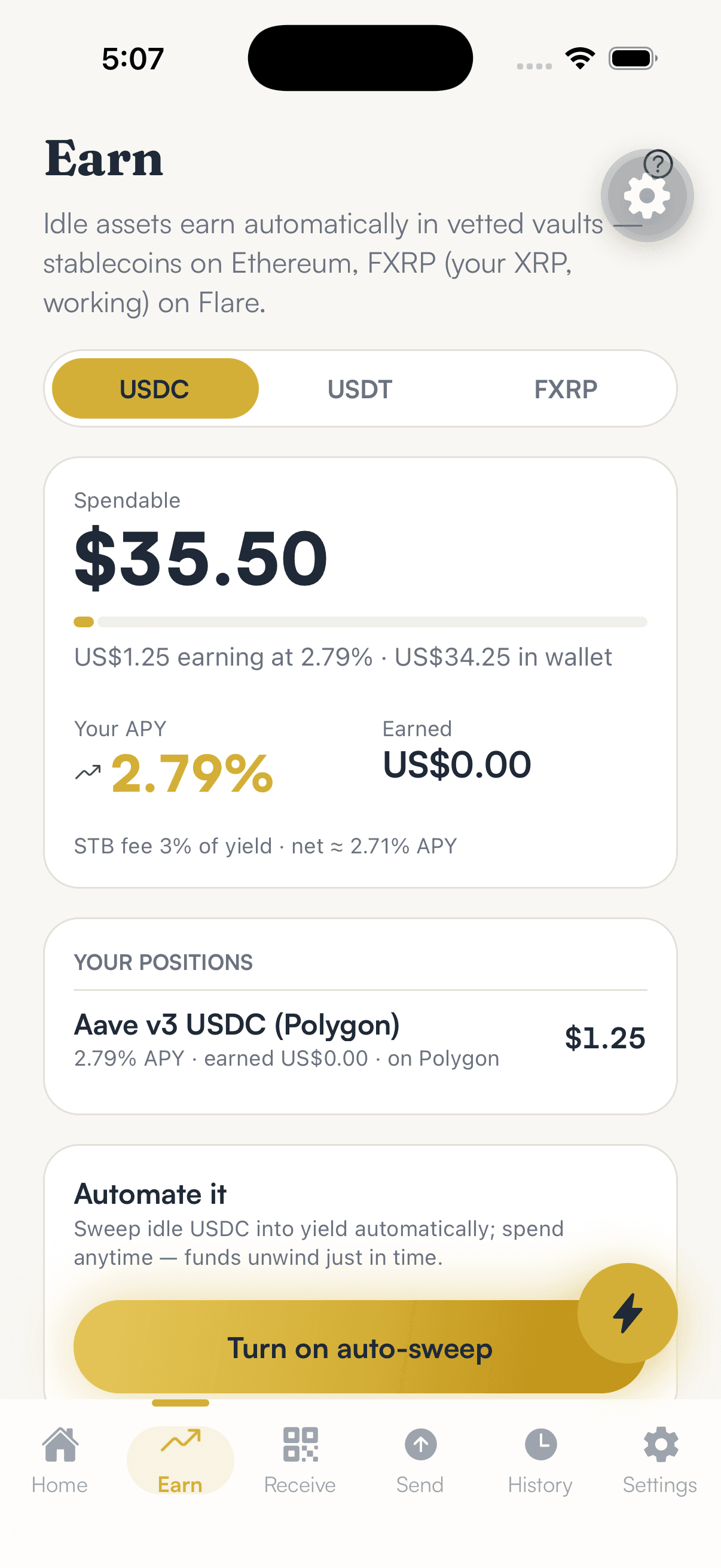
Switch to FXRP and tap Get FXRP
With no FXRP yet, the tab offers Get FXRP. It converts XRP to FXRP one to one and says it is always redeemable back to XRP.
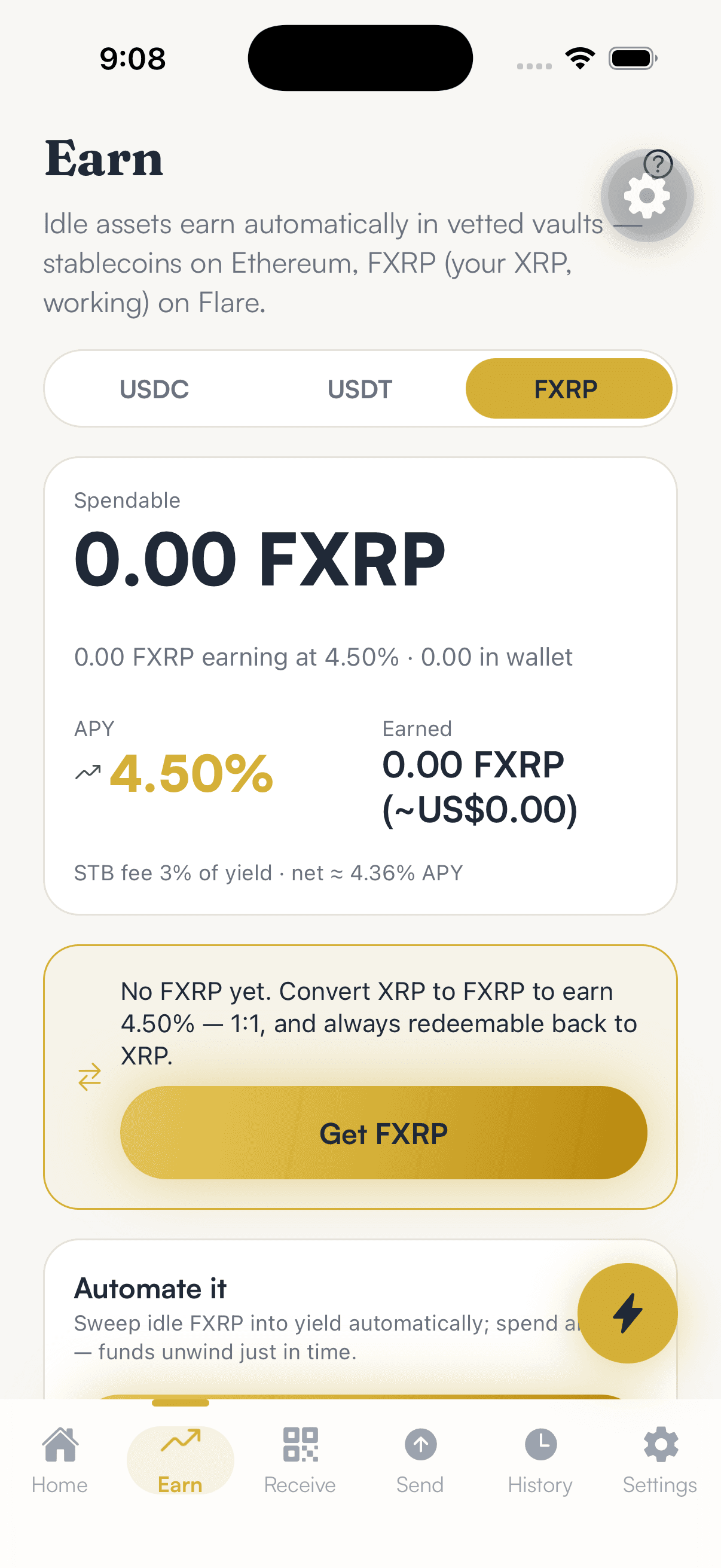
Mint in whole 10-XRP lots
FAssets mints in lots of 10 XRP. The app sets aside about 2 XRP for Flare's minting and executor fees and shows the total before you sign.
Sign the XRP Ledger payment
The app builds one XRP Ledger payment with the minting memo. You approve it on your phone; your keys never leave it.
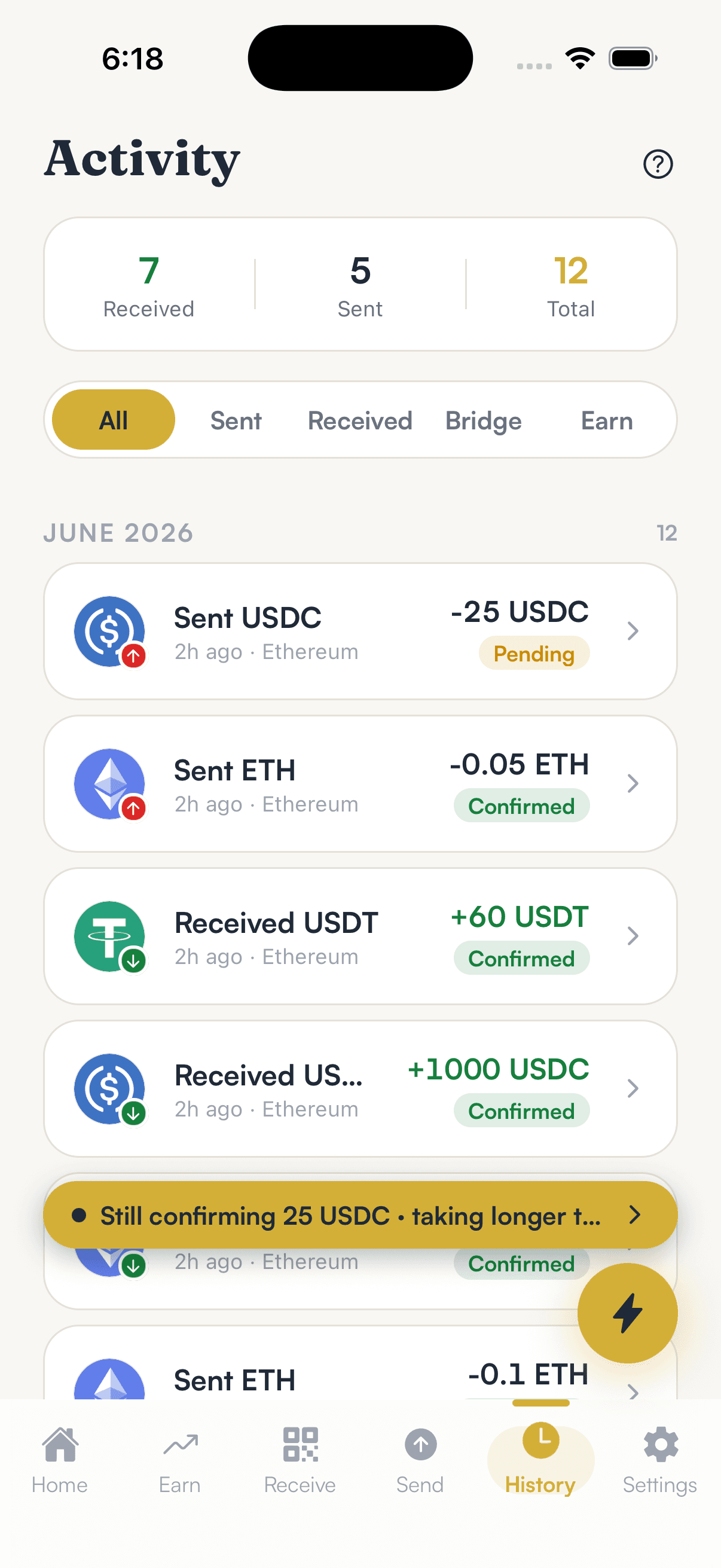
Track the mint
The payment and the FXRP that arrives on Flare both appear in Activity.
Hold your own keys, keep the yield, skip the middleman.
SpendTheBits is a fully non-custodial wallet for 13 chains, free on iOS and Android.