
Three chains, three different fee recipes
Every chain charges a fee, but the ingredients differ a lot. Arc denominates all transaction fees in USDC and uses an EIP-1559 pricing model with smoothing on top [1]. Base splits each transaction into two costs: an L2 execution fee and an L1 security fee [3]. Solana charges a base fee for signatures plus an optional prioritization fee [4].
That difference matters more than any single number. A fee made of one part behaves differently from a fee made of two parts that move on different schedules. If you only look at what a transfer cost yesterday, you miss why it might cost something else tomorrow. A chain whose fee has a floor and a ceiling will feel different from one with a floor and no stated ceiling.
So before you pick a chain, ask three plain questions. What is the fee made of, which coin do I need to hold to pay it, and how does the chain decide a payment is final? The next sections answer those for each chain in turn, using the docs as the only judge. We will stay close to what each page actually says, and flag where a page says nothing at all.
Arc: one coin for the amount and the fee
On Arc, USDC is the native gas token, so the same coin you send also pays the toll [1]. The docs describe a design-time target of about $0.001 per ERC-20 transfer under normal load [1]. That is a target, not a promise, and the docs say so by labeling it design-time. Treat it as the aim of the design, and check the live number before you send.
The fee market combines EIP-1559 with exponentially weighted moving average smoothing, which weights recent blocks more than older ones [1]. The stated aim is stable, predictable gas costs, and short spikes should raise the fee only slightly [1]. The protocol also enforces a minimum base fee of 20 Gwei and a maximum of 20,000 Gwei, which bounds the worst case [1]. A hard ceiling is rare, and it is a real help if you budget for payments.
For an everyday user the practical gain is simple: no second coin to top up. Arc's wallet guidance even says to show fees in USDC, never ETH or Gwei [2]. One more detail helps: the native balance and the ERC-20 balance are the same balance, not two separate tokens [2]. If you want more on why that matters, see our look at USDC as gas on Arc, and for background on the network itself, what the Arc blockchain is.
Base: a two-part fee with an Ethereum layer underneath
Base describes every transaction as two costs: an L2 execution fee and an L1 security fee [3]. The L2 fee covers running your transaction on Base, and the L1 fee is the estimated cost to publish it on Ethereum [3]. The docs note that typically the L1 security fee is higher than the L2 execution fee [3]. So the part you usually pay most for is the part the rollup does not control directly.
That structure has a useful side effect. Because part of your fee tracks activity on the L1, the docs say that if your timing is flexible you can save by sending during quieter L1 periods, such as a weekend [3]. The L2 part moves with how many transactions are submitted to the L2, using the same adjustment mechanism as the L1 [3]. For a shop that must take payment right now, flexible timing is not much help.
Base also sets a floor. Since the Jovian upgrade it has a minimum base fee of 5,000,000 wei, or 0.005 gwei, on Base Mainnet [3]. The docs tie this to faster inclusion and more predictable costs, and they say the value may be adjusted over time [3]. They also describe a cap on how fast the base rate can rise: at most four percent per block, so doubling takes at least 36 seconds [3]. Wallets can ask a GasPriceOracle contract for the L1 part before signing [3].
Solana: a flat signature fee plus an optional tip
Solana's fee has two components: a base fee and an optional prioritization fee [4]. The base fee compensates validators for verifying signatures, and it is 5,000 lamports per signature [4]. Every transaction fee is paid in SOL, so a USDC payer on Solana needs SOL on hand as well [4]. That is the same kind of second-coin habit described in the previous section.
The base fee is split, with half burned and half going to the validator [4]. The prioritization fee exists to raise the odds that the current leader schedules your transaction ahead of competing ones, and all of it goes to the validator [4]. If you never set it, you pay only the base fee. The tip is a choice, so you can skip it for a plain payment and add it when you are in a hurry.
Compute matters too. The default compute unit limit is 200,000 per instruction, and the maximum is 1,400,000 per transaction [4]. The tip is priced per compute unit, so a bigger transaction costs more to prioritize [4]. A simple payment uses little compute, while a complex one can use more, so the same chain can price two actions very differently. The takeaway is that Solana's fee is easy to reason about for a plain transfer and gets richer as the transaction does.
Finality: when is a payment truly done?
Cost is half the story. The other half is how quickly you can treat a payment as settled. Arc's wallet docs say transactions finalize in under one second with no risk of reorganization, so one confirmation is final [2]. They even advise wallets to drop the progress bars that count confirmations [2]. For a checkout, that removes a whole class of waiting screens.
The other two pages we used focus on fees, not finality, so this article makes no claim about how they compare on speed. That gap is worth naming. When a source does not state a number, the right move is to say so rather than fill it in from memory. Base's page does mention two-second blocks in one worked example, but that is a block time, not a finality guarantee [3].
If finality matters to you, for example a shop that hands over goods the moment a payment lands, note that Arc says transactions finalize in under one second with no risk of reorganization [2]. Arc also states a block time of 0.5 seconds in its fee table [1]. For the details of how that works, read how Arc's deterministic finality helps payments. For other chains, check their own finality docs before you build a checkout around them, and test with a small amount first.
Choosing without a winner, and moving between chains
Put the three side by side and the choice becomes a matter of fit. Pick Arc if you want fees in USDC, the native gas token [1], and transactions that finalize in under one second [2]. Pick Base if you are happy with a fee made of an L2 execution fee and an L1 security fee [3]. Pick Solana if you are comfortable with a fee paid in SOL, made of a base fee and an optional prioritization fee [4]. None of these is a ranking. It is a match between your habits and each design.
You are also not locked in. Circle's Cross-Chain Transfer Protocol moves USDC between chains by burn and mint, without traditional bridge liquidity pools [5]. Its Fast Transfer takes roughly 8 to 20 seconds, while Standard Transfer takes 15 to 19 minutes on Ethereum and its layer twos [5]. For more on timing, see when to move USDC between chains and our guide to USDC transfer fees.
SpendTheBits supports all three chains in one non-custodial wallet, and it shows the network fee before a send. On Arc, gas is paid in USDC, so no second coin is needed. In our production test on 18 September 2026, a Polygon to Arc bridge completed in about one minute, and a USDC send on Arc cost about 0.001 USDC in network fee. You can try this yourself through the SpendTheBits bridge. When you weigh the best blockchain for USDC payments, remember that Arc denominates all transaction fees in USDC, the native gas token [1].
In the app · 3 steps
Choose the chain for a USDC payment in SpendTheBits
The app supports Arc, Base and Solana for USDC. Here is how the choice shows up when you use it.
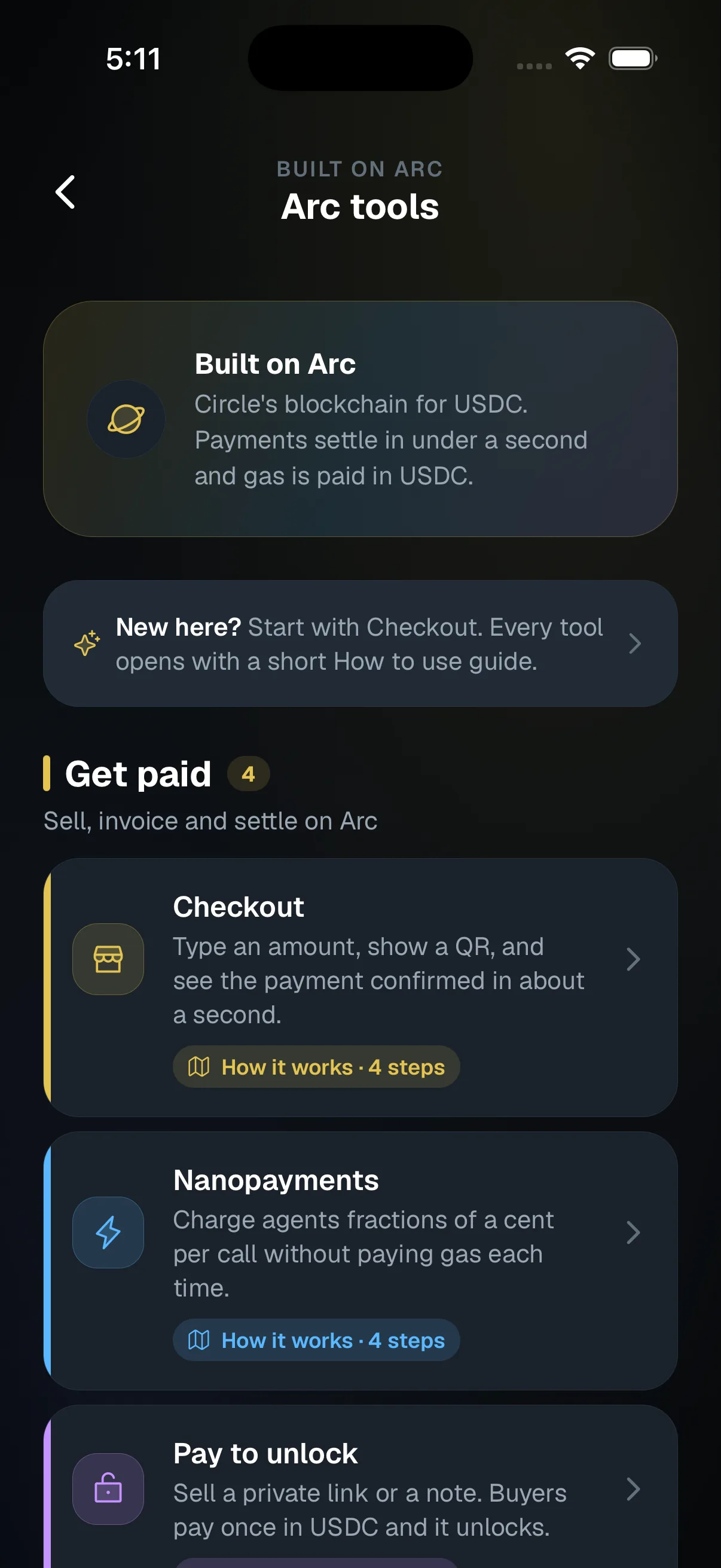
Find the Arc tools
Tools that rely on fast finality, like Checkout and Bulk payouts, sit under Arc tools.
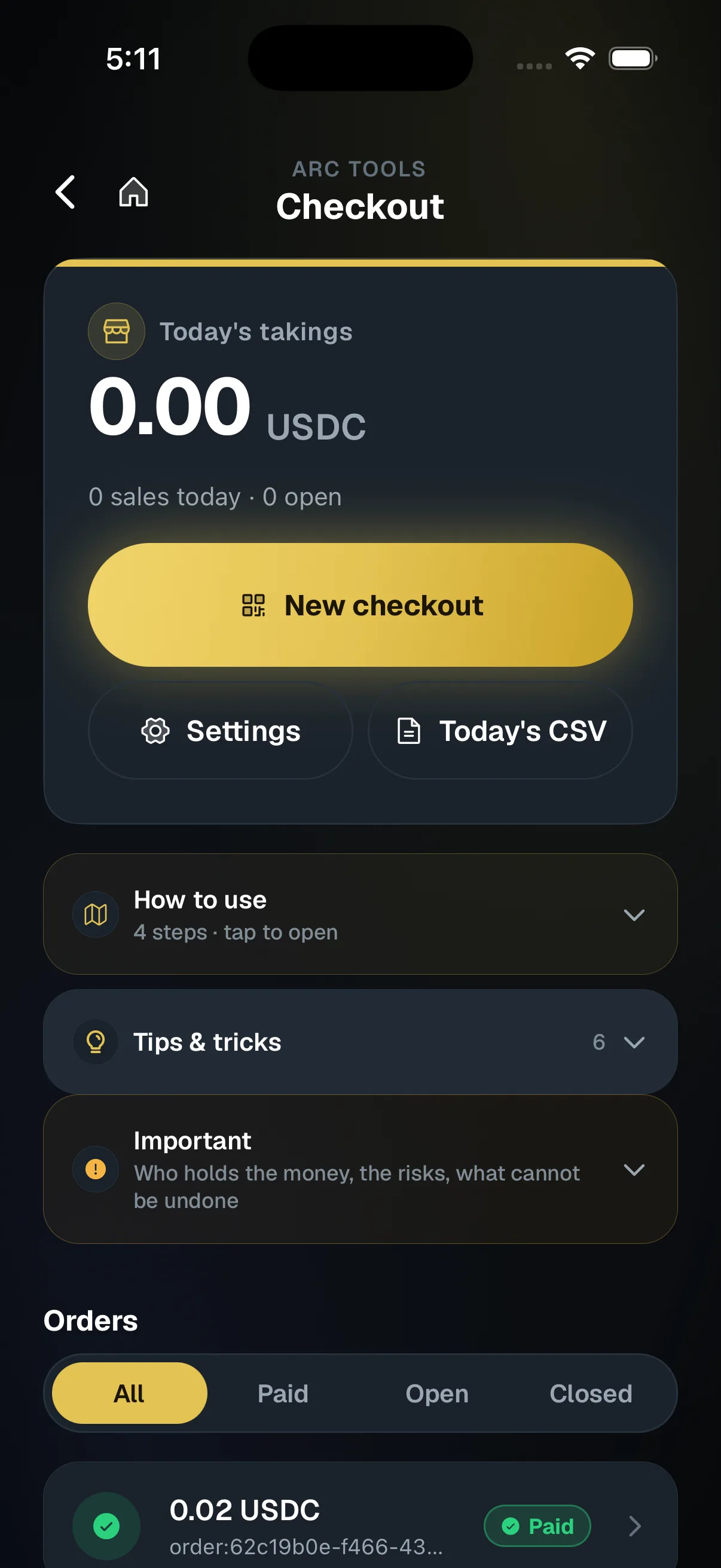
Take payments where they settle fast
Checkout on Arc shows Paid about a second after the payment lands.
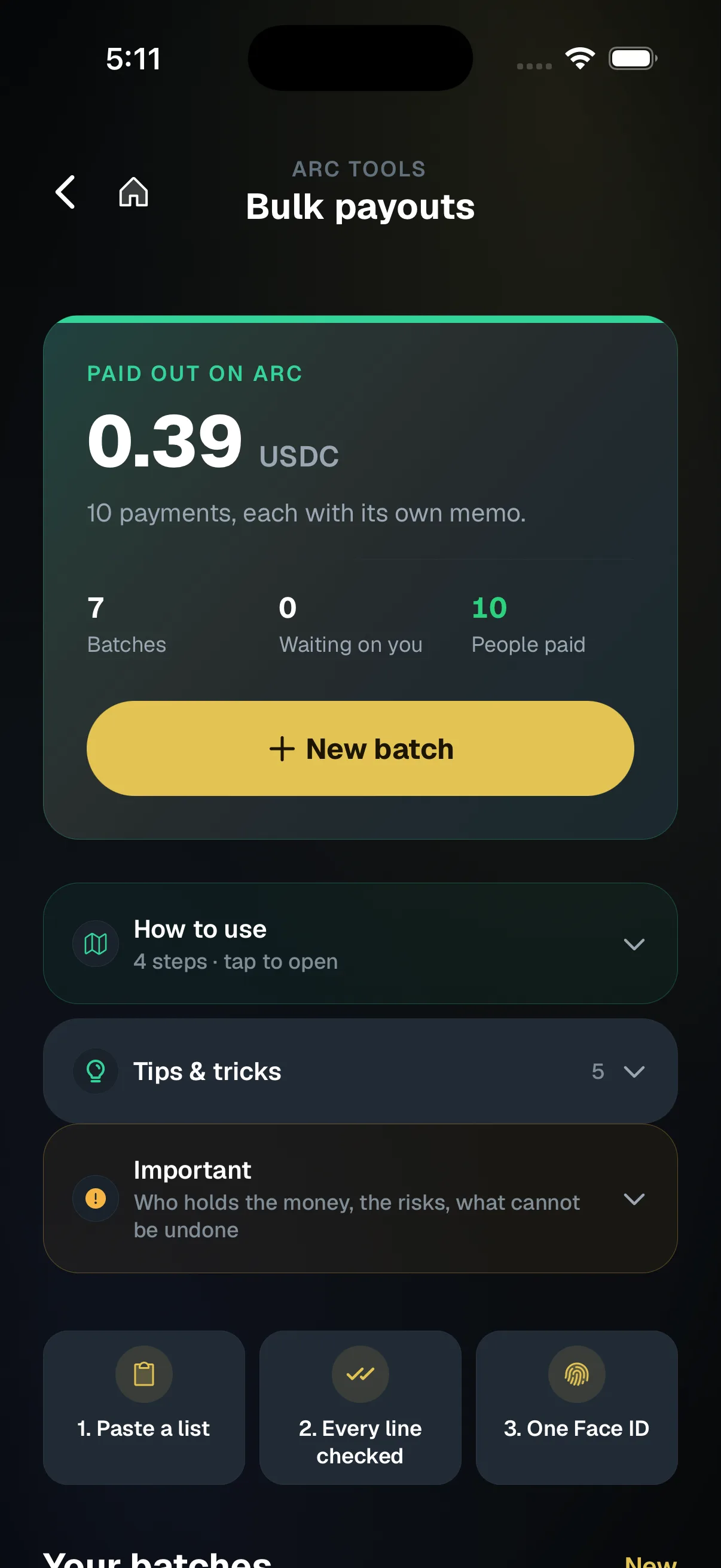
Pay out in one signature
Bulk payouts on Arc pay a whole list at once, with gas in USDC.
Hold your own keys, keep the yield, skip the middleman.
SpendTheBits is a fully non-custodial wallet for 13 chains, free on iOS and Android.