

What USDC actually is, and what backs it
USDC is a regulated stablecoin that you can redeem 1:1 for US dollars, and Circle is its issuer [1]. Circle describes it as a regulated digital currency that you can redeem 1:1 for US dollars, backed by highly liquid cash and cash-equivalent assets, with holdings that equal or exceed the amount in circulation [1]. The design goal is that one USDC tracks one dollar, which is a different goal from a normal crypto coin whose price moves with the market [1].
Circle says it publishes monthly reserve attestations by a Big Four accounting firm, and its page showed 72.0 billion dollars of USDC in circulation as of 22 October 2026 [1]. That is a claim by the issuer, so treat it as a starting point and read the reserve pages yourself. Our longer look at whether USDC is safe covers what to check.
One catch matters for small firms. Circle says its Mint service, which redeems USDC straight into dollars, is not available to individuals or small businesses [1]. Startups and small businesses are pointed to on and off ramp providers in Circle's Alliance Program instead [1]. Circle says Circle Mint redeems USDC 1:1 for USD only for institutions, and not for individuals or small businesses, which use on/offramp providers instead [1].
Taking payment in person and online
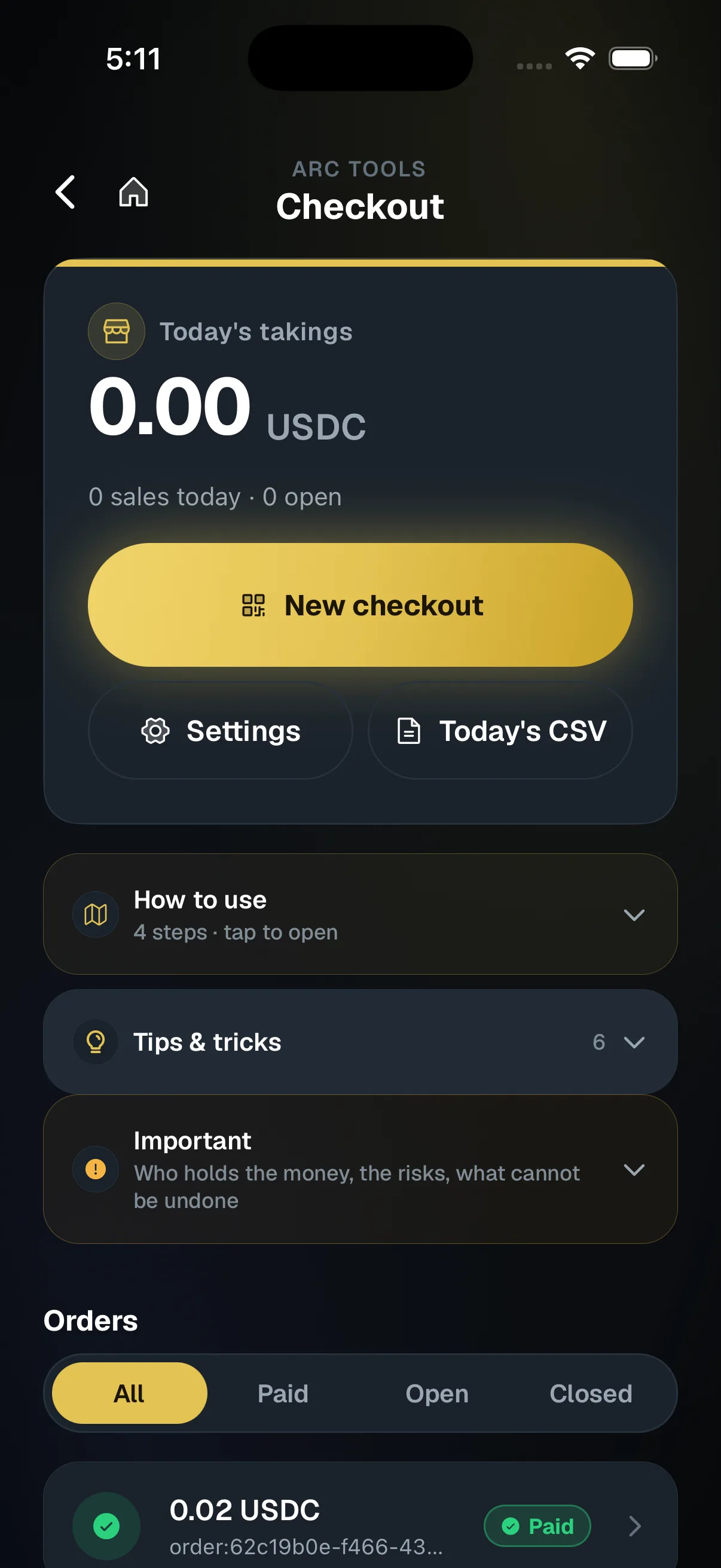
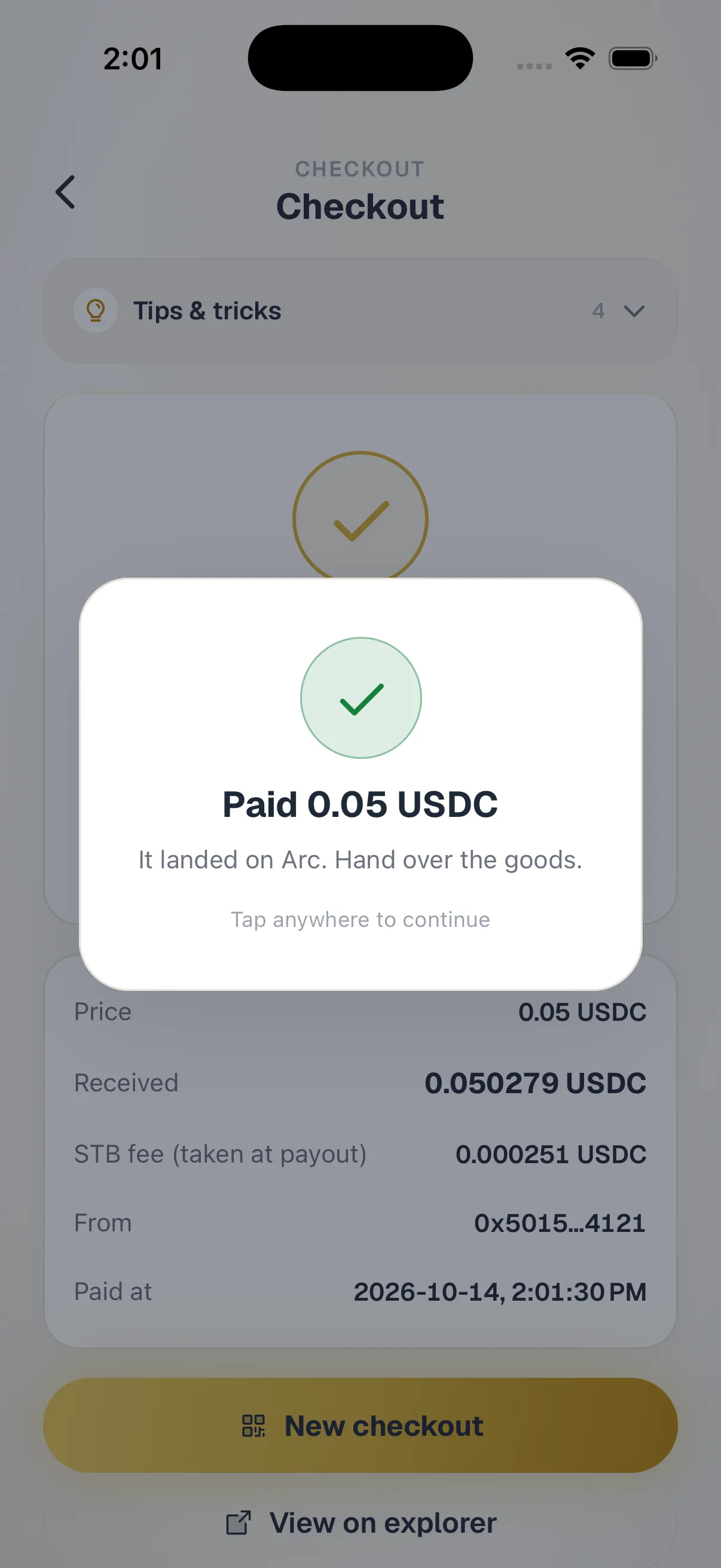
In a shop, the flow is short. In SpendTheBits, Arc Checkout lets a seller type an amount on their phone and show a QR code. The customer pays USDC on Arc from any wallet, and the screen shows Paid about a second after the payment lands. Each checkout adds a few millionths of a dollar to the amount so a payment matches its order on its own.
Sales are paid into the seller's own address through a payout contract nobody owns, which also pays a small SpendTheBits fee, and SpendTheBits never holds the money. Orders, today's CSV export and an optional signed webhook live in the app. That matters for online shops, where a webhook can mark an order as paid without you watching a screen.
For online sales without a storefront, a payment link or invoice can do the job; see our guide to accepting USDC payments and the how-to on sending a crypto invoice link. Whichever route you pick, one habit saves pain: check the payment address on your own screen before you show it, and use a business payment address check so customers can confirm it is really yours.
Finality and network cost on a chain like Arc
Speed is the usual pitch, so look at what it means in practice. Arc's wallet docs say transactions finalize in under one second with no risk of reorganization, so one confirmation is final [2]. For a cashier, that is the difference between waiting for a progress bar and handing over the goods. The docs even tell wallet makers to remove the X of N confirmations screens [2].
Fees on Arc are paid in USDC, the native gas token, so a business does not need a second coin to move money [3]. Arc's docs give a design-time target of about 0.001 dollars per ERC-20 transfer under normal load, with a protocol floor on the base fee and a hard ceiling that bounds the worst case [3]. In our production test on 18 September 2026, a USDC send on Arc cost about 0.001 USDC in network fee.
Those are network costs, not the whole picture. Any wallet or checkout tool may add its own small fee, and the Fees screen in the SpendTheBits app is the source of truth. Arc is also not the only choice: Circle lists USDC as natively supported on 38 blockchain networks [1], so a customer may arrive on a different chain. Our piece on Arc and deterministic finality explains why one-second finality changes the counter experience.
Refunds without chargebacks
Card payments come with chargebacks. A stablecoin sale on Arc Checkout is final on chain, and that cuts both ways. The money cannot be pulled back by a bank dispute, but the customer cannot pull it back either. For a small business, the refund becomes a plain business decision.
In SpendTheBits, refunds on Arc Checkout are never automatic. The seller sends one from their own wallet, signed on their phone, up to the sale amount, and the SpendTheBits fee is not returned. That last point is worth putting in your refund policy, because the customer gets back the sale amount while the small fee stays spent.
The same idea holds for x402 sales, where a seller can promise a refund window and approve a refund with a transfer signed on their own phone that can only go back to the payer. There is no escrow, and every answer, and every silence, becomes part of the seller's public refund record. Write a short policy, tell customers how long they have, and keep proof of each refund. Our guide to self-custody covers the key habits behind all of this.
Bookkeeping, payouts and tax records
Getting paid is the easy half. The harder half is the books. The IRS treats digital assets as property, not currency, lists stablecoins as an example, and says you may have to report transactions with digital assets on your tax return [4]. It also says that if you receive a digital asset in exchange for goods or services in a business context, the income is taxed as ordinary income or a loss [4].
The same page tells you to keep records of the fair market value, in US dollars, of all digital assets received as payment in the ordinary course of a trade or business [4]. With a dollar stablecoin that number is usually close to the amount, but you still need a record for every sale. This is not tax advice, so talk to your accountant before you start.
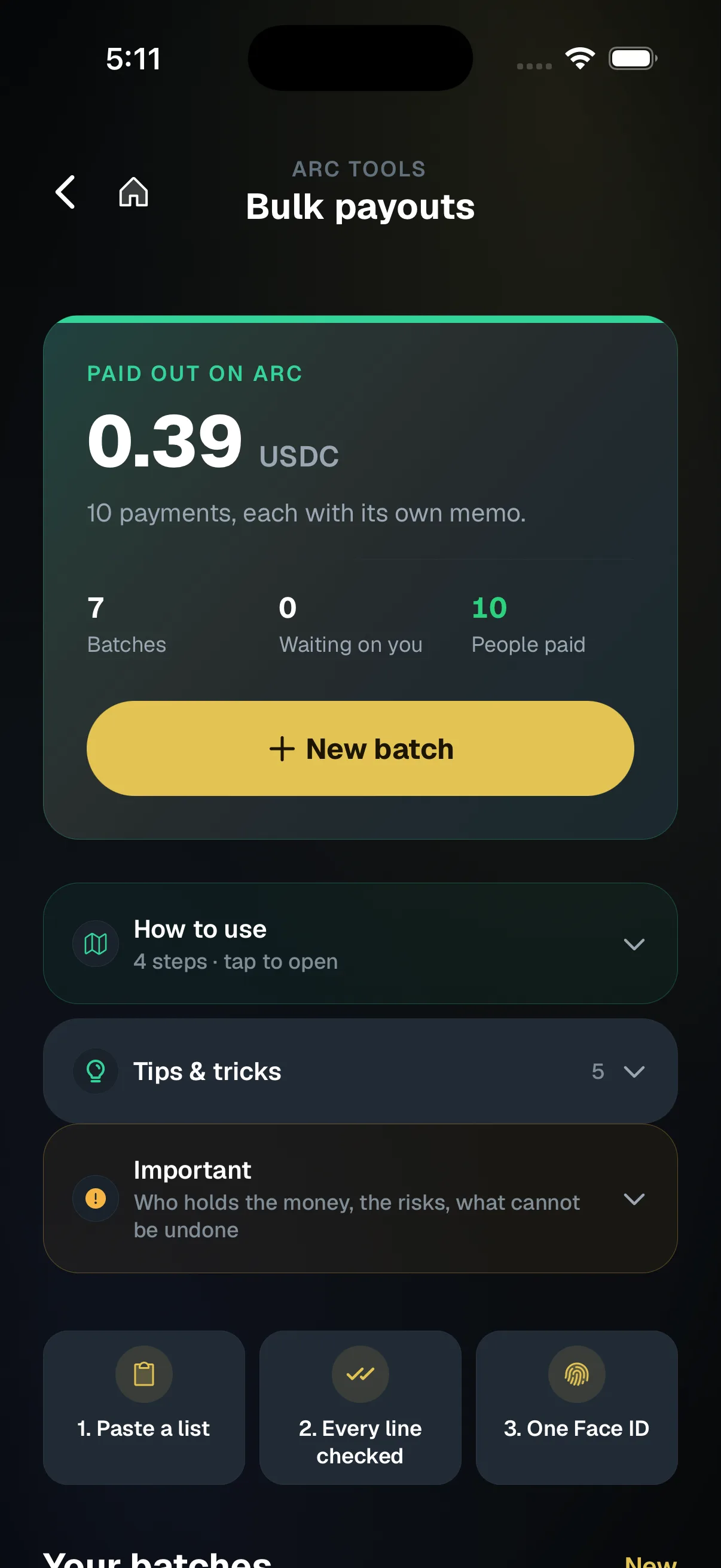
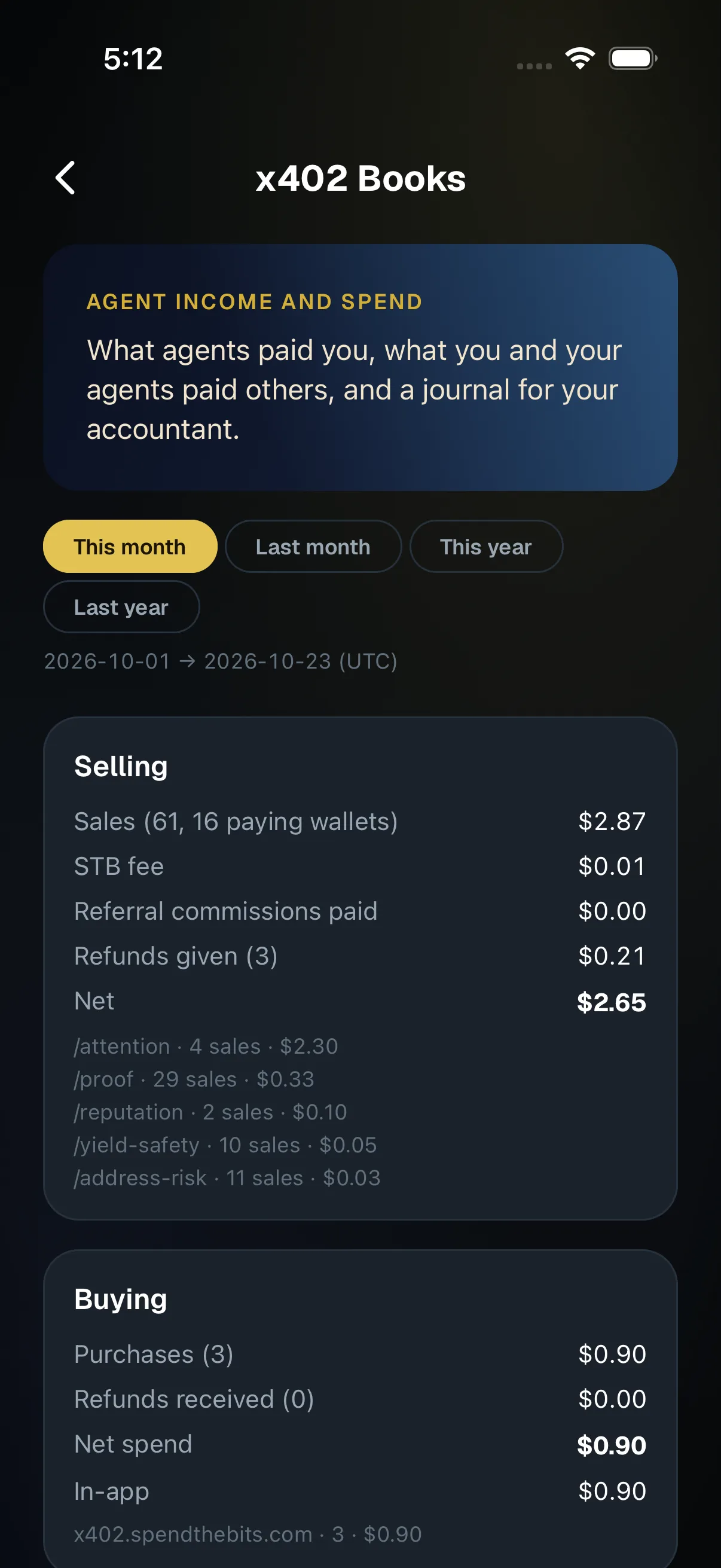
CFO Books turns the public ledger into FIFO or HIFO cost-basis lots, realized and unrealized profit and loss, and a QuickBooks or Xero general-journal export; see our note on FIFO versus HIFO. For paying people, Bulk payouts sends USDC on Arc to a pasted list of addresses or @handles with one signature on the phone, shows each line as paid or not paid, and exports a CSV for the books. There is no SpendTheBits fee on bulk payouts today, and network gas is paid in USDC. Each payment can carry a public, permanent memo, as we explain in bulk USDC payouts with one signature.
The risks: blocked addresses and mistakes you cannot undo
Now the part that vendors skip. USDC is issued by a company, and a company can act on an address. Arc's wallet docs say the USDC blocklist is enforced at runtime, and if either the sender or the recipient of a transfer is blocklisted, the call reverts [2]. SpendTheBits says the same in plain words: Arc is a network run by Circle, which also issues USDC, SpendTheBits does not operate Arc, and Circle can block an address from sending or receiving USDC. So an address that is blocked cannot send or receive USDC on Arc.
The second risk is human. Because a sale or a send is final on chain, a wrong address or a typo cannot be reversed. Address-poisoning scams, where a look-alike address sits in your history waiting to be copied, are a real way to lose money; read our note on the address poisoning scam. Before a send goes out, the SpendTheBits Send screen warns in plain words when an address looks almost identical to one you have paid or saved, and when a first payment to a new address is a large amount it suggests a small test send first. The final check is still yours.
Add a few controls. Use spending guardrails so no single send or day can drain the account, keep the seed phrase backed up, and decide who in your team can sign. Finally, keep the share of sales you take in stablecoin modest at first, and move funds to the bank in small steps through your chosen provider.
In the app · 4 steps
Run stablecoin payments for a small business in SpendTheBits
The pieces a shop needs, in the order you would use them.
Take the payment
Checkout under Arc tools shows a QR for the amount at the counter.
Confirm it is paid
Hand over the goods when the screen says Paid.
Pay people back or pay suppliers
Bulk payouts pays a list with one signature.
Hand over clean books
x402 Books and the tax export give your accountant the files they need.
Hold your own keys, keep the yield, skip the middleman.
SpendTheBits is a fully non-custodial wallet for 13 chains, free on iOS and Android.